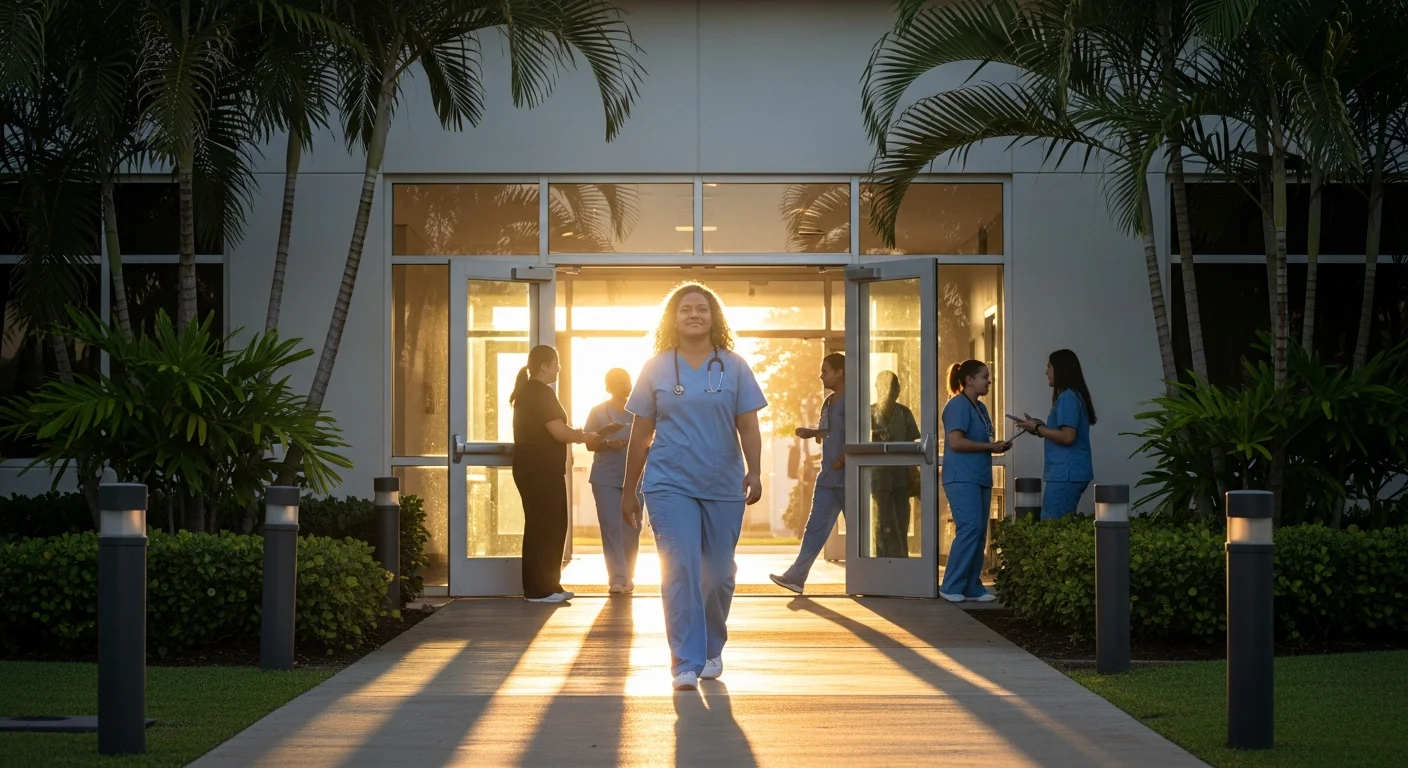
To become a certified nursing assistant in Hawaii, you need to complete a state-approved training program of at least 100 hours, pass a criminal background check through Fieldprint Hawaii, and pass the Prometric competency exam. Most people finish the entire process in 6 to 12 weeks.
This guide covers every requirement, every state-approved program on all four major islands with real costs, Hawaii-specific financial aid options, and what to expect from the background check and exam. If you already hold a CNA certification from another state, see our Hawaii CNA reciprocity guide.
| What | Details |
|---|---|
| Training Required | 100 hours minimum (30 classroom + 70 clinical) |
| Exam Provider | Prometric (written + clinical skills) |
| Total Cost Range | $725–$2,425 (training + exam fees) |
| Timeline | 6–12 weeks typical |
| Background Check | Fieldprint Hawaii |
| Registry | Prometric for Hawaii DCCA |
CNA PROGRAMS AVAILABLE IN HAWAII
Find CNA Training Programs Near You
Enter your zip code to find accredited CNA programs in Hawaii. Compare costs and schedules across all islands.
Programs near you • No obligation to enroll
Sponsored Ad
What is a CNA and What Do They Do in Hawaii?
A Certified Nursing Assistant (CNA) provides hands-on patient care under the supervision of licensed nurses. In Hawaii, CNAs work in hospitals like Queens Medical Center, long-term care facilities, rehabilitation centers, and home health agencies across all islands.
Daily responsibilities include monitoring and recording vital signs, assisting patients with bathing, dressing, and mobility, supporting meal preparation and feeding, and documenting patient status for the nursing team.
Hawaii’s aging population drives sustained demand for CNAs statewide. The state’s 65-and-older population is among the fastest-growing in the nation, according to Hawaii DLIR Workforce Projections, and the Bureau of Labor Statistics projects continued growth in nursing assistant employment nationally. For residents on every island, that means consistent job availability across Hawaii CNA programs and healthcare settings statewide.
CNA certification is also a recognized first step into nursing. The pathway from CNA to Licensed Practical Nurse (LPN) to Registered Nurse (RN) is well-established, and UH Maui College offers a dedicated CNA-to-PN bridge program for working CNAs who want to advance.
Hawaii CNA Requirements at a Glance
| Requirement | Details |
|---|---|
| Minimum Age | 18+ to take the state certification exam |
| Training Hours | 100 minimum: 30 classroom + 70 clinical |
| Exam Provider | Prometric (prometric.com/nurseaide/hi) |
| Exam Format | Written: 60 questions, 90 min + Clinical: 5 skills |
| Passing Score | 70% (42/60 correct) |
| Background Check | Fieldprint Hawaii |
| Registry | Prometric on behalf of Hawaii DCCA |
| Cost Range | $725–$2,425 total |
| Timeline | 6–12 weeks typical |
Each step is covered in detail below.
Step 1: Meet Basic Eligibility Requirements
You must be at least 18 years old to take Hawaii's CNA certification exam, according to Prometric. There is no maximum age limit.
English proficiency is required for the written exam. Prometric offers an oral exam option for an additional $10 fee if needed.
Most Hawaii CNA training programs require a high school diploma or GED for enrollment. This is a program-level requirement, not a statewide rule. One notable exception: Kapi'olani Community College has an additional prerequisite of 12 college credits or a vocational certificate.
No prior healthcare experience is required. CNA training is designed as a starting point, and programs are built assuming you're coming in without clinical background.
Step 2: Complete a State-Approved Training Program
Hawaii requires a minimum of 100 hours of state-approved CNA training, split between 30 hours of classroom instruction and 70 hours of supervised clinical practice, per Hawaii Administrative Rules, Title 11, Chapter 94.1. The federal minimum is 75 hours; Hawaii exceeds it.
Some programs go further. Kapi'olani Community College offers a 150-hour program at approximately $2,200 with textbooks included, available as both a credit and non-credit option.
If you're on the Big Island, your in-person options are more limited than on Oahu. See the Big Island section below the table for the Good Jobs Hawaii Grant, which covers full tuition for Hawaii Island residents.
Approved Programs by Island
| Program | Island | Hours | Cost | Format | Notable Features |
|---|---|---|---|---|---|
| Kapi'olani Community College CNA program | Oahu | 150 | ~$2,200 | In-person | Textbooks included; credit + non-credit |
| Hawaii Medical College (HMI) | Oahu | 10 weeks | $899+ | In-person | Clinicals at Queens Medical Center, Pali Momi |
| Healthcare School of Hawaii | Oahu | Varies | ~$990 (verify with school) | In-person | Multiple session start dates |
| CNA Training Academy of Hawaii | Oahu | 100 | ~$500 | In-person | Subsidized; lowest-cost option |
| Leeward Community College | Oahu | 100+ | ~$1,100 (verify via ocewd.org) | In-person | Leeward Oahu; ocewd.org/nurseaide |
| Windward Community College CNA program | Oahu | 100+ | ~$1,000 (verify via windwardcce.org) | In-person | Windward Oahu; windwardcce.org |
| UH Maui College CNA program | Maui | Varies | ~$800-$1,200 (verify with school) | In-person | CNA-to-PN bridge program available |
| Kaua'i Community College CNA program | Kauai | 100+ | ~$800-$1,200 (verify with school) | In-person | Only state-approved program on Kauai |
For guidance on comparing these options, see our guide on how to choose a CNA program.
Choosing a program is a big decision, and it's normal to feel a mix of readiness and nerves, even after you've enrolled:
"I'm currently enrolled in a 4 week course and I'm feeling comfortable but anxious at the same time."
(551 upvotes, r/cna)
That mix of comfort and anxiety is the starting point for most CNAs. Training programs build skills incrementally: classroom fundamentals first, then supervised clinical hours with a licensed nurse guiding you through real patient care.
Online and Hybrid Options
You can complete the theory portion of CNA training online through some programs, but all 70 clinical hours must be completed in person at a Hawaii-approved facility. No fully online program satisfies Hawaii's state approval requirements. See our resource on online CNA classes that pair remote coursework with local clinicals.
Big Island Residents
If you're on the Big Island, in-person options are more limited than on Oahu. The Good Jobs Hawaii Grant through the University of Hawaii covers full tuition for Hawaii Island residents pursuing healthcare training, which can offset the cost of training or help fund travel to a program on another island.
How to Verify State Approval
Before enrolling in any program, confirm state approval through the Hawaii Department of Commerce and Consumer Affairs at cca.hawaii.gov. Completing an unapproved program means you won't qualify to sit for the Prometric exam.
Step 3: Pay for Training — Costs and Financial Aid
The total cost to become a CNA in Hawaii ranges from about $725 to $2,425, covering training ($500–$2,200) and exam fees ($200–$225). In a state with the highest cost of living in the nation, even the lower end of that range is a real financial commitment.
Before exploring financial aid options, it's worth being honest about what you're investing in. Not everyone who earns a CNA discovers it's the right fit:
"I recently just got my CNA. I've worked as a dialysis tech for a bit and just started as a CNA at a nursing home. To be honest, I really dread work... Truthfully, I really don't like healthcare. I'd rather work at walmart or some other retail shop."
(542 upvotes, r/cna)
That honesty matters because the financial aid options below aren't just about affording training. They're about reducing your financial risk while you find out whether direct patient care is the right career for you.
Training Cost Breakdown
| Cost Category | Amount | Notes |
|---|---|---|
| Training tuition | $500–$2,200 | CNA Training Academy (low) to Kapi'olani CC (high) |
| Application fee | $25 | Paid to Prometric |
| Exam fee | $200 | Written + clinical skills |
| Oral exam option | $210 | If oral version needed (+$10) |
| Total estimated | $725–$2,425 | Training + exam fees |
Hawaii-Specific Scholarships and Grants
| Scholarship / Grant | Amount | Eligibility | How to Apply |
|---|---|---|---|
| Caregiver Foundation + 'Ohana Health Plan | Varies | Multilingual residents committed to in-home care | thecaregiverfoundation.org |
| HCCN Mary Huebner Memorial Scholarship | $1,100 | Island CPR students in Kona, Big Island | islandcpr.com |
| Good Jobs Hawaii Grant | Covers tuition | Hawaii Island (Big Island) residents | hawaii.edu/goodjobs |
| OHA Career Pathways | Varies | Native Hawaiians below income threshold | oha.org |
See additional CNA scholarship opportunities beyond these Hawaii-specific programs.
Employer-Sponsored Training Options
Some Hawaii employers cover your entire training cost in exchange for a work commitment after certification.
Kahala Nui (Oahu) offers full tuition reimbursement for graduates who work as CNAs at their facility. No upfront cost if you commit to employment there after certification.
Ohana Care Maui provides free training and covers the Prometric exam fee. You pay nothing out of pocket. A work commitment is required after certification.
While no Hawaii CNA program is free at enrollment, both employer-sponsored options eliminate out-of-pocket costs entirely. For a full picture of your earnings after certification, see our CNA Salary in Hawaii guide.
Exploring CNA Training Options?
Compare accredited programs near you while you plan your next steps.
Step 4: Pass the Background Check
Hawaii requires a criminal background check through Fieldprint Hawaii before you can work as a CNA. This requirement is overseen by the Department of Health Office of Health Care Assurance (OHCA), as established in Hawaii state law.
What's checked: FBI fingerprint records, the Adult Protective Services (APS) registry, the Child Abuse and Neglect (CAN) registry, and the sex offender registry, per Hawaii.gov.
How to complete it:
- Visit fieldprinthawaii.com to schedule an appointment
- Submit your fingerprints electronically at the appointment
- Pay the processing fee (approximately $40–$55)
- FBI and state agencies process your records, typically within 1 to 2 weeks
- Results are sent to the Hawaii Department of Health/OHCA
The background check must be no older than six months at the time you apply for certification. Start Fieldprint Hawaii after enrolling in your training program so the results are ready when you complete your hours.
For most applicants, this is a routine step. The OHCA review focuses on specific offenses related to patient safety.
Step 5: Pass the CNA Competency Exam
Hawaii's CNA competency exam is administered by Prometric. You take two parts: a written test and a clinical skills demonstration.
Written exam: 60 multiple-choice questions, 90-minute time limit. You need a 70% score to pass, which means 42 out of 60 correct answers, according to Prometric. Questions cover patient care principles, safety, infection control, and CNA responsibilities.
Clinical skills exam: You perform 5 nursing skills selected randomly, plus a mandatory handwashing demonstration. An evaluator scores each skill. Narrate every step aloud during the demonstration, since the evaluator scores what they can observe and hear. For step-by-step breakdowns of each skill, see our CNA skills test guide.
Retake policy: You have 3 attempts within 2 years of completing your training to pass both portions, per the Prometric Hawaii Candidate Information Bulletin. If you don't pass within that window, you'll need to complete a new training program. For strategies if you need a second attempt, see our guide on retaking the CNA exam.
Exam fees: $25 application + $200 exam = $225 total ($235 with the oral option).
To prepare: use our CNA exam guide for a complete walkthrough of tested topics, take a free CNA practice exam to get comfortable with the format, and review how to study for the CNA exam for written and clinical strategies.
Register at prometric.com/nurseaide/hi once you've completed your training hours and background check.

Step 6: Get Listed on the Hawaii Nurse Aide Registry
Once you pass both exam portions, Prometric adds your name to the Hawaii Nurse Aide Registry. This is a public database maintained by Prometric on behalf of the Hawaii Department of Commerce and Consumer Affairs (DCCA).
To verify your listing, visit registry.prometric.com/publicHI. Search by your name or certification number. Your listing shows certification status, expiration date, and any findings on record.
Employers use this same portal to verify your certification before hiring. What they see is exactly what you see. Allow up to two weeks after passing your exam for your listing to appear.
Your registry listing is your official proof of certification. Keep a copy of the page or note your certification number, as some employers will ask you to provide it during onboarding before they run their own verification check.
Keeping Your Certification: Renewal Requirements
Your Hawaii CNA certification must be renewed every 24 months through Prometric on behalf of the Hawaii DCCA.
Requirements for each renewal period:
- Work: At least 8 hours of paid nursing-related work under a licensed nurse's supervision within the past 24 months
- Continuing education: Requirements vary by facility type. Verify your specific CE obligation through the Prometric Hawaii renewal materials
- Evaluation: A competency evaluation by an RN instructor confirming your skills are current
Renewal fees: $25 for online renewal, $27 for paper renewal through Prometric.
If your certification lapses, reinstatement may require retesting. An extended lapse may require full retraining. Set a calendar reminder 60 days before your expiration date.
CNA Career Outlook in Hawaii
Hawaii's aging population creates sustained demand for direct patient care workers across every island. The state's 65-and-older population is among the fastest-growing in the nation, according to Hawaii DLIR Workforce Projections, and the Bureau of Labor Statistics projects continued growth in nursing assistant employment nationally.
Hawaii CNAs earn a mean annual wage of $48,170 per year ($23.16 per hour), according to the Bureau of Labor Statistics. Pay ranges from roughly $35,300 to $48,800 depending on experience, facility type, and location. Job postings on ZipRecruiter and Indeed show comparable ranges.
Those averages reflect the full spread of experience levels and settings. For many CNAs early in their careers, the reality is more immediate:
"Just now realizing that working full time, I make under 30k a year."
(536 upvotes, r/cna)
Hawaii's cost of living makes this gap especially pronounced. It's one reason many Hawaii CNAs use certification as a first step toward higher-paying nursing roles rather than a long-term destination. For a full salary breakdown including facility type comparisons and cost-of-living context, see our CNA Salary in Hawaii guide.
High demand also means some facilities are operating short-staffed. This is a national pattern, and Hawaii is not exempt:
"I refused an unsafe assignment and walked out... it's me and 3 cnas for 68 residents"
(4,040 upvotes, r/nursing)
Understanding staffing realities helps you ask the right questions during job interviews, including patient-to-CNA ratios, mandatory overtime expectations, and support resources. Where you work matters as much as what you do.
Career advancement: UH Maui College runs a CNA-to-Practical Nurse (PN) bridge program that lets working CNAs earn LPN credentials through an accelerated pathway. From LPN, the route to RN is well-established. Work settings include hospitals, long-term care facilities, rehabilitation centers, and home health agencies statewide.
FIND CNA PROGRAMS IN HAWAII
Find CNA Training Near You
You've read the full guide — now find accredited programs on your island. Enter your zip code to compare options.
Programs near you • No obligation to enroll
Sponsored Ad