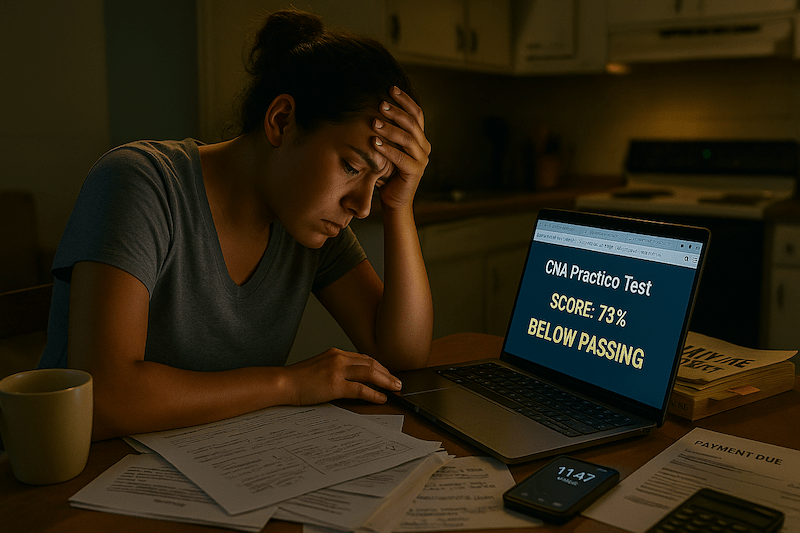
Confused about how to study for the CNA exam? You’re far from alone. Students face wildly conflicting advice ranging from “you don’t need to study” to “8 weeks of intense preparation.” You’ve probably heard the exam is “just common sense.” Yet many students fail. Here’s why that advice is dangerous – and what actually works.
The truth is, most students don’t struggle with understanding CNA content. Training programs teach you the skills and knowledge. What’s missing is study methodology – the specific techniques that help your brain retain information and perform under pressure. This guide provides exactly that: research-backed study methods, complete timeline plans, and honest resource guidance to transform your confusion into confidence.
“I feel like I know how to do it, but don’t at the same time.”
This uncertainty resonates throughout CNA communities. It’s not confusion about content – it’s the gap between knowing facts and trusting yourself to perform under pressure. Here’s how to bridge that gap.
How Long Should You Study for the CNA Exam?
Students report study timelines ranging from 4 hours the night before to 8 weeks of daily preparation – both with success stories. So how long do YOU need?
Here’s what matters: duration is less important than the distribution of study effort. Starting early doesn’t guarantee success if you’re using passive methods. Conversely, compressed timelines can work when you use active techniques strategically.
Your optimal timeline depends on four factors:
- When you completed training: Fresh knowledge (within 2 weeks) requires less time than rusty recall (3+ months later).
- Your existing knowledge base: If you excelled in training with strong retention, you need less review than someone who struggled initially.
- Your work schedule: Full-time employees need longer calendar time with shorter daily sessions compared to those studying full-time.
- Your learning pace: Some people master skills quickly through observation; others need extensive repetition for muscle memory.
“I literally started studying the night before the test, and basically just watched CNA skills youtube videos for 4 hours…I am still amazed that I passed.”
While this student succeeded, last-minute cramming is a high-risk strategy. You can’t build muscle memory for skills overnight, and research shows 70% of crammed information disappears within 24 hours. More reliable approaches follow.
Understanding How Your Brain Learns: Study Methods That Actually Work

Research tracking actual exam performance reveals a surprising truth: the most common study method – passive reading of notes, used by 94% of students – has no statistically significant relationship with exam scores.
Why doesn’t passive reading work? Re-reading creates an illusion of mastery. Material looks familiar, which feels like progress. But familiarity and retrieval ability are different things. On test day, you won’t have notes to re-read. You need to recall from memory under pressure.
The Retention Problem
Without reinforcement, you’ll forget approximately 70% of new information within 24 hours. Within one week, 90% vanishes. This forgetting curve explains why cramming fails – you’re fighting your brain’s natural disposal of information it considers unimportant.
How does your brain decide what’s important? Through repeated retrieval attempts. Every time you successfully recall information, your brain strengthens that memory pathway. This is why testing yourself works better than re-reading.
The Testing Effect
Landmark research by cognitive psychologists Roediger and Karpicke found that after one week, students who took practice tests recalled 61% of the material. Those who repeatedly studied the same content recalled only 40%. Testing isn’t just assessment – it’s one of the most powerful learning tools available.
Students using active recall methods retain approximately 57% of material long-term, compared to just 29% for passive reading. This isn’t a “study hack” – it’s how memory actually works.
How to Study for the CNA Written Exam
Active recall, spaced repetition, strategic practice testing, and learning style adaptation form the foundation of effective written exam preparation. Here’s how to use each method.
Active Recall Techniques
Active recall means retrieving information from memory without prompts or notes. Four specific methods work especially well for CNA content.
- Method 1: Close-Book Recall (Blurting)
- Study material for 20-30 minutes, then close all materials. Write or say aloud everything you remember about that topic. Don’t peek at notes. After exhausting your memory, check your notes and mark what you missed in red. Your next study session focuses ONLY on red items.
- Why it works: Forces retrieval and identifies real knowledge gaps versus false confidence from recognition.
- Method 2: Self-Quizzing with Flashcards
- Create questions on the front and detailed answers on the back. Include “why” explanations, not just facts. When reviewing, ask yourself: Can I explain this concept to someone who knows nothing about it?
- Digital flashcards (Quizlet) offer convenience and tracking. Handwritten cards provide additional memory reinforcement through the physical writing process. Both work – choose what fits your learning style.
- Method 3: Feynman Technique
- Choose a concept like “Resident Rights.” Teach it out loud to an imaginary beginner, explaining it in simple terms. When you get stuck, you’ve found a knowledge gap. Go back, re-learn that specific part, then teach it again until you can explain fluently without notes.
- This technique works because teaching requires a deeper understanding than recognition. You can’t fake your way through explaining something to someone else.
- Method 4: Practice Questions with Deep Analysis
- Don’t just answer practice questions and check if you’re right. For EVERY question, ask: Why is the correct answer right? Why is each wrong answer wrong? What concept is being tested?
- Create mini-lessons from question explanations. If you missed a question about infection control, review the entire infection control domain, not just that single fact.
Research on Harvard medical students found that those using active recall scored 50% higher on final exams overall and 70% higher on application-based questions. The CNA exam tests application, not just memorization.
Spaced Repetition Schedule
Spaced repetition fights the forgetting curve by reviewing material at increasing intervals. Here’s the proven protocol.
The 1-3-7-14 Schedule:
- Day 1: Learn new material (infection control procedures)
- Day 2: Review infection control (first reinforcement – CRITICAL)
- Day 5: Review again (3 days after first review)
- Day 12: Review again (7 days after second review)
- Day 26: Final review (14 days after third review)
Without that Day 2 review, you’ll forget 70% within 24 hours. Each review session rebuilds the memory strongly. By the fourth review, information transfers to long-term storage.
How to Implement:
Use a calendar or planner to schedule reviews in advance. Set phone reminders for review days. Each review should feel slightly challenging – if too easy, space reviews farther apart; if too hard, review sooner.
Focus on content domains rather than individual facts.
- Day 1: study the Physical Care Skills domain.
- Day 2: review entire domain with active recall.
Combining spaced repetition with active recall can increase long-term retention by up to 75% compared to cramming or massed study sessions.
Practice Test Strategy
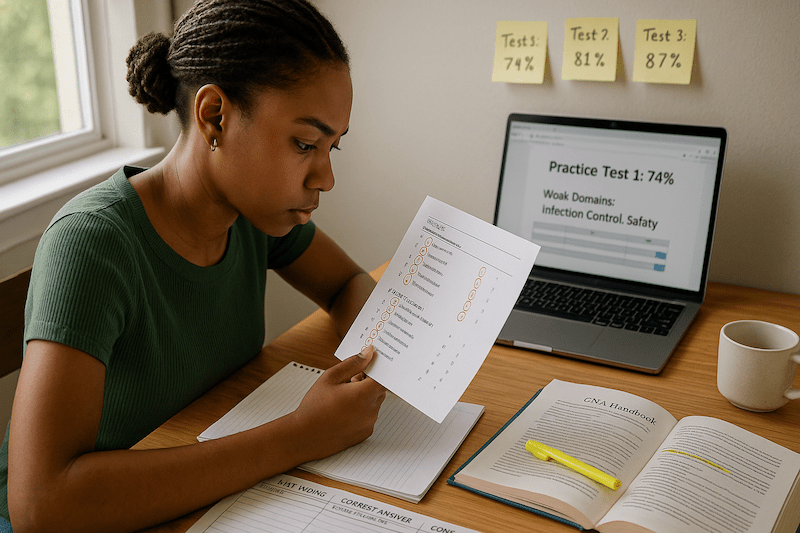
Practice tests serve three purposes: diagnostic assessment, skills building, and test simulation. Use this three-stage progression.
- Stage 1: Diagnostic (Untimed, Open-Book)
- Take your first practice test with notes available and no time pressure. The goal is identifying what you don’t know, not proving what you do. Mark questions where you guessed, even if you guessed correctly. Create your “weak domain” list.
- Stage 2: Skills Building (Timed, Closed-Book)
- Take practice tests under realistic time limits (90 minutes for 60 questions). No notes allowed. Track three metrics: score, time, and confidence level. Review ALL wrong answers plus questions where you guessed correctly.
- Stage 3: Test Simulation (Strict Conditions)
- One week before your exam, take a practice test under strict test-day conditions. Quiet room, no interruptions, strict time limit, no notes. This reduces test-day anxiety by making the experience familiar.
Error Analysis Framework
For every wrong answer, determine the failure type:
- Did I misread the question? Test-taking skill issue – slow down and read carefully.
- Did I know the content but choose wrong? Elimination strategy issue – practice narrowing choices.
- Did I not know the content at all? Knowledge gap – study that specific domain.
- Was it a tricky resident rights scenario? Application issue – review decision-making frameworks.
Research shows that reviewing mistakes is more important for score improvement than simply taking more tests. Dedicate 60% of the time to practice and 40% to thorough error analysis.
Learning Style Adaptations
Adapt methods to your learning style for maximum effectiveness.
- Visual Learners: Create concept maps linking related topics. Use color-coding by domain (infection control = green, safety = red). Watch YouTube demonstrations. Draw diagrams of procedures.
- Auditory Learners: Record yourself explaining concepts, listen during commutes. Use study groups for discussion. Verbalize while studying – talk through flashcards aloud. Listen to YouTube videos for explanations.
- Kinesthetic Learners: Write notes repeatedly for muscle memory. Walk while reviewing flashcards. Use physical props for concepts. Practice skills while reviewing written content.
- Reading/Writing Learners: Rewrite textbook sections in your own words. Create detailed study guides. Write practice essay answers for key concepts. Use traditional note-taking methods.
“What helped me the most is quizlet!! I used quizlet and upgraded to premium and made my own flashcards, with pics, etc”
The key is using active methods regardless of style. Visual learners still need to practice retrieval, just with visual materials. Auditory learners still need testing, just with verbal components.
How to Study for the CNA Skills Exam
Skills exam preparation is fundamentally different from written exam study. You can’t cram muscle memory the night before – procedural skills require time-distributed physical practice.
State-level data consistently show significant gaps between written and skills pass rates. For example, data from 2023 Arizona showed an 85% written pass rate compared to 79% for skills – a pattern repeated across most states with gaps ranging from 6-39 percentage points.
Deliberate Practice Protocol
Mindless repetition builds bad habits. Deliberate practice builds competence through focused repetition with targeted feedback.
Step-by-Step Protocol:
Perform the skill while someone observes (classmate, family member, instructor). Observer identifies ONE specific error – not everything, just one weakness. Your next repetition focuses ONLY on correcting that error. Repeat until that element is perfect. Then move to the next error.
Example: If the observer says, “You forgot to knock before entering,” your next five repetitions focus ONLY on remembering to knock. Don’t try to fix hand hygiene, call light placement, and knocking simultaneously.
Research shows that deliberate practice – focused repetition with targeted feedback on specific weaknesses – is vastly more effective than mindless repetition.
Verbalization (Talk-Through) Technique
Narrate every step while performing. Say critical steps louder or emphasize them. This helps organize your mental plan and reduces cognitive load during performance.
Research using Peyton’s 4-Step clinical instruction model shows that learners who can correctly verbalize procedures before performing them have a significantly greater likelihood of performing skills correctly on the actual test.
Practice Progression:
- Weeks 1-2: Perform while reading steps aloud from the checklist
- Weeks 3-4: Perform while reciting steps from memory
- Final week: Teach the skill to someone else – the ultimate test of mastery
Many state exams REQUIRE verbalization during testing. Practice this from day one to make it natural.
“Study, read the bold black steps, and WASH YOUR HANDS! Actually saying your steps out loud, especially bold steps, out loud when you test AND when you practice is KEY!”
Critical Steps Mastery
Critical elements are marked in bold on official skills checklists. Missing ONE critical step equals automatic skill failure, regardless of how well you performed everything else.
These aren’t complex procedures – they’re fundamental safety and infection control measures. The four most commonly missed critical steps:
- Hand hygiene: 20 seconds with friction, don’t touch the sink after cleaning. This is the #1 failure point.
- Safety: Lock bed brakes, use a gait belt when required, adjust bed height appropriately, and place the call light within reach.
- Infection control: Proper glove use, maintain clean/dirty separation, and avoid contamination.
- Privacy/dignity: Knock before entering, explain procedures, use a privacy curtain, minimize exposure.
“Apparently, I didn’t wash my hands correctly. My skills were taking a patient’s pulse, turning a patient onto their side, and foot care. I passed all of them. Just not the hand washing.”
Handwashing feels too simple to practice extensively. But it’s the most common critical step failure. Master this perfectly – practice handwashing 10 times in a row without errors before considering yourself ready.
Skills Practice Resources
Access to lab equipment helps significantly, though creative home practice works too. Most training programs provide lab access for graduates.
Practice with family members as “patients” for interactive skills. Use stuffed animals or pillows for non-interactive skills like positioning. Record yourself performing skills, then review for errors.
YouTube channels provide visual reference. Nurse Jar offers state-specific demonstrations for different testing vendors (Prometric, Headmaster, Pearson VUE). Watch each skill video three times minimum: first to observe, second to practice along, and third to perform without pausing.
Study Groups: When They Help and When They Hurt
Research shows that structured study groups can be highly effective, with one meta-analysis finding they could improve exam performance from the 50th to the 73rd percentile. However, the keyword is “structured.”
When Study Groups Work
All members come prepared, having completed individual study. An agenda with time limits keeps sessions focused. A group size of 3-5 members is optimal – small enough for participation and large enough for diverse perspectives. Members share a commitment to study goals and similar timelines. A mix of teaching (explaining to others) and learning occurs naturally.
When Study Groups Fail
Sessions devolve into socializing rather than studying. Large skill disparities exist (one person tutoring everyone else). Scheduling conflicts or unprepared members disrupt consistency. Groups of over 6 members struggle to keep everyone engaged. Personality conflicts or competitive dynamics create tension.
Optimal Group Structure
- Pre-work: Everyone reviews the same material solo before meeting.
- Session format: Quiz each other using active recall, explain difficult concepts, and practice skills with peer feedback.
- Duration: 60-90 minutes maximum. Productivity drops significantly after 2 hours.
- Frequency: Once or twice weekly. Daily meetings leave insufficient time for solo study and spaced repetition.
Solo vs. Group Decision Matrix
- Solo study works best for: Initial learning and foundation building. Memorization and flashcard work. Addressing personal weak areas. Self-paced spaced repetition.
- Group study works best for: Clarifying difficult concepts through discussion. Teaching/explaining concepts to others (Feynman technique). Practicing skills with peer feedback. Maintaining motivation and accountability.
Studies show that 70% of students report increased motivation from study groups when properly structured. Use groups strategically as a supplement to solo work, not a replacement.
Complete Study Timeline Plans
You know what to study and how to study it. Now let’s answer when.
Your timeline should match three factors: how soon you’re testing, your daily availability, and your current preparation level. We’ve built four timelines optimized for different situations.
Use the interactive planner below to explore each timeline with day-by-day breakdowns, or download the PDF to print and track your progress.
Your Personalized CNA Study Timeline
Choose your timeline below to see a complete day-by-day study plan with practice test schedules and readiness criteria
Download Your Study Plan
Prefer a printable version? Download any timeline as a PDF:
- 2-Week Intensive Plan
- Best for: Test scheduled soon, 3-4 hours daily available
- Focus: Quick ramp-up, 70% written → 70% skills
- 4-Week Balanced Plan ← Most Popular
- Best for: Moderate timeline, 1.5-2 hours daily
- Focus: Gradual progression, sustainable pace
- 6-8 Week Extended Plan
- Best for: Working full-time, 45-60 minutes daily
- Focus: Flexible schedule, weekend skill labs
- 10-Day Retake Plan
- Best for: Failed once, have score report
- Focus: Targeted recovery on weak areas only
Study Resources – What Actually Works
You do NOT need expensive resources to pass the CNA exam. Many successful students use only free resources. Here’s the strategic approach with honest ROI assessment.
Tier 1: Essential Free Resources
YouTube Channels:
- Nurse Jar (77K subscribers): State-specific skills videos for different testing vendors (Prometric, Headmaster, Pearson VUE)
- 4yourCNA (149K subscribers): Comprehensive skills demonstrations, practice Q&A, live study sessions
- Florida Training Academy/Nurse Eunice: Practice question compilations with detailed rationales
How to use: Watch each skill video a minimum of three times. First watch: observe. Second watch: practice along. Third watch: perform without pausing the video.
“There is a YouTube channel called Nurse Jar that is wonderful for learning exactly how to do your skills test and pass. She has different videos for each skill and testing provider (Prometric, Pearson Vue)…I challenged the exam and passed the first time by just watching her videos over and over.”
Quizlet:
Create personal flashcards after learning topics (writing them = active recall). Use study mode for learning, test mode for retrieval practice.
How to use: Focus on question/answer format, not just term/definition. Create cards AFTER studying topics, not during – the act of creating them reinforces learning.
Free Practice Tests:
Our comprehensive CNA practice exam covers all major testing domains with detailed answer explanations. The questions mirror real exam format and difficulty, helping you identify weak areas before test day.
How to use: Take the full practice exam under timed conditions to simulate test day pressure. Review every incorrect answer thoroughly – understanding *why* you got something wrong is more valuable than your score. Retake sections where you scored below 80% after additional study.
Candidate Handbook (FREE – MOST IMPORTANT):
Download from your state’s testing vendor (Credentia, Prometric, Headmaster). Contains an exact content outline and skills checklist with critical steps marked in bold.
How to use: This is your authoritative source. Check all other materials against the handbook for accuracy.
Tier 2: Helpful Paid Resources
Official Practice Exams ($30-60):
- Credentia: $30 (1 test), $60 (3 tests) – exact NNAAP simulation
- Prometric: Varies by state – includes feedback plus source material references
Value assessment: High-fidelity test-day experience reduces anxiety. Experiencing exact software and procedures beforehand provides a confidence boost worth more than content alone.
When worth it: If you struggle with test anxiety, one official proctored exam ($30) is a valuable investment.
Commercial Study Guides ($30-50):
- Mometrix CNA Secrets Study Guide (~$30-56): Comprehensive single-source coverage, structured framework, vetted practice questions
Value assessment: Provides an authoritative single reference versus piecing together free resources. NOT necessary if comfortable with self-directed learning.
When worth it: If you want one comprehensive book to guide all your studies and prefer a structured curriculum over self-assembly.
Online Course Subscriptions ($25-50/month):
- BoostPrep ($25-40): Large question banks, supplementary videos
- Nurse Eunice ($30): Structured curriculum
- Mometrix online ($50): Digital study platform
Value assessment: Question bank access and external accountability. Budget-conscious: Use a 1-month subscription during the final month only.
When worth it: If you need external structure and accountability, or want extensive practice question access beyond free resources.
Practice With 600+ CNA Exam Questions
See exactly how this skill appears on the real test
Tier 3: Unnecessary Resources
- Expensive CNA Prep Courses ($200-500+): Claims of “guaranteed pass” are marketing. Study techniques in this guide match what expensive courses teach.
- Multiple Study Guides: One good guide is sufficient. Additional guides create information overload, not a better understanding.
- For every online subscription, pick ONE if you want paid support. Multiple subscriptions provide overlapping content and wasted money.
Budget Recommendations
Zero-Budget Plan ($0):
YouTube plus Quizlet plus free practice tests plus candidate handbook. Requires self-discipline and strategic resource use. Many students pass this way successfully.
“I challenged the Florida CNA exam and I passed!!! (After failing skills once 😅)…I’m really proud of myself and excited to move forward…I paid nothing for learning materials, and now I have a whole new career.”
Smart Investment Plan ($30-50):
All free resources PLUS Mometrix study guide ($30-50). Provides an authoritative single source for modest investment.
Optimal Plan ($60-100):
Smart Investment resources PLUS one official practice exam ($30). Addresses knowledge, practice, AND psychological preparation. Reduces retake risk (retakes cost $100+).
Independent research on nursing exam preparation found no statistically significant change in first-attempt pass likelihood from commercial prep products alone, suggesting study methodology matters more than resource spending.
How to Know When You’re Ready to Test
Many students ask, “Am I ready?” without clear criteria for assessment. Here are objective indicators – not guesswork, but measurable competencies.
Written Exam Readiness Checklist
Practice Test Performance:
- Scoring 85%+ on three consecutive full-length practice tests
- Scoring 75%+ on EACH content domain (no critical weak spots)
- Completing tests in 80% of allotted time (buffer for test-day anxiety)
Content Mastery:
- Can explain every content domain in your own words (not reciting memorized definitions)
- Can identify why wrong answers are wrong, not just why right answers are right
- Can teach key concepts to someone who knows nothing about CNA care
Application Ability:
- Correctly answering scenario-based questions (resident rights, proper response)
- Can apply infection control principles to new situations
- Understanding CNA scope (know what to report versus what to do independently)
Skills Exam Readiness Checklist
Performance Consistency:
- Can perform all 21-25 testable skills from memory without reference materials
- completed at least 3 full mock skills tests with observer feedback
- Can perform each skill correctly 3 times consecutively (proving consistency, not luck)
Critical Steps Mastery:
- Can identify all critical elements for each skill without reviewing the checklist
- Can explain WHY each step is critical (safety, infection control, dignity)
- Handwashing performed perfectly 10 consecutive times without errors
Under-Pressure Performance:
- Can perform skills while being observed without significant anxiety disruption
- Can verbalize steps while performing (if state requires)
- Can self-correct minor errors during performance without panic
Integrated Readiness Indicators
Timeline Completion:
- Finished chosen study plan (2-week, 4-week, 8-week, or retake plan)
- Met all milestone checkpoints without major delays
- Used spaced repetition consistently, not cramming at the end
Emotional Shift:
- Feeling shifts from “I hope I pass” to “I should pass”
- Nervousness is normal and manageable, not crippling anxiety
- Can visualize a successful test day without a panic response
Physical Readiness:
- Sleeping normally (not staying up all night cramming)
- Eating well and managing stress effectively
- Have test-day logistics planned (know location, what to bring, arrival time)
“You’re NOT Ready Yet” Red Flags
Performance Issues:
- Scoring below 80% on practice tests
- Frequently forgetting critical steps during skills practice
- Heavy reliance on lucky guesses or elimination without understanding
- Can’t explain concepts in your own words (only recite memorized text)
Knowledge Gaps:
- Consistently missing questions in a specific domain (Resident Rights, Mental Health)
- Confusion about the CNA scope of practice
- Can’t identify critical steps versus non-critical steps
Psychological Unreadiness:
- Severe test anxiety is interfering with practice performance
- Overwhelming self-doubt despite objective readiness indicators
- Cramming mindset (studying until midnight before exam day)
If you see red flags: Add 1-2 weeks to the timeline. Focus specifically on weak areas (don’t restart entire study plan). Consider stress management techniques or brief counseling for severe anxiety. Don’t test prematurely – data from nursing licensure exams shows first-time pass rates are 88.8%, but drop dramatically to just 49.3% for those retaking the exam.
Readiness Interpretation Guide
- All green checkboxes: You’re ready to test with confidence
- Missed 1-2 criteria: Add 3-5 days of targeted study for specific gaps
- Missed 3+ criteria OR any red flag: Continue study plan, don’t schedule test yet
Are You Actually Ready for Your CNA Exam?
Answer 8 quick questions to get your personalized readiness score, identify knowledge gaps, and receive a custom study plan tailored to your timeline.
Managing Test Anxiety
Test anxiety affects 55-60% of nursing students at moderate to high levels – more than triple the 17% rate in the general public. If you’re anxious, you’re not alone, and it’s not a character flaw.
Anxiety isn’t just “feeling nervous.” Research shows a significant negative correlation between anxiety levels and exam performance, as worry consumes the working memory needed to recall information and perform skills. Your brain can only handle so much at once, and worry competes for the same mental resources needed for the exam.
Clinical Anxiety Management Techniques
5-4-3-2-1 Grounding (For Acute Anxiety):
- Name 5 things you can see
- Name 4 things you can touch
- Name 3 things you can hear
- Name 2 things you can smell
- Name 1 thing you can taste
This technique brings attention to the present moment, interrupting the anxiety spiral. Use it in the waiting room if anxiety spikes before testing.
Progressive Muscle Relaxation (Night Before Exam):
Tense each muscle group for 5 seconds, then release for 10 seconds. Start with the feet, progressively move up to the face. Reduces physical tension that amplifies anxiety.
Practice this during your study period, not just on test day. Your body learns the relaxation response through repetition.
Cognitive Reframing:
Transform anxious thoughts:
- “I’m nervous” becomes “My body is preparing me to perform”
- “What if I fail?” becomes “I’ve prepared thoroughly, I have the tools I need.”
- “Everyone is watching me fail” becomes “Evaluator wants me to succeed, just needs to see safe performance”
Box Breathing (Before Skills Performance):
Inhale for 4 counts, hold for 4 counts, exhale for 4 counts, hold for 4 counts. Repeat 4 cycles.
This activates your parasympathetic nervous system (calming response). Use it immediately before entering the skills testing room.
Test-Day Anxiety Protocol
- Morning: Progressive muscle relaxation after waking. Light breakfast (avoid heavy foods or excess caffeine). Arrive 15-20 minutes early to acclimate to the environment.
- Waiting room: If anxiety spikes, use 5-4-3-2-1 grounding. Avoid comparing yourself to other candidates – their visible nervousness or confidence tells you nothing about their preparation.
- Before skills: Box breathing technique. Visualization of successful performance. Remind yourself: “I know these skills, I’ve practiced them dozens of times.”
- During exam: If panic starts during a question or skill, pause briefly. Take one deep breath. Refocus on the specific task in front of you, not the entire exam.
“It was nerve wrecking, as I was pacing back and forth, just waiting…I was shaking up the whole time…I was sweating so much.”
Notice this student went on to pass despite severe physical anxiety symptoms. Anxiety doesn’t prevent success when you have management techniques and solid preparation.
When to Seek Additional Support
If anxiety prevents you from studying effectively, consider seeking help. If panic attacks occur during practice tests, professional support can help. If intrusive thoughts about failing disrupt daily life, this exceeds normal test anxiety. If physical symptoms interfere with sleep or eating, your body needs additional support.
Campus counseling services, online therapy platforms, or your medical provider can help with clinical anxiety management beyond self-help techniques. There’s no shame in seeking support for mental health – 54% of nursing students suffer from severe depression, anxiety, or stress.
Common Mistakes to Avoid
Learning from others’ errors helps you avoid predictable failure points.
Mistake #1: Believing “It’s Just Common Sense”
You’ve heard this repeatedly. Reality: Many well-prepared students fail. The exam tests application of knowledge, proper protocols, and the CNA scope – not general logic. Questions require understanding why specific approaches work, not just what feels intuitive.
Mistake #2: Passive Reading of Notes
94% of students use passive reading as the primary method. Research shows no correlation with exam performance. Highlighting, re-reading, and summarizing WITHOUT testing yourself creates false confidence through familiarity, not retrieval ability.
Mistake #3: Cramming Everything the Night Before
Yes, some students pass after cramming. But you can’t cram muscle memory for skills, and written knowledge crammed today is 70% forgotten within 24 hours. Success stories at extreme timelines don’t prove the method is reliable.
Mistake #4: Only Studying Written Content
Skills exams consistently have lower pass rates (6-39 percentage points below the written score in most states). You can’t learn hands-on procedures from textbooks alone. Physical practice is non-negotiable.
Mistake #5: Taking Practice Tests Without Reviewing Errors
Research suggests dedicating 60% of the time to practice and 40% to error analysis and taking test, seeing scores, and moving on wastes the learning opportunity. Wrong answers show exactly what you need to study.
Mistake #6: Ignoring Critical Steps
Most skills failures happen on fundamental safety steps (handwashing, bed brakes, call light placement), not complex procedures. These seem “too simple to practice,” but they’re automatic failures if missed. Every single time you practice a skill, include ALL critical steps.
Mistake #7: Studying Alone When You Need Support
If you’re confused or discouraged, isolation makes it worse. Structured study groups (3-5 members) or instructor office hours can clarify concepts. Don’t suffer in silence when support is available.
Frequently Asked Questions
Most successful candidates study for 4-6 weeks with consistent daily sessions of 1-2 hours. However, the optimal timeline depends on your situation: 2 weeks if you just finished training with fresh knowledge, 4-6 weeks if it’s been 1-3 months since training, or 6-8 weeks if working full-time. Study method quality matters more than duration.
Use active recall methods instead of passive reading. Close your book and quiz yourself, create flashcards with detailed explanations, take practice tests and thoroughly analyze errors, and teach concepts to others. Research shows active recall improves retention by 50% compared to re-reading notes.
Practice each skill physically with deliberate focus on critical steps. Use the talk-through technique (verbalize steps while performing), practice under observation to simulate test conditions, and master handwashing perfectly – it’s the most common failure point. Skills require muscle memory that can’t be built through reading alone.
No. Many students pass using only free resources (YouTube channels like Nurse Jar and 4yourCNA, Quizlet flashcards, free practice tests, and your state’s candidate handbook). If you want paid resources, a comprehensive study guide ($30-50) and one official practice exam ($30) provide the best value without breaking your budget.
You’re ready when you score 85%+ on three consecutive practice tests, can perform all skills from memory without notes, have mastered critical steps (especially handwashing), and feel your mindset shift from “I hope I pass” to “I should pass.” If you’re missing multiple readiness criteria, continue studying rather than testing prematurely.
Conclusion & Next Steps
You now have what most CNA students desperately need: specific study techniques backed by research, complete timeline plans for every scenario, honest resource guidance, and objective readiness criteria.
Success isn’t about studying longer – it’s about studying smarter. Active recall, spaced repetition, deliberate skills practice, and strategic resource use will prepare you thoroughly without breaking your budget or burning you out.
Your next steps are clear:
- Choose your timeline (2-week, 4-week, 6-8 week, or retake plan)
- Download your state’s free candidate handbook from your testing vendor
- Create your study schedule with spaced repetition intervals built in
- Start today with a diagnostic practice test to identify your weak areas
Test anxiety is normal. Confusion about study methods is common. But with the strategies in this guide, you’re equipped to transform anxiety into confidence and confusion into clarity.
Ready to Ace Your CNA Exam?
Get everything you need: video guides, practice tests, and detailed study plans
