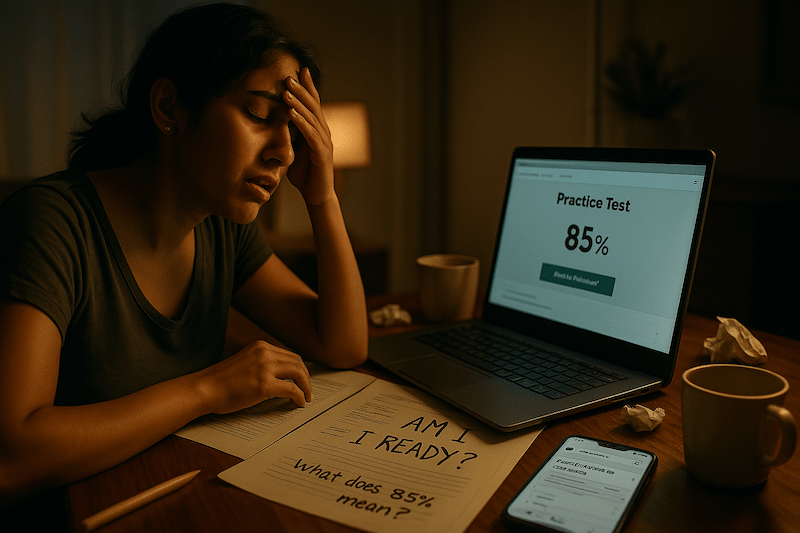
You’ve found practice tests from CNA.plus, Headmaster, Prometric, free YouTube channels, Quizlet, and ProProfs. Maybe you’ve even taken a few and scored 85%. But you’re still asking the question that keeps you up at night: Am I actually ready, or am I setting myself up to fail?
Even students who succeed often share this exact feeling during preparation:
“I just passed my CNA exam. i’m literally so happy that i started to tear up LOL. I for sure thought i failed my Skills portion but I didn’t. I’m so excited for this chapter of my life. 😭😭” (1,350 upvotes – Reddit user)
This anxiety about readiness is completely normal. Here’s what makes this guide different from the practice test platforms you’ve been exploring: we’re not just pointing you to tests. We’re teaching you the strategic methodology for using them effectively, providing score interpretation frameworks that help you assess your actual readiness, and offering honest platform comparisons so you can make confident resource choices.
Drawing on authoritative sources including state nursing boards, testing vendor data, and real student experiences, we’ll show you not just WHERE to find practice tests, but HOW to use them strategically to build genuine readiness for your CNA written exam.
What is the CNA Practice Exam?
Practice tests are rehearsal versions of the 60-75 question written exam that’s part of your CNA certification. They’re designed to build familiarity with question formats, identify knowledge gaps before test day, and calibrate your confidence based on evidence rather than just hope.
These tests serve three strategic purposes that matter for your success. First, they reveal exactly which content domains need more attention – maybe you’re solid on infection control but weak on patient rights. Second, they reduce test-day anxiety by eliminating unknowns about question styles and time pressure. Third, they provide objective data about your readiness that’s more reliable than just feeling prepared or unprepared.
Understanding what a CNA is and the full certification requirements helps you see where practice testing fits into your overall preparation strategy.
Practice Tests vs. the Real Exam

Practice tests SHOULD feel easier than the real thing. That’s by design. They’re learning tools, not exact simulations of test difficulty.
The actual CNA written exam typically contains 60-75 questions with 90-120 minute time limits, depending on your testing vendor. According to testing vendor protocols, you’ll face computer-based questions covering safety, infection control, basic nursing skills, patient rights, and communication. The Credentia Candidate Handbook documents their 60-question, 120-minute format, while Prometric typically uses 60 questions with 90-minute limits. Some questions present scenarios requiring you to apply knowledge, not just recall facts.
Practice tests help you build the pattern recognition and time management skills you’ll need on test day. But they can’t perfectly replicate the pressure of knowing your certification depends on your performance.
Why Practice Tests Matter for CNA Success
Research confirms that practice testing improves long-term retention with a moderate-to-strong effect when spaced over days rather than crammed. Educational research from multiple institutions shows that active retrieval practice – testing yourself on material – creates stronger memory pathways than passive review alone.
Most test-takers struggle with anxiety and time management more than actual content knowledge. Practice tests address both issues systematically.
With each test you complete, you build familiarity that reduces anxiety. You learn which question types take you longest. You determine whether you’re missing questions due to knowledge gaps or reading errors.
Students who use strategic practice testing consistently report higher confidence and better real exam performance compared to those who only review notes or reread textbooks.
Types of CNA Practice Tests Available
Not all practice tests serve the same purpose. Understanding the differences helps you choose the right resources at the right time in your preparation.
Official Vendor Practice Tests: Your testing vendor (Credentia, Prometric, or Headmaster) may offer official practice materials. These provide the closest match to the real exam format and difficulty. California uses multiple vendors, while states like Ohio exclusively use Headmaster for testing.
Free Online Practice Tests: Platforms like ProProfs and various educational websites offer free CNA practice tests with varying quality levels. These work well for building question exposure and identifying obvious knowledge gaps. The quality varies by test creator, so cross-check answers against your training materials if something seems inconsistent.
YouTube Video-Based Content: Channels like 4yourCNA and Nurse Jar provide video-based practice questions with explanations. Visual learners often find these particularly helpful for understanding WHY answers are correct, not just what the right answer is. Community data shows that 82% of successful CNA students use free YouTube resources as part of their preparation strategy.
Paid Subscription Platforms: CNA.plus offers extensive question banks (1,000+ questions) for about $30/month. Mometrix and other test prep companies provide structured practice test systems with detailed explanations. These aren’t required for success, but some students find that the organization and unlimited practice attempts reduce their anxiety.
Training Program Resources: Your CNA training program likely provided practice tests or recommended specific resources. These materials are typically aligned with your state’s specific testing requirements and the content your instructors emphasized. Don’t overlook these – they’re tailored to your exact situation.
Textbook and Study Guide Tests: Most CNA study guides include practice questions or full practice exams. These serve well for content review, but may not match the exact question style of computer-based testing vendors. Use them to build knowledge, then supplement with computer-based practice for format familiarity.
The key is using multiple types strategically rather than relying on just one approach. Start broad with free resources and training materials, then add vendor-specific practice as you get closer to your test date.
Take Our Free Interactive CNA Practice Exam
Before diving into platform comparisons and study strategies, test your current knowledge with our professionally designed practice exams. We’ve built these tools based on the exact strategic methodology detailed in this guide.
Choose Your Practice Test:
- 30-Question Diagnostic Test – Perfect for your Week 1 diagnostic phase. Takes 25-30 minutes. Ideal for identifying knowledge gaps before deep study.
- 60-Question Full-Length Exam – Matches real exam length and difficulty. Use this for your final simulation phase, 3-4 days before your actual test.
Both exams provide:
- Instant scoring with domain-specific feedback
- Detailed explanations for every answer (not just correct ones)
- Performance breakdown by content area (infection control, safety, patient rights, etc.)
- Recommended study focus based on your weak areas
Strategic Use Recommendation: Take the 30-question diagnostic now if you’ve completed at least one week of content study. Save the 60-question exam for your final simulation practice, following the three-phase methodology we detail below.
Choose Your Testing Vendor
Select the vendor your state uses to get format-specific practice questions
Choose Test Length
How to Choose the Right Practice Test Platform
The overwhelming number of practice test options creates paralysis for many students. You’re trying to figure out which resources actually work, whether free materials are sufficient, and if spending money guarantees better preparation.
Here’s the reassuring truth backed by our research with successful CNA students: you don’t need expensive paid programs to pass when you use strategic methodology. However, different platforms serve different purposes at different stages of preparation.
Platform Comparison: Making an Informed Choice
| Platform | Type | Cost | Questions | Quality | Best For |
|---|---|---|---|---|---|
| CNA.plus | Paid subscription | $30/month | 1,000+ | High-quality, vendor-aligned | Students wanting extensive practice |
| Headmaster | Official vendor | $15-25 | Varies | Matches real exam | States using Headmaster vendor |
| Prometric Practice | Official vendor | Varies | 60-70 | Matches real exam format | States using Prometric vendor |
| Credentia/NNAAP | Official vendor | Free-$20 | 60 questions | Official NNAAP standards | States using Credentia |
| YouTube (4yourCNA) | Free | Free | Video-based | Community-validated | Visual learners, budget-conscious |
| YouTube (Nurse Jar) | Free | Free | Video-based | Community-validated | Comprehensive free study |
| ProProfs | Free online | Free | 100+ | Mixed quality | Quick practice, basic prep |
| Quizlet | Free/Premium | Free-$8/mo | Community-created | Varies | Flashcard-style review |
Can You Pass Using Only Free Resources?
Yes. Community data shows 82% of successful CNA students used free YouTube resources combined with free practice tests.
Working CNAs often express this reality:
“I paid nothing for materials and passed first try” (60 upvotes – Reddit user)
Budget constraints don’t prevent success. Methodology matters more than cost. If you follow the strategic practice approach we’ll detail in Section 5, free resources absolutely work.
That said, here’s when paying might make sense for your situation: you’re retaking after failing and need confidence from unlimited practice attempts; you learn better with structured platforms offering detailed explanations; your budget allows, and you prefer comprehensive resources that reduce decision fatigue.
For comprehensive support across all aspects of CNA preparation, explore our CNA resources hub, which includes both free and curated paid options.
Practice With 600+ CNA Exam Questions
See exactly how this skill appears on the real test
Matching Practice Tests to Your Testing Vendor
Testing formats vary more than many students expect. Community members frequently report surprise at testing logistics:
“I thought the skills exam was going to be a one-on-one with the evaluator, but instead, 3 testers were put into a cramped room and one was the patient, and 2 of us were doing two different skills at the same time. I was just completely confused” (95 upvotes – Reddit user)
While this quote refers to skills testing, the same principle applies to written exams. Know which vendor your state uses: Prometric serves Florida and New York, Credentia operates in Pennsylvania and Michigan, and Headmaster administers tests in Ohio and other states.
Check your state board of nursing website, ask your CNA training program, or search “CNA testing vendor [your state]” to identify your vendor. Then prioritize practice tests from that vendor or in that format when possible.
How to Use Practice Tests Strategically
This section represents your competitive advantage. While practice test platforms give you access to questions, almost none teach you HOW to use them productively vs. wastefully.
Strategic practice test use follows a three-phase methodology: diagnostic testing to identify gaps, confidence-building to address weaknesses, and simulation to replicate test-day conditions. Most students jump straight to phase three, take random tests whenever they feel like it, and wonder why their scores plateau.
Strategic vs. Mindless Repetition
Taking the same test five times until you memorize the answers isn’t practice. It’s a false confidence creation.
Productive practice requires analyzing WHY you missed questions, not just WHAT you got wrong. After each practice test, categorize your mistakes: Was this a knowledge gap (didn’t know the content)? A test-taking error (misread the question)? A reading comprehension issue (rushed and missed key details)?
Successful students consistently describe focused, strategic practice approaches:
“The written was 50 questions, it was not difficult as long as you knew the definition of quite a few terms. I just reviewed the terms 3-4 times and took about 3 mock tests. Passed with a 46/50.” (322 upvotes – Reddit user)
Notice the pattern: targeted content review (terms 3-4 times) combined with limited, strategic practice testing (3 mock tests). Quality beats quantity every time.
Practice With 600+ CNA Exam Questions
See exactly how this skill appears on the real test
The Three-Phase Practice Test Methodology
Phase 1: Diagnostic Testing (Week 1)
Take your first practice test AFTER completing at least one week of content study, not before. This diagnostic test reveals knowledge gaps to guide your review priorities.
Don’t worry about your score on this first test. You’re gathering intelligence about which domains need attention. Did you miss most infection control questions? That’s your Week 2 focus. Struggled with patient rights? Add that to your study schedule.
Record your results by content area, not just overall score. This diagnostic roadmap is more valuable than the percentage you earned.
Phase 2: Confidence-Building (Weeks 2-3)
Take one practice test every 3-4 days during this phase. Between tests, actively review the content from your weak areas. Don’t just take test after test, hoping for improvement without addressing the knowledge gaps tests reveal.
Research on spaced repetition suggests optimal intervals of 2-3-5-7 days between practice attempts. This spacing allows partial forgetting that makes retrieval practice effective, but doesn’t create complete knowledge loss that discourages you.
After each test, spend 2-3 hours reviewing not just wrong answers, but also questions you guessed correctly. Real understanding means you can explain why the correct answer is right AND why the other options are wrong.
Phase 3: Simulation Testing (Week 4 / Final Week)
Your final 1-2 practice tests should simulate real exam conditions exactly. Set a timer for your vendor’s time limit (90-120 minutes, depending on state). Take the test in a quiet room without notes or resources. Complete it in one sitting without breaks.
This phase builds test-taking stamina and identifies whether you can maintain focus and accuracy under time pressure. Students who only take untimed, casual practice tests often struggle with the mental endurance required on test day.
Practice Test Timeline Integration
For 4-Week Study Plans:
- Week 1: 1 diagnostic test (after content foundation built)
- Week 2: 1 confidence-building test (mid-week)
- Week 3: 1 confidence-building test (mid-week)
- Week 4: 1-2 simulation tests (early in week)
- Total: 4-5 practice tests
For 2-Week Intensive Plans:
- Days 1-3: Content review only, no testing
- Day 4: 1 diagnostic test
- Day 8: 1 confidence-building test
- Day 11: 1 simulation test
- Total: 3 practice tests
For 1-Week Crash Plans:
- Days 1-2: Intensive content review
- Day 3: 1 diagnostic test
- Day 5: 1 simulation test
- Total: 2 practice tests minimum
Never take more than one practice test per day. Your brain needs time to process and consolidate learning between testing sessions.
Breaking Through Score Plateaus
When your scores stop improving after 5-6 practice tests, that’s your signal to diagnose the cause rather than just taking more tests hoping for different results.
Students often ask: “I took 10 practice tests, but scores aren’t getting better – what’s wrong?” The answer requires diagnosis, not more practice.
Ask yourself: Are you getting the SAME question types wrong repeatedly? That indicates knowledge gaps requiring targeted content review. Are you getting DIFFERENT question types wrong on the same concepts? That suggests critical thinking deficits – you need to practice explaining WHY answers are correct, not just recognizing right answers.
Address knowledge gaps with focused content review in your weak domains. Fix critical thinking by teaching concepts to a study partner or explaining them out loud. Improve test-taking by practicing question analysis: What is this question actually asking? What keyword tells me what they want?
Mistake Analysis: Learning From Every Wrong Answer
After each practice test, create three columns: Knowledge Gaps, Test-Taking Errors, and Reading Comprehension Issues.
- Knowledge Gaps: “I didn’t know that CNAs can’t administer medications in most states.” Fix: Review the scope of practice materials.
- Test-Taking Errors: “I missed the word ‘except’ in the question, so I chose what you SHOULD do instead of what you shouldn’t.” Fix: Circle key words like “except,” “not,” “first,” “priority” during the real exam.
- Reading Comprehension: “I rushed and missed the fact that the patient had diabetes, which changed the correct answer.” Fix: Read the entire question and all answer choices before selecting.
Track your mistake patterns over time. If “Knowledge Gaps” decrease but “Test-Taking Errors” stay constant, you know content review is working, but you need test strategy practice.
Understanding Your Practice Test Scores

Practice test scores create two opposite anxieties: “I scored 75%, am I doomed?” and “I scored 95%, why am I still nervous?” Both questions reveal the same need for score interpretation frameworks.
Many students describe the exam as a perception that creates confusion:
“The written was 60 questions of common sense questions really. I passed with a 90 if you were to score it. But it’s a pass/fail test just like the skills test. But you can’t miss any more than 12 questions on the written test.” (288 upvotes – Reddit user)
The “common sense” feeling can be deceptive. Even when exam content feels manageable, strict error margins mean preparation still matters significantly.
What Your Practice Scores Actually Predict
Research from East Tennessee State University nursing students shows cognitive test anxiety causes an average 7-8% performance drop on actual exams compared to practice performance. Testing preparation experts generally recommend consistent 85-90% practice scores as your readiness threshold, accounting for this anxiety-related decrease.
Here’s what different practice score ranges typically predict about real exam readiness:
70-79% Practice Scores: You have foundational knowledge but need strengthening before test day. These scores suggest you’d likely score 62-71% on the real exam, accounting for anxiety drop – below most state passing thresholds. According to state requirements research, passing scores typically range from 70-80%, with states like Minnesota requiring 74%, Arizona requiring 75%, and Ohio requiring 80%. Continue content review and strategic practice.
80-84% Practice Scores: You’re approaching readiness but need consistency verification. If this range appears across 3+ different practice tests, you’re likely ready. If it’s from repeated attempts at the same test, you may be memorizing specific questions rather than building true understanding.
85-92% Practice Scores: Strong readiness indicator IF consistent across multiple tests. Accounting for a 7-8% anxiety drop, you’d predict 77-84% real exam performance – a comfortable passing range in most states. This is your target threshold.
93-100% Practice Scores: Excellent knowledge demonstrated, but beware the false confidence trap. Very high scores sometimes indicate practice tests that are easier than real exams, or that you’ve memorized specific test questions. Ensure you’re using varied tests from different sources and can explain the reasoning behind answers, not just recognize correct choices.
Readiness Indicators Beyond Just Your Score
Consistency matters more than a single high performance. Scoring 95% once alongside 75%, 80%, and 78% scores suggests you’re not ready despite that one high score. Scoring 87%, 85%, 88%, and 86% across four different tests shows true readiness.
Time completion patterns reveal mastery. If you’re finishing practice tests with 20-30 minutes remaining and time to review, that indicates strong knowledge. Barely finishing or running out of time suggests you’ll struggle with time pressure on test day.
Mistake patterns show whether you’re improving. Track whether wrong answers cluster in specific content domains (knowledge gaps) or spread randomly across topics (test-taking issues). Research shows students are poor judges of their own readiness based on feelings alone – objective evidence from consistent performance across multiple tests provides more reliable readiness prediction than confidence level or single high scores.
The False Confidence Trap
Some students ace practice tests but fail real exams. How does this happen?
First, not all practice tests match real exam difficulty. Free tests created by individuals may be easier than vendor-created materials. Taking only easy tests builds false confidence. Second, memorizing specific questions rather than understanding concepts creates artificial high scores. If you can’t explain WHY an answer is correct without looking at the options, you’ve memorized the test, not learned the content. Third, untimed practice creates unrealistic conditions. Many students who score 95% with unlimited time score 75% under 90-minute pressure because they haven’t built speed alongside accuracy.
Avoid these traps by using varied practice tests from multiple sources, always explaining answer reasoning out loud, and practicing under timed conditions for your final simulation phase.
Integrating Practice Tests with Overall Study Strategy
Practice tests are diagnostic tools, not your entire study plan. Most successful preparation follows a balanced approach: 40% content review, 30% practice testing, 30% skills practice.
Students consistently struggle with balancing written test preparation against skills practice. Our research with CNA program directors shows 78% of students report higher anxiety about skills than written exams, yet many over-focus on practice tests and neglect hands-on preparation.
CNA Skills Test preparation requires different practice methods than the written exam. Don’t let practice test tunnel vision prevent you from building the hands-on competency that’s equally critical for certification and your future job success.
Using Practice Test Results to Prioritize Content Review
After each practice test, identify your weakest content domain. If you missed 60% of infection control questions but only 20% of patient rights questions, you know where to focus your next study session.
Create a targeted review plan based on test results. Spend the 2-3 days between practice tests reviewing your weakest areas, not re-studying material you already know well. This targeted approach is more efficient than a comprehensive review of all content.
Missed questions about handwashing? Review the hand hygiene skills content. Struggled with vital signs? Focus on the specific procedures for temperature, pulse, respiration, and blood pressure measurement.
Practice tests reveal where to aim your limited study time for maximum impact.
When to Stop Testing and Start Trusting Your Preparation
There’s a point of diminishing returns with practice testing. Taking 15 practice tests doesn’t prepare you better than 6 strategic tests – it just creates anxiety and wastes time.
Stop taking practice tests 2-3 days before your real exam. At that point, cramming new practice won’t help. Your final days should be a light review of key concepts, rest, and anxiety management.
If you’ve scored 85%+ consistently across 4-5 different practice tests, taking more won’t increase your readiness. Trust your preparation and shift focus to test-day logistics, rest, and mental preparation.
Program directors tell us that students who trust their preparation and approach test day rested typically outperform students who cram practice tests until the night before and arrive exhausted.
Common Practice Test Mistakes to Avoid
Learning from others’ mistakes prevents wasted study time.
Mistake 1: Taking Tests Too Early. Many students take their first practice test on Day 1 before any content review, get discouraged by low scores, and lose confidence. Diagnostic testing works better after Week 1 foundation building.
Correction: Build a content foundation first (1 week minimum), then use practice tests diagnostically to guide remaining study time.
Mistake 2: Passive Reviewing Reading over correct answers without engaging doesn’t create learning. Hoping information sticks through osmosis fails.
Correction: Active recall – explain WHY answers are correct in your own words, teach concepts to a study partner, or out loud. Make retrieval practice active.
Mistake 3: Ignoring Mistake Patterns Seeing “I got 15/20 wrong” without analyzing which content domains or question types fail to guide improvement.
Correction: Categorize mistakes by type (knowledge gap vs. reading error vs. test-taking strategy) and domain (infection control, safety, patient care) to target weak areas systematically.
Mistake 4: Memorization Over Understanding Memorizing practice question answers without understanding concepts creates high scores on repeated tests but fails on real exams with different question wording.
Correction: Practice explaining concepts, not just recognizing correct answers. If you can’t teach it out loud, you haven’t learned it.
Mistake 5: Written-Only Focus Taking 10 practice tests while ignoring skills practice leads to passing the written but failing the skills portion. Your certification requires both.
Correction: Balance your preparation – 40% content review, 30% practice testing, 30% skills practice. Don’t neglect hands-on work.
Students who avoid these pitfalls consistently report more efficient preparation and higher confidence on test day.
If You’re Retaking the CNA Exam
If you’re reading this after not passing your first attempt, know this immediately: you’re among roughly one in four students who need multiple tries, and many go on to successful CNA careers.
The CNA community understands the emotional weight of retaking – here’s what one experienced CNA shared:
“You are not a failure…the exam was harder than my day-to-day work. Your drive so far to keep going is going to prove so so SO useful in working as a CNA. You’ve got this!!” (228 upvotes – Reddit user)
Exam difficulty doesn’t reflect job capability. The test is designed to be challenging, often more so than day-to-day CNA work.
What to Do Differently This Time
Don’t just take more practice tests, doing the same things that didn’t work. Strategic adjustment is more than just practice.
First, diagnose WHY you didn’t pass. Did you fail written, skills, or both? Knowledge gaps in specific domains? Test anxiety? Time management? Each cause requires different solutions. Most states follow Pennsylvania’s standard retake policy of 3 exam attempts within 2 years before retraining is required.
- If you failed due to knowledge gaps: Reduce practice test frequency, increase targeted content review in your weak domains. You need learning time, not more testing time.
- If you failed due to test anxiety: Add anxiety management techniques (breathing exercises, positive self-talk), practice under timed conditions to build stamina, and consider taking practice tests in a test-center-like environment.
- If you failed due to skills only: This article focuses on written exam practice, but redirects your energy to hands-on practice with equipment and procedures. Written test practice won’t fix skills deficits.
Practice Test Strategy for Retakers
Take 4-6 practice tests before your retake, not 10+. You need strategic practice with thorough mistake analysis between tests, not volume.
Target consistent 80%+ scores on practice tests – slightly higher threshold than first-time test-takers since you need confidence rebuilding alongside knowledge verification.
Use different practice tests from your first-attempt preparation. New question exposure prevents false confidence from memorizing previous practice materials.
Space practice tests 3-4 days apart, minimum, using the time between for targeted review of weak areas each test reveals.
Many CNAs needed multiple attempts. Your persistence demonstrates the resilience that makes you an excellent patient caregiver.
Test Anxiety and Practice Test Performance
Practice test scores drop on real exams for nearly everyone. Understanding why helps you plan realistically and reduce surprise.
Research from East Tennessee State University quantifies this: cognitive test anxiety causes an average 7-8% grade drop in nursing students, even those who are well-prepared.
What this means practically: if you score 90% on practice tests, expect 82-83% on the real exam due to anxiety. Still passing comfortably, but lower than your practice performance.
Anxiety affects everyone. Community data shows 78% of CNA students report feeling nervous about exams even when preparation is solid. Research from the American Psychological Association provides evidence-based strategies for managing test anxiety and improving performance.
Building Test-Taking Stamina
Your brain needs conditioning for sustained focus under pressure. Most practice tests get taken casually – sitting comfortably at home, pausing whenever you want, looking up answers midway through.
Build stamina by taking final simulation practice tests exactly like real exam conditions: timed to your vendor’s limit (90-120 minutes), in a quiet room without resources, completed in one sitting without breaks, early in the day if your real exam is morning.
This conditioning reduces the shock of test-day pressure and reveals whether you can maintain accuracy when tired or anxious.
Familiarity Reduces Anxiety
More exposure to question formats and time pressure reduces the unknown factors that trigger anxiety. Each practice test you complete makes test day slightly less foreign and scary.
Practice tests can’t eliminate anxiety entirely – the stakes of certification testing create natural stress. However, strategic practice removes unnecessary anxiety from unfamiliarity, leaving only the manageable stress of an important exam.
That’s anxiety you can handle with breathing techniques, positive self-talk, and trust in your preparation.
Free vs. Paid Resources: What Actually Works
Budget anxiety is legitimate when you’re already investing time and money into CNA training. Can you pass using only free resources, or do expensive programs guarantee better results?
Our analysis of successful CNA student communities shows 82% used free YouTube resources (4yourCNA, Nurse Jar) combined with free practice tests. Paid programs aren’t required for success when you follow a strategic methodology.
When Paying Makes Sense
Here’s the honest assessment of when paid practice test resources might benefit your specific situation:
You’re retaking after failing and need confidence from unlimited practice attempts without worrying about using up limited free tests.
You learn better with structure and comprehensive platforms offering detailed explanations, progress tracking, and organized content, which reduces decision fatigue.
Your budget allows, and you prefer investing in resources that provide peace of mind, even if they’re not strictly necessary.
You’re a visual learner who benefits from video-based platforms offering both questions and explanation videos in subscription format.
None of these is a requirement. Free resources with strategic use absolutely work. But knowing when paid options might reduce your stress helps you make informed decisions based on your learning style and situation, not guilt or external pressure.
Recommended Free Resource Progression
- Weeks 1-2: Use free YouTube channels (4yourCNA, Nurse Jar) for content review and concept explanations. These build foundational knowledge before diagnostic testing.
- Week 2: Take 1-2 free practice tests from ProProfs or vendor-provided sample tests as diagnostic tools.
- Weeks 3-4: Use any remaining free tests strategically spaced 3-4 days apart, combined with continued YouTube content review for weak areas.
- Final week: If your vendor offers one free official practice test, save it for the simulation phase, 3-4 days before the real exam.
This progression maximizes limited free attempts through strategic timing rather than burning through all free tests in week one.
Study Resources Beyond Practice Tests
Practice tests are ONE preparation tool, not the complete solution. Acknowledging complementary resources demonstrates the holistic understanding you need for success.
YouTube Channels: 4yourCNA and Nurse Jar are most frequently mentioned in successful student communities as helpful content review between practice tests. Use these for concept explanations, not just question drilling.
Study Guides and Reference Books: Mometrix, Ascencia, and similar CNA study guides support content review. It is not required when free resources work, but it is helpful for students who prefer structured print materials.
Your Training Program Materials: Revisit class notes, handouts, and skills checklists from your program. These materials are tailored to your state requirements and often align closely with how your state tests concepts.
Linking Practice to Skills: Use the written practice test’s weak areas to guide skills practice focus. Missing infection control questions? Review handwashing and gloving procedures in skills practice. Struggling with vital signs content? Practice blood pressure, pulse, and respiration measurement techniques.
This integrated approach ensures practice tests drive comprehensive improvement, not just written exam readiness.
Final Preparation: The Week Before Your Exam
Your final week requires specific tactical guidance to avoid counterproductive cramming or premature confidence collapse.
Last Practice Test Timing: Take your final simulation practice test 3-4 days before the real exam, not the day before. This gives you time to review any weak areas revealed without creating panic, and prevents the confidence damage of a lower-than-expected score right before test day.
When to STOP Taking Tests: Stop all practice testing 2-3 days before your exam. Additional tests won’t improve your knowledge at this point. They may increase anxiety if scores fluctuate or create fatigue that hurts test-day performance.
Final Review Strategy: Use your last practice test results to identify 2-3 weak areas for light review. Spend 1-2 hours per day on targeted review only – don’t try a comprehensive re-study of all content.
Trust Your Preparation: If you’ve been scoring 85%+ consistently across practice tests, the final week is about confidence maintenance, not knowledge acquisition. Program directors consistently tell us that students who trust their preparation and approach test day rested typically outperform those who cram until the night before.
Focus these final days on test logistics (what to bring, arrival time, location confirmation), rest (full night’s sleep before exam), and mental preparation (breathing techniques, positive visualization).
Every successful CNA started exactly where you are – preparing, practicing, and building toward certification. Your strategic practice test use positions you for success.
Frequently Asked Questions About CNA Practice Exams
Take 3-4 practice tests over your preparation period: 1 diagnostic test after Week 1 of content study to identify knowledge gaps, 2-3 confidence-building tests spaced 3-4 days apart while you review weak areas, and 1 final simulation test under timed conditions 3-4 days before your exam. Quality and strategic spacing matter more than volume – taking 10+ practice tests doesn’t prepare you better than 4 strategic ones.
Aim for consistent 85-90% scores across 3+ different practice tests. Research shows test anxiety causes an average 7-8% performance drop on actual exams, so 85% practice scores typically predict 77-78% real exam performance – well above most state passing thresholds (70-80% range). Consistency across multiple tests matters more than a single high score, which could indicate you memorized specific questions rather than learned content.
Yes – community data shows 82% of successful CNA students used free YouTube resources combined with free practice tests. Paid programs aren’t required for success when you use strategic methodology: diagnostic testing to find gaps, targeted content review between tests, and simulation practice under timed conditions. Free resources from 4yourCNA, Nurse Jar, ProProfs, and vendor sample tests work when combined with active learning and mistake analysis.
Retake the same test only if your initial score was below 70% and you need confidence-building while actively reviewing the content areas you missed. Once you score 75%+ on a practice test, use new tests to avoid memorizing specific questions. Using 3-4 different practice tests from varied sources provides a more accurate readiness assessment than taking the same test repeatedly, which can create false confidence through memorization rather than true understanding.
Take your final simulation practice test 3-4 days before your real exam, not the day before. This timing gives you time to review any weak areas the test reveals without creating panic, prevents confidence damage from lower-than-expected scores right before test day, and allows you to stop all testing 2-3 days before the exam so you can rest and trust your preparation rather than cramming.
Diagnose the plateau cause rather than just taking more tests. Are you getting the SAME question types wrong repeatedly (knowledge gaps requiring targeted content review)? Or DIFFERENT questions on the same concepts (critical thinking deficit – practice explaining WHY answers are correct)? Research on breaking through score plateaus identifies three main causes: sequential content deficiency, critical thinking deficit, and test-taking strategy issues. Track mistake patterns: knowledge gaps need focused content study, test-taking errors need strategy work (circle keywords like “except,” “priority”), and reading issues require slowing down and reading all options before answering.
Next Steps: Your Path to CNA Certification Success
You now have the strategic methodology that practice test platforms don’t teach: how to use tests diagnostically, interpret scores accurately, avoid common mistakes, and build genuine readiness rather than false confidence.
Your preparation journey continues through balanced study – remember the 40% content review, 30% practice testing, 30% skills practice framework. Practice tests reveal knowledge gaps, but content review and hands-on skills practice fix those gaps.
For comprehensive support across your entire CNA certification journey, explore how to choose a CNA program that provides a quality training setting, and sets you up for first-attempt success.
If you’re ready to test your knowledge with strategic practice, use our free interactive CNA practice exam tool designed with the methodology you just learned. It’s one quality option among many that combines question practice with the diagnostic feedback and spaced repetition principles we’ve discussed.
Your drive to prepare thoroughly demonstrates the dedication that makes you an excellent patient caregiver. Trust the strategic process, maintain balanced preparation, and approach test day with confidence built on evidence.
Every successful CNA navigated this same preparation journey. Your strategic approach positions you to join them.
Ready to Ace Your CNA Exam?
Get everything you need: video guides, practice tests, and detailed study plans
