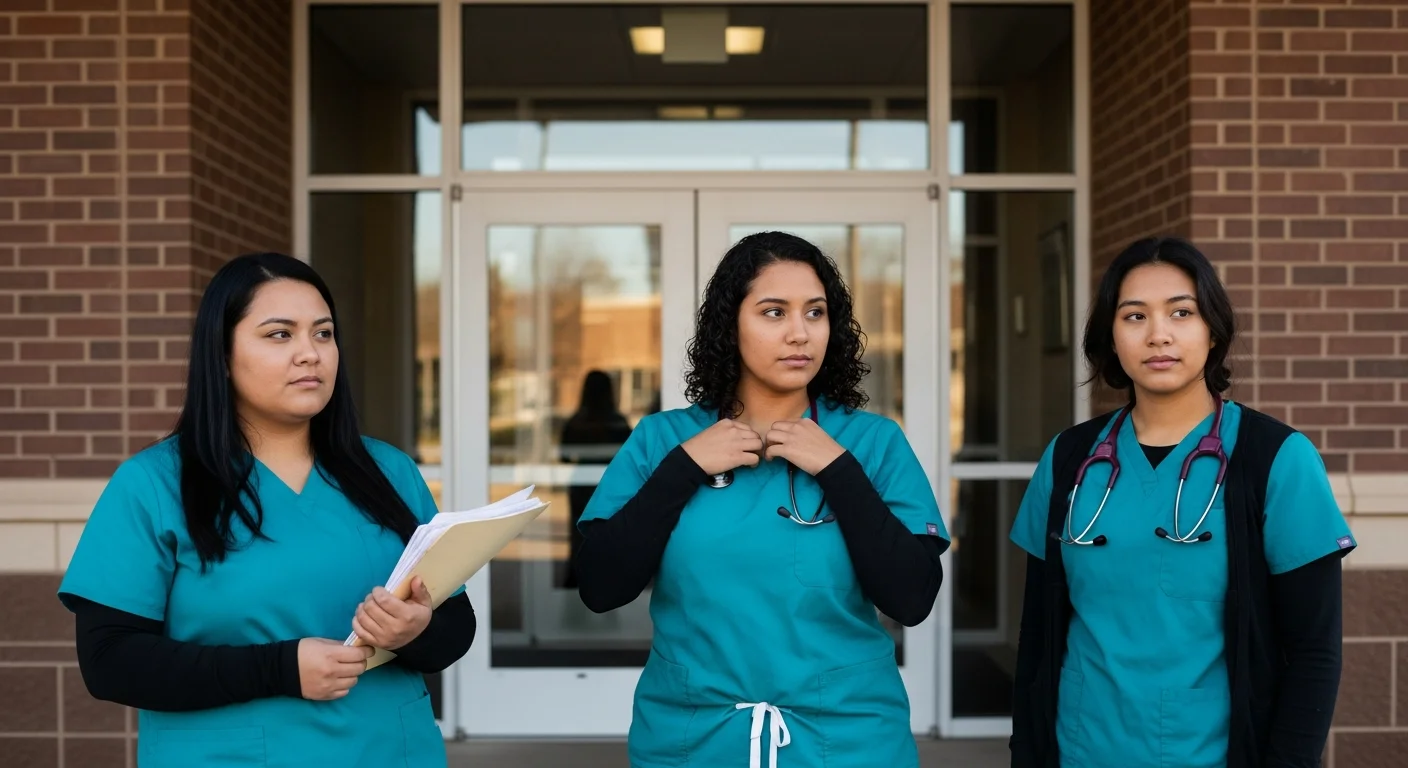
New Jersey CNA certification requires 90 hours of approved training, a two-part competency exam administered by PSI Services, and listing on the NJ Nurse Aide Registry. This guide covers every step from eligibility to your first day of work, including training costs ($0 to $3,000+), financial aid options, the exam format, reciprocity for out-of-state CNAs, renewal requirements, and career outlook.
One important detail before you start: New Jersey does not require certification for nurse aides working in acute care hospitals. Certification is required only in licensed long-term care facilities and certain sub-acute hospital units.
| Requirement | Detail |
|---|---|
| Training | 90 hours (50 classroom + 40 clinical) through an approved NATCEP |
| Exam | PSI Services two-part competency test (written/oral + skills) |
| Background check | Criminal Background Investigation, N.J.A.C. 8:43I |
| Registry | NJ Nurse Aide Registry (maintained by NJDOH) |
| Timeline | Roughly 8-12 weeks from enrollment to working |
| Cost range | $0 (employer-sponsored) to $3,000+ (community college) |
| Renewal | Every 2 years |
What Does a CNA Do in New Jersey?
Certified nurse aides in New Jersey assist patients with activities of daily living under the supervision of a licensed nurse. That includes helping with bathing, dressing, feeding, and toileting; taking and recording vital signs; assisting with mobility and transfers; and reporting changes in a patient’s condition to nursing staff. For more background on what a CNA does before diving into NJ’s specific requirements, that resource has you covered.
Most certified CNAs in New Jersey work in nursing homes, assisted living facilities, rehabilitation centers, home health agencies, and sub-acute hospital units.
One NJ-specific detail you should know: New Jersey does not require nurse aide certification to work in an acute care hospital. Hospitals train their nurse aides through the NJ Board of Nursing’s UAP (Unlicensed Assistive Personnel) curriculum instead, under Hospital Licensing Standards N.J.A.C. 8:43G-18.3(e),(f). If you plan to work in a nursing home, assisted living facility, or sub-acute unit, you’ll need a CNA license in New Jersey.
The certification path for long-term care settings involves three milestones: 90 hours of NATCEP training, passing the PSI competency exam, and getting listed on the NJ Nurse Aide Registry. Here’s what each step requires.
FIND CNA PROGRAMS IN NEW JERSEY
Compare CNA Programs in Your Area
You’ve read the full guide — requirements, costs, exam format, and career outlook. Find accredited programs near you.
Local programs • Compare on your schedule • No obligation
Sponsored Ad
New Jersey CNA Certification Requirements
To sit for the NJ CNA competency exam, you need to complete a state-approved NATCEP (Nurse Aide in Long Term Care Facilities Training and Competency Evaluation Program) and clear a criminal background check. Here are the core requirements:
| Requirement | What It Means |
|---|---|
| Training program | 90 hours through a state-approved NATCEP |
| Classroom hours | 50 hours minimum |
| Clinical hours | 40 hours supervised, in a licensed long-term care facility |
| Exam | Two-part PSI competency exam (written/oral + skills) |
| Background check | Criminal Background Investigation under N.J.A.C. 8:43I |
| Character requirement | Good moral character (NJ-specific language) |
New Jersey’s 90-hour requirement exceeds the 75-hour federal minimum set by 42 CFR § 483.152. That means NJ’s standard is stricter than baseline Medicare and Medicaid requirements. For a general overview of how CNA training and certification works nationally, that’s a useful starting point before the NJ-specific details below.
Eligibility and Background Checks
Before you can work as a CNA in a New Jersey long-term care facility, you’ll need to complete a criminal background check through the state’s Criminal Background Investigation Program, governed by N.J.A.C. 8:43I. The check includes fingerprinting and a review of both state and federal criminal records.
The background check is required before employment, not necessarily before enrolling in training. Your training program will provide instructions on when and where to complete fingerprinting. Schedule your fingerprinting at IdentoGO.com using Service Code 2F1HSX (NJ DOH Health Care-Nurse Aide). The fee is currently $66.05, which covers both state and federal record searches. Under N.J.S.A. 26:2H-7.1, disqualifying crimes include first-, second-, and third-degree drug offenses, aggravated assault, and theft convictions. If you have a criminal record and are unsure of your eligibility, contact NJDOH before paying for training, not after.
Alternative routes to certification: The NJ Department of Health recognizes pathways that may allow you to skip the full 90-hour program:
| If you are… | You may be eligible to… |
|---|---|
| A nursing student who completed a clinical rotation including a fundamentals of nursing course | Sit for the PSI exam without completing a NATCEP program |
| A military-trained nurse aide with qualifying documentation | Apply for an alternative certification pathway |
| A current NJ Certified Homemaker-Home Health Aide (CHHA) | Apply for a training waiver |
If any of these situations apply to you, contact NJDOH directly before enrolling in a full training program.
Once you’ve confirmed you qualify, the next step is finding an approved program and understanding what it will cost.
CNA Training Programs in New Jersey
CNA training in New Jersey must be completed through a state-approved NATCEP program. Not all programs that advertise CNA training in New Jersey meet this standard. Completing a non-approved program means you can’t sit for the PSI competency exam.
What Training Covers
The 90-hour program includes 50 hours of classroom instruction and 40 hours of supervised clinical practice in a licensed long-term care facility. The clinical hours must be completed in person under nurse supervision; simulation labs cannot substitute.
Curriculum areas include: communication skills, patient rights, safety and emergency procedures, basic nursing skills, restorative services, mental health and social service needs, and infection control. Federal regulations under 42 CFR § 483.152 require a minimum of 16 hours specifically in communication, infection control, resident rights, and safety and emergency procedures.
Full-time programs typically complete the 90 hours in 6-9 weeks. Part-time and evening programs, like those offered by the Healthcare Training Institute (HTINJ), run approximately 2 months with AM/PM schedule options. If you’re weighing your options, how to choose a CNA program walks you through what to look for in an approved program. For readers interested in flexible formats, see online CNA classes, though note NJ requires the 40 clinical hours to be completed in person.
Training Costs and Program Types
The cost of CNA training in New Jersey depends entirely on which program type you use:
| Program Type | Cost | Duration | Key Detail |
|---|---|---|---|
| Employer-sponsored (LTC facility) | $0 | 6-9 weeks | Employment commitment required (typically 6-12 months) |
| WIOA-funded (One-Stop Career Center) | $0 or reduced | Varies | Eligibility requirements; apply in person at local One-Stop |
| Community college (e.g., CCM) | ~$3,000 + $99 screening fee | 6-9 weeks | Class limited to 10 students; DOL-approved for WIOA vouchers |
| Private vocational school (e.g., HTINJ) | Call for pricing | ~2 months | AM/PM schedules; tuition not publicly listed |
County College of Morris charges approximately $3,000 plus a $99 screening fee for their 6-9 week program, with classes capped at 10 students. CCM is approved by the NJ Department of Labor for WIOA training vouchers, meaning eligible applicants may attend at reduced or no cost.
A note on CNA apprenticeships: New Jersey does not have a formal CNA apprenticeship program registered with the Department of Labor. Employer-sponsored training at long-term care facilities functions similarly. You enter employment, the facility covers training, and you earn a credential while building work history.
To find approved NATCEP programs near you, start with the NJ Department of Health’s Nurse Aide/Personal Care Assistant resources page to verify that any program you’re considering is currently state-approved. Cross-reference before enrolling or paying any deposit. You can also browse New Jersey CNA programs on our state page to compare options.
Free CNA Training Options in New Jersey
“Free CNA training” in New Jersey is real, but it’s not unconditional.
Employer-sponsored training is the most common free option. Long-term care facilities hire trainees as employees and cover the full NATCEP cost in exchange for an employment commitment, typically 6-12 months after certification. Some facilities also cover textbooks, scrubs, and the screening fee. The catch: if you leave before the commitment period ends, some employers have clawback clauses that require you to repay training costs. Ask about this in writing before you sign.
WIOA funding through NJ One-Stop Career Centers covers tuition at approved programs for unemployed or underemployed NJ residents. Eligibility is determined at your local One-Stop Center in person; there’s no online application. If you qualify, WIOA can cover community college tuition entirely, including CCM.
“My New CNA starter pack! Excited to be starting classes soon! Let me know if I’m missing anything”
(524 upvotes, Reddit user, r/cna)
The excitement of starting is real, and knowing your costs upfront makes it easier to commit. If the cost is still a barrier beyond employer sponsorship or WIOA, the next section covers additional financial options.
Ready to Compare CNA Programs?
View accredited training options near you — costs, schedules, and program details.
How to Pay for CNA Training in New Jersey
If the $3,000 community college price is a barrier, most NJ residents have options that bring that cost down significantly, or to zero.
WIOA Funding and Government Vouchers
WIOA (Workforce Innovation and Opportunity Act) is a federal workforce training program administered locally by the NJ Department of Labor through its One-Stop Career Centers. If you’re unemployed or underemployed, you may qualify for a training voucher covering CNA program tuition at approved schools.
To access WIOA funding, visit your local One-Stop Career Center in person with documentation of your employment status. County College of Morris specifically notes their DOL-approved status, so WIOA vouchers are accepted there.
If you’re enrolling at a community college, also check whether you qualify for FAFSA-based financial aid or the New Jersey Tuition Aid Grant (TAG) through the NJ Higher Education Student Assistance Authority. Some CNA programs at community colleges are eligible for state grant funding. A CNA scholarship resource may also surface additional options worth exploring.
What “Free Training” Really Means
Employer-sponsored training is free upfront, but it comes with an employment agreement. You’re committing to work there for a set period, typically one year, after you receive your certification.
If you leave before that window, some facilities invoke a clawback clause and require repayment of training costs. This is standard practice in NJ long-term care, and it surprises people who didn’t read the fine print. WIOA has eligibility requirements and sometimes waitlists. Neither option is unconditionally free.
The commitment is usually reasonable: you’re entering a field anyway, and one year of experience at a facility that trained you builds your resume at the same time.
“Hello.. my name is Eric and I’ve decided to embark on this journey to help people who need it.. also to help myself in the future and to care for my mother that is ill. I’m currently enrolled in a 4 week course and I’m feeling comfortable but anxious at the same time.”
(551 upvotes, Reddit user, r/cna)
People start this path for different reasons, and finding the right funding route makes the difference between starting and not starting. With training funded, the next step is the state certification exam.
New Jersey CNA Certification Exam
The NJ CNA competency exam is administered by PSI Services, LLC under contract with the NJ Department of Health. You must pass both parts to be listed on the NJ Nurse Aide Registry. Failing one part doesn’t eliminate the other; you can retake only the section you didn’t pass. For a full breakdown of the CNA certification exam format, scoring, and what to expect, that resource covers it in depth.
Written or Oral Exam
The written exam is multiple-choice, covering topics from your 90-hour training curriculum: communication, patient rights, safety, basic nursing skills, restorative services, infection control, and mental health concepts. An oral exam option is available for candidates who need it; contact PSI to arrange this accommodation.
Skills Evaluation
The clinical skills evaluation requires you to demonstrate a set of randomly selected nursing skills in front of a trained evaluator. Skills that may be tested include hand hygiene, vital sign measurement (including manual blood pressure), patient positioning, transfers, personal hygiene tasks, and catheter care.
Because the selection is random, you need to be prepared for all skills, not just the ones you practiced most. Your 40 hours of supervised clinical practice exist specifically to build repetition across the full range. For targeted preparation on the clinical portion, the CNA skills test guide walks through what evaluators look for on each skill.
“Any tips or tricks to doing manual blood pressure? I always seem to have the cuff put on too loose”
(551 upvotes, Reddit user, r/cna)
If a specific skill is giving you trouble, you’re in good company. The PSI Candidate Information Bulletin lists all testable skills; use it as your prep checklist. Your training program may also offer open lab hours for additional practice before exam day.
Exam Registration and Preparation
Exam fees: Check the PSI Candidate Information Bulletin for current NJ CNA exam pricing. Fees apply separately for the written/oral portion and the skills evaluation. Retakes are charged per section, so you only pay for the part you need to retake. If you trained through an employer-sponsored program, ask whether exam fees are included in your sponsorship agreement.
Register for the NJ CNA exam through the PSI candidate portal or by calling PSI at 1-877-774-4243. Download the Candidate Information Bulletin from the PSI website; it covers every testable skill, exam policies, and what to bring on test day.
For written exam prep, the CNA practice exam helps you get familiar with the question format. The how to study for the CNA exam guide covers both the written and skills sections.
On test day: bring a valid government-issued photo ID, arrive early, and follow PSI’s guidelines on what you can and cannot bring into the testing area.
“just wanted to say i’ve officially passed all the tests and i am a registered cna. i’m 17 in HS and went through a career and technology program in my school where i can get my cna. i’m low key proud of myself… to anyone else reading this: you’re doing amazing!”
(671 upvotes, Reddit user, r/cna)
The exam pressure is real, but so is the relief on the other side. With both parts passed, PSI submits your results to NJDOH for registry listing.
If you’re already certified in another state, you may be able to skip NJ training and testing entirely.
CNA Reciprocity in New Jersey
New Jersey CNA reciprocity is available for out-of-state certified nurse aides who want to transfer their credentials to NJ. The state offers two distinct pathways, and which one applies to you depends on whether you have recent CEU credits or recent employment history.
Both routes require that your current CNA certification is in good standing with no findings of abuse, neglect, or misappropriation of resident property. For out-of-state CNAs wondering about the testing vendor in their home state, NNAAP exam vendors by state can help you identify your state’s system. For questions about your NJ application, call 1-877-774-4243.
Route 1: CEU-Based Reciprocity
If you’ve completed 24 hours of approved continuing education (CEUs) within the past 24 months, you can apply for NJ reciprocity without taking the NJ competency exam.
Your 24 hours must include 12 hours in Alzheimer’s disease and dementia care, plus 12 hours across these five topics: infection control, emergency procedures, abuse and neglect prevention, resident rights, and pharmacy. Route 1 does not require a new NJ exam. You submit your application with proof of your current certification and CEU completion certificates.
Route 2: Employment-Based Reciprocity
If you don’t have the CEU hours but have extensive recent work history, Route 2 applies. Requirements:
- 24 months of full-time CNA employment (35+ hours per week) in another state within the 24 months preceding your application
- Employment in a nursing home setting, supervised by a licensed nurse
- You must also pass the NJ clinical skills and written/oral competency exam
Route 2 requires passing the NJ exam. Route 1 does not. This distinction matters most if you’re deciding which route to pursue.
Which Route Is Right for You?
| Your Situation | Route | NJ Exam Required? |
|---|---|---|
| Have 24 hours of qualifying CEUs in the last 24 months | Route 1 | No |
| Have 24 months of full-time CNA work (35+ hrs/week) but fewer CEUs | Route 2 | Yes |
| Have both qualifying CEUs and qualifying employment | Route 1 | No (fastest path) |
New Jersey considers reciprocity applicants from any state, but approval is not automatic. Your out-of-state certification must be active and in good standing, and you must meet NJ’s route-specific requirements for CEUs or work history. To apply, visit the NJDOH Nurse Aide reciprocity page for the application form and required documents. For Route 1, submit proof of your current certification and CEU completion certificates. For Route 2, submit employment verification letters showing 24 months of qualifying work. Call 1-877-774-4243 if the online instructions don’t cover your situation. CNAs transferring from New York or Pennsylvania should check their current state’s renewal status before applying, as both routes require active certification in good standing.
New Jersey Nurse Aide Registry
The New Jersey Nurse Aide Registry is a database maintained by the NJ Department of Health listing all certified nurse aides authorized to work in New Jersey’s licensed long-term care facilities. You can search it by name at any time.
How to Verify Your Certification
Go to newjersey.mylicense.com and search by your name. This is the same portal employers use to verify your credentials; what you see is what your employer sees. Under NJ regulations, employers are legally required to check CNA status on the registry before hiring you.
If you’ve recently passed your PSI exam and don’t see your name yet, it typically takes two to four weeks for PSI to transmit results to NJDOH for processing. You can call PSI at 1-877-774-4243 to confirm your pass status and request a results letter for potential employers while you wait. Many facilities will hire you with a results letter before your registry listing is active.
What the Registry Shows
Your registry record includes four data points: name, certification status, certification date, and findings. The findings field shows any substantiated reports of abuse, neglect, or misappropriation of resident property. If you have no findings, your record is clean.
Substantiated findings are permanent and visible to any employer who searches your name. No separate application is needed after passing your PSI exam; PSI submits results directly to NJDOH for listing.
Getting on the registry is the milestone. Staying on it requires meeting renewal requirements every two years.
CNA License Renewal in New Jersey
New Jersey CNA certification renews every 2 years. To keep your CNA license in New Jersey active, you must meet four requirements before your expiration date:
- Work at least one 8-hour shift (or 7 paid days) providing nursing or nursing-related services within the 24 months preceding your expiration date
- Complete 12 hours of annual in-service training set by your employing facility, typically covering infection control, resident rights, safety, and clinical skills updates
- Complete a criminal background check with fingerprinting under N.J.A.C. 8:43I before your expiration date
- Submit your renewal through the NJDOH renewal portal, where online renewal is available
The renewal application itself has no fee. The background check fingerprinting costs $66.05 at IdentoGO (Service Code 2F1HSX). Your annual in-service education is typically provided by your employer at no cost to you.
Clarification on in-service hours: The 12-hour requirement is per year, meaning you need 24 total hours of in-service education over your 2-year renewal cycle. If you’re employed, your facility typically provides this training at no cost. If you’re between jobs, you’ll need to complete CEUs independently through an approved provider and keep documentation.
What to keep for renewal:
– Pay stubs or employer records showing at least one qualifying 8-hour shift within the 24-month period
– Certificates or sign-in sheets documenting your in-service hours
– Background check/fingerprinting confirmation
– Any renewal notice or confirmation from the NJDOH portal
When to start: Check your expiration date on the registry portal and begin the renewal process at least 30 days before it expires. Do not wait until the last week. Portal processing, employer verification, or background check delays can cause a lapse.
What happens if your certification lapses? If you don’t meet the employment requirement, your certification is not eligible for standard renewal. You’ll need to retake and pass the PSI competency exam to be re-listed on the registry. You don’t need to repeat the full 90-hour training if your original NJ NATCEP training was completed at an approved program. Contact NJDOH to verify your reinstatement pathway before scheduling anything with PSI.
With your certification active, here’s what the NJ CNA job market looks like.
CNA Career Outlook in New Jersey
Here’s what CNA pay looks like in New Jersey, according to Bureau of Labor Statistics data:
| Metric | Amount |
|---|---|
| Mean hourly wage | $18.98/hr |
| Mean annual wage | $39,480/yr |
| NYC-Newark-Jersey City metro | $44,720/yr ($21.50/hr) |
| NJ vs. national average | 9% above |
| Entry-level (10th percentile) | $32,440/yr |
| Experienced (90th percentile) | $47,230/yr |
For a complete breakdown by metro area and facility type, see our CNA salary in New Jersey guide.
“CNA salaries are already at least a decade behind what they should be… I’ve only made around 13K in the past 6 months as a PCT, and that’s on full time night shift! Looked up my hospitals profits, and they make 98 million profit AFTER paying salaries and other costs.”
(224 upvotes, Reddit user, r/cna)
CNA pay is a real concern, and NJ’s cost of living makes the numbers feel tighter than they look. New Jersey ranks among the top three states for cost of living nationally, so $39,480 goes further in some parts of the state than others. The salary guide covers that regional math in detail.
The career ladder is where the math changes. From CNA, your options in New Jersey include:
| Advancement | Path | Approximate Time |
|---|---|---|
| Medication Aide | Additional certification, no degree required | Weeks to months |
| Licensed Practical Nurse (LPN) | Community college program | ~1 year |
| Registered Nurse (RN) | Associate or bachelor’s degree | 2-4 years |
New Jersey has multiple LPN and RN bridge programs specifically designed for working CNAs. CNA certification also gives you clinical hours that count toward nursing school requirements in many programs. The role is one of the most AI-proof jobs without a degree available in healthcare, involving physical, hands-on care that machines can’t replicate.
On the demand side: according to U.S. Census Bureau data, 17.4% of New Jersey’s population is 65 or older, and the state is the most densely populated in the nation. That combination sustains consistent CNA demand across LTC, home health agencies, and assisted living. If you’re still evaluating whether the field is right for you, see why become a CNA in New Jersey for a fuller picture.
“I’ll be starting class soon to be a CNA and everytime I mention it people use the remarks ‘you like to wipe ass?!’ ‘Oh don’t they just clean ass?’ I know the duties both my parents were CNAs and they talked about their job. Cleaning someone who needs care does not disgust me. I see it as giving them care.”
(851 upvotes, Reddit user, r/cna)
If you’ve made it through this guide, you already know the work is demanding and the pay has real limitations. The people who stay in this career tend to see the work the way this reader does: not as a burden, but as care. New Jersey needs CNAs who see it that way.
CNA PROGRAMS AVAILABLE IN NEW JERSEY
Find CNA Training Programs Near You
Enter your zip code to compare accredited CNA programs in New Jersey. View costs, schedules, and requirements.
Programs near you • No obligation to enroll
Sponsored Ad