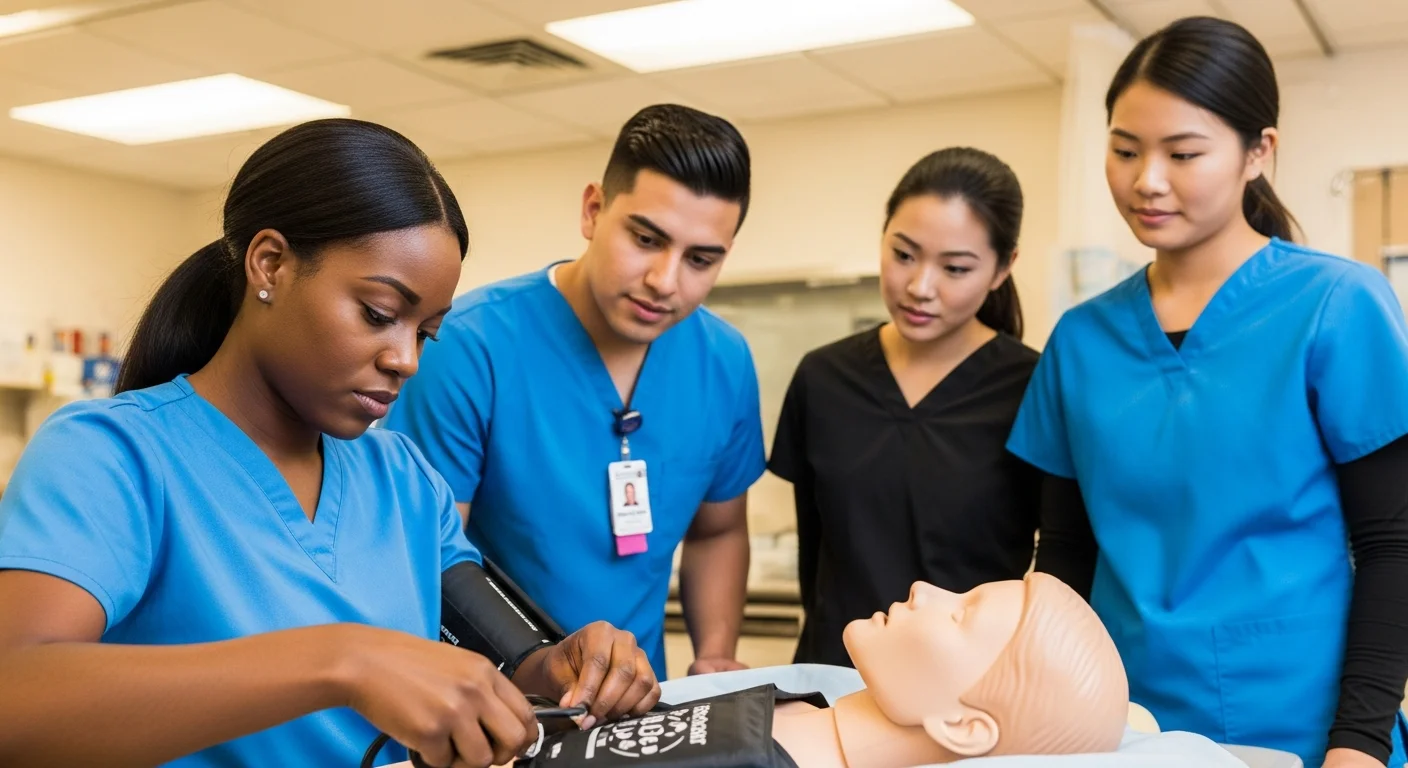
To become a certified nursing assistant in Nevada, you need to complete a state-approved training program of at least 75 hours, pass the Credentia competency evaluation, and get listed on the Nevada Nurse Aide Registry. From the day you enroll to your first day on the job, most people finish in 2 to 6 months. This guide covers every step, including approved programs, the exact exam format, realistic costs, and what you’ll earn once you’re working.
What Does a CNA Do in Nevada?
A certified nursing assistant provides direct patient care under the supervision of a licensed nurse. In Nevada, you’ll find CNAs working across four main settings: hospitals, long-term care facilities, home health agencies, and assisted living communities.
In hospitals, CNAs support nurses caring for patients recovering from surgery, illness, or injury. You’ll take vital signs, help patients move safely, assist with bathing and grooming, document observations, and flag changes in condition to the nursing team. The pace is fast and the patient mix changes frequently.
In long-term care (LTC) facilities, you’ll build ongoing relationships with residents who need daily support with activities like dressing, eating, and mobility. The work is physically demanding and emotionally rich. You often become a consistent, trusted presence in residents’ lives over months or years.
Home health CNAs provide one-on-one care in a client’s residence. Scheduling is flexible, but you work with more independence and fewer teammates nearby. Home health tends to attract CNAs who prefer a quieter pace and a closer relationship with individual clients.
In assisted living, CNAs support residents who need help with daily activities but do not require skilled nursing care. The pace is typically steadier than a hospital or LTC facility, and resident relationships tend to be long-term.
Under Nevada law, CNAs work under the supervision of a licensed nurse (RN or LPN). According to Nevada State Board of Nursing regulations (Nevada Administrative Code Chapter 632), CNAs can take vital signs, assist with activities of daily living, document patient conditions, and report changes in status. CNAs cannot administer medications, perform clinical assessments, or make independent care decisions.
Where you start working matters more than most training programs will tell you.
“If you are a brand new aide, and you choose to work for an agency rather than a facility, you will be thrust into a work environment that is much more sink than it is swim.”
(195 upvotes — Reddit user)
That is why understanding the differences between hospitals, long-term care facilities, and home health agencies before you start training can save you from a rough first few months. Here is how the certification process works in Nevada.
Nevada CNA Requirements at a Glance
Nevada requires completion of a state-approved training program and passing the Credentia competency evaluation. Here is everything at a glance.
| Requirement | Details |
|---|---|
| Training Hours | 75 minimum per NAC 632.736 (most programs offer 100-120) |
| Approved Programs | Community colleges, private schools, facility-based academies |
| Minimum Age | 16 (TMCC), 18+ (most programs) |
| Exam Vendor | Credentia |
| Written Exam | 70 questions, 120 minutes |
| Skills Exam | Clinical skills demonstration |
| Cost Range | $800-$5,200 (tuition only); $1,500-$6,000 total |
| Timeline | 4-16 weeks training + exam scheduling |
| Certification Body | Nevada State Board of Nursing (NSBN) |
| Registry | Nevada Nurse Aide Registry (NDPBH) |
Each requirement is covered in detail below. If you are ready to start, jump to Step 1: Training Programs.
✓ CNA PROGRAMS AVAILABLE IN NEVADA
Find CNA Training Programs Near You
Enter your zip code to compare accredited CNA programs in Nevada. View costs, schedules, and requirements.
Programs near you • No obligation to enroll
Sponsored Ad
Step 1: Complete a State-Approved Training Program
Nevada’s Training Hour Requirements
Nevada requires at least 75 hours of state-approved training per NAC 632.736, split between classroom instruction and supervised clinical practice at a healthcare facility. Most community college programs exceed this minimum at 100 to 120 hours. Clinical hours must always be completed in person. There is no path to Nevada CNA certification through purely online training.
Prerequisites You’ll Need
Before starting a program, most schools require several prerequisites. Budget 2 to 4 weeks and $200 to $500 extra if these are not already in place:
- Background check — $20-$70, processed through the Nevada Nurse Portal
- Immunizations — MMR, Varicella, Hepatitis B, Tdap, and annual flu shot
- TB test — Required by most programs before clinical placement
- CPR/BLS certification — $50-$100, American Heart Association or Red Cross
- Government-issued ID — Required for both program enrollment and exam registration
Approved Nevada CNA Programs
Nevada has dozens of state-approved CNA programs across community colleges, private trade schools, and healthcare facilities. The Nevada State Board of Nursing maintains the current approved list. Always verify a program’s approval status before enrolling. Here are the major community college and institutional programs:
| Program | City | Duration | Cost (In-State) | Min. Age | Format |
|---|---|---|---|---|---|
| College of Southern Nevada (CSN) | Las Vegas | Varies | $3,500-$5,200 | Contact program | Campus |
| UNLV Lifelong Learning (Perry Foundation) | Las Vegas | 4 weeks | $2,650 | 18+ | Hybrid |
| Pima Medical Institute | Las Vegas | ~6 weeks | Contact program | Contact program | Campus |
| Truckee Meadows Community College (TMCC) | Reno | 1 semester | Contact program | 16+ | Campus |
| Great Basin College (GBC) | Elko (multiple locations) | Varies | $3,100-$4,700 | Contact program | Campus |
| Western Nevada College (WNC) | Carson City | Varies | Contact program | Contact program | Campus |
This is not a complete list. Private programs and facility-based training academies (some at no cost to the student) also hold NSBN approval. Check the NSBN approved program list for all current options in your area.
The Las Vegas metro has three options listed above (CSN, UNLV, Pima), plus private vocational schools. Reno is served by TMCC. Rural Nevada is primarily served by GBC and WNC.
UNLV’s program through the Perry Foundation offers online coursework with in-person clinical rotations, the only hybrid format among Nevada’s major approved programs. All other programs listed here are campus-based. Regardless of program format, clinical hours are always completed in person at a healthcare facility.
Where cost is listed as “Contact program,” the school has not published current tuition publicly. Contact the school directly before enrolling. UNLV at $2,650 is the most affordable option with publicly listed tuition. For help evaluating which program fits your schedule and budget, see our guide to choosing the right CNA program.
How to Verify a Program Is State-Approved
Before enrolling anywhere, confirm state approval by checking the Nevada State Board of Nursing’s approved program list directly. A program that is not on the NSBN list will not qualify you to take the Credentia exam. Your training hours will not count.
Step 2: Pass the Nevada CNA Competency Evaluation
After completing your training, you will take the Nevada Nurse Aide Competency Evaluation. Nevada’s exam is administered by Credentia, not Prometric or Headmaster. The exam has two separate components: a written test and a clinical skills demonstration.
Written/Oral Exam — 70 Questions, 120 Minutes
The written exam consists of 70 questions with a 120-minute time limit, according to Credentia. Questions cover activities of daily living, basic nursing skills, communication, infection control, safety, and patient rights.
A portion of the questions are unscored pilot questions mixed in with the scored questions. You will not know which questions are scored and which are not. Answer every question as if it counts.
Clinical Skills Demonstration
The skills evaluation tests your ability to perform hands-on care tasks in front of an evaluator. Common skills include hand hygiene, vital signs measurement, patient positioning, ambulation assistance, and personal care tasks. You will be told in advance which skills you need to demonstrate on exam day.
For step-by-step breakdowns of each skill, see our CNA skills test guide. For an overview of how the national exam framework works, see our CNA exam overview.
How to Schedule Through CNA365
After completing your program, schedule your exam through the CNA365 portal on Credentia’s website. You will need your training program completion certificate to register. Budget 1 to 4 weeks between program completion and your test date depending on site availability.
Prepare with our free CNA practice exam to build confidence before test day. For a structured study plan, see our guide on how to study for the CNA exam.
What Happens If You Don’t Pass
If you do not pass on the first attempt, you retake only the component you failed. Nevada allows up to three attempts per component. If you fail either part three times, you must complete additional training before testing again. Retake fees are charged per component. Check Credentia for the current fee. You can schedule a retake as soon as the next available test date.
Step 3: Get Listed on the Nevada Nurse Aide Registry
Once you pass both exam components, you will be listed on the Nevada Nurse Aide Registry, maintained by the Nevada Division of Public and Behavioral Health (NDPBH). This listing is what employers verify before they hire you.
Apply through the Nevada Nurse Portal at nvbn.boardsofnursing.org. You will need your exam results and training program documentation. Registry processing typically takes several business days. Once listed, employers can verify your certification status through the same portal at any time.
A common point of confusion: The Nevada Nurse Portal (nvbn.boardsofnursing.org) handles your licensing and certification. The Nevada Registry (ww2.nevadaregistry.org) is a separate professional development registry that tracks training hours and continuing education. Employers checking your CNA certification use the Nurse Portal, not the Nevada Registry.
Your registry listing confirms you have met Nevada’s certification requirements. Most employers will verify your status before your first shift.
For ongoing license management, including verifying your certification status, renewing before it lapses, or transferring your CNA from another state, see our complete guide to Nevada CNA license verification, renewal, and transfer.
How Long Does It Take to Become a CNA in Nevada?
Most people become a CNA in Nevada within 2 to 6 months, depending on the program format and exam scheduling availability. Here is the full phase-by-phase timeline:
- Enroll in a state-approved program (1-2 weeks) — Application and prerequisites can often run concurrently
- Complete training (4-16 weeks) — UNLV’s accelerated program takes 4 weeks; semester-length programs at CSN, TMCC, or GBC take up to 16 weeks
- Schedule and pass the Credentia exam (1-4 weeks) — Budget for potential delays during busy enrollment periods
- Get listed on the Nevada Nurse Aide Registry (1-2 weeks) — Processing time after exam results are confirmed
Fastest path: UNLV’s 4-week program followed by immediate exam scheduling can have you certified in as few as 7 to 8 weeks from enrollment.
Part-time path: Semester-based programs at CSN or TMCC take 16 or more weeks but allow you to work or take other classes at the same time.
The CNA training and certification timeline in Nevada is one of the fastest entry points into healthcare available.
How Much Does It Cost to Become a CNA in Nevada?
The total cost to become a CNA in Nevada ranges from approximately $1,500 to $6,000, depending on your training program and which prerequisites you still need.
Itemized Cost Breakdown
| Cost Category | Estimated Range |
|---|---|
| Tuition (state-approved program) | $800-$5,200 |
| Credentia Exam Fee | $100-$150 (verify current fee with Credentia) |
| Background Check | $20-$70 |
| Immunizations (if not current) | $100-$300 |
| CPR/BLS Certification | $50-$100 |
| Books/Supplies (scrubs, stethoscope) | $100-$200 |
| Total Estimated | $1,170-$6,020 |
That is a real financial commitment, especially for career changers. UNLV at $2,650 is the most affordable named option with published tuition. CSN and GBC run $3,100 to $5,200 for in-state students.
Financial Aid and Employer-Sponsored Options
Community college programs (CSN, TMCC, GBC, WNC) accept FAFSA and may qualify for Pell Grants. Some students qualify for workforce development funding through Nevada’s Department of Employment, Training, and Rehabilitation (DETR).
Some long-term care facilities and hospitals hire candidates first and pay for CNA training as a condition of employment. Ask about employer-sponsored training when you apply to facilities. This path requires zero upfront cost and gets you paid during training.
The cost of training is typically recovered within one to two months of working as a CNA at Nevada’s average wage.
Comparing CNA Programs in Nevada?
View accredited training options near you — costs, schedules, and program details.
CNA Salary in Nevada
Metro Area Comparison — Las Vegas vs Reno
According to BLS OEWS data, Nevada nursing assistants earn approximately $20.87/hour ($43,420/year) statewide. That is 10% above the national average of $39,530, placing Nevada among the higher-paying states for CNA work. Nevada employs approximately 8,670 CNAs statewide (BLS).
The Las Vegas-Henderson-Paradise metro area averages approximately $19.90/hour ($41,400/year), and Reno averages approximately $19.69/hour ($40,960/year), according to BLS OEWS data.
Salary by Facility Type
Work setting significantly affects both pay and day-to-day experience.
| Work Setting | Typical Hourly Range | Notes |
|---|---|---|
| Hospital | $18-$24/hr | Higher acuity, faster pace, harder to land without experience |
| Long-Term Care | $15-$20/hr | Consistent schedules, ongoing resident relationships |
| Home Health | $14-$19/hr | Flexible scheduling, one-on-one care, more independence |
| Agency/Staffing | $20-$30/hr | Premium pay, variable shifts, higher autonomy demands |
Evening and weekend shifts typically pay $1 to $3 per hour more. Holiday shifts carry additional premiums depending on the facility.
The numbers tell part of the story, but CNAs who have worked multiple settings describe the difference in starker terms.
“I finally made the switch to the hospital… I like it so much better than all of the shitty nursing homes I’ve worked at.”
(150+ upvotes — Reddit user)
Hospital positions tend to pay more, but they are also harder to land without experience. Many CNAs start in long-term care to build their resume, then transition to hospitals within 6 to 12 months.
At $19 per hour, a standard 40-hour week grosses about $760 before taxes. Reaching $1,000 per week requires overtime, shift differentials, or agency rates, all available in Nevada’s healthcare market but requiring extra hours or premium shifts.
Las Vegas cost of living context: $43,420 is above the national CNA average, but Las Vegas has a higher cost of living than many comparably sized cities. A single CNA supporting themselves can expect a modest but livable wage. Dual-income households have significantly more flexibility. Agency work at $20 to $30 per hour changes the math considerably for those who can manage variable scheduling.
Nevada CNA Career Pathways
CNA certification is the fastest entry point into healthcare in Nevada, and it opens multiple advancement paths, not just nursing.
The CNA certification opens more doors than most people realize when they start training.
“You have soooooo many options… Phlebotomist, Medical Assistant, Medical Coder, Unit Secretary/Clerk, Medical Office Receptionist”
(199 upvotes — Reddit user)
Here is how those paths look with Nevada-specific data:
| Pathway | Additional Training | Estimated NV Salary | Notes |
|---|---|---|---|
| Licensed Practical Nurse (LPN) | 12-18 months | $55,000-$65,000/yr (BLS) | Community college programs in NV; CNA experience counts |
| Registered Nurse — ADN | 2 years | $75,000-$90,000/yr (BLS) | CNA-to-RN bridge programs available |
| Registered Nurse — BSN | 4 years | $80,000-$100,000+/yr (BLS) | Some programs grant clinical credit for CNA experience |
| Medical Assistant | 6-12 months | $40,000-$50,000/yr (BLS) | Separate certification; different scope |
| Phlebotomist | 4-8 weeks | $38,000-$48,000/yr (BLS) | Short add-on; can complete alongside CNA work |
For more on the long-term value of the credential and Nevada’s job outlook, see why become a CNA in Nevada.
Whatever path you pursue, experienced CNAs agree on one thing.
“NEVER let your CNA lapse or expire — It’s so easy to keep current, and it’s your security blanket when something goes wrong.”
(199 upvotes — Reddit user)
Keeping your Nevada CNA certification active is straightforward. Here is exactly what you need to do.
Maintaining Your Nevada CNA Certification
To keep your Nevada CNA certification active, you must maintain paid employment as a CNA within the required timeframe set by the Nevada State Board of Nursing. If your certification lapses, you may need to retake the Credentia competency evaluation.
Renewal is handled through the Nevada Nurse Portal at nvbn.boardsofnursing.org. The process includes verifying your employment status and paying the renewal fee.
Transferring Your CNA to Nevada (Endorsement)
To transfer your CNA certification from another state, apply through the Nevada Nurse Portal. You will need:
- Active CNA certification in good standing from your current state
- Verification from your current state’s nurse aide registry (you must request this — Nevada cannot pull it)
- Proof that your original training met Nevada’s minimum hour requirement (if your state required fewer hours, Nevada may require additional training)
- A clear background check and fingerprinting
- The $50 non-refundable endorsement fee
The most common delay is waiting for your home state’s registry to send verification. Contact them early. For the complete process, see our Nevada CNA license guide.
✓ FIND YOUR CNA PROGRAM
Compare CNA Programs in Your Area
You have the full picture — requirements, costs, and salary. Find accredited training programs near you.
Local programs • Compare on your schedule
Sponsored Ad