Confused about what the CNA exam actually involves? Whether it’s understanding the two-part structure, knowing which testing vendor you’ll use, or figuring out what to study, you’re far from alone. This confusion is one of the most common concerns for CNA students preparing for their first attempt.
Drawing on state nursing board data, testing vendor protocols, and real student experiences, we’ll provide the clearest explanation of exam format, vendor differences, and realistic expectations available. By the end of this guide, you’ll understand exactly what to expect, how to prepare effectively, and why the majority of well-prepared students pass on their first attempt.
The relief many feel after passing resonates throughout the CNA community:
“I just passed my CNA exam. i’m literally so happy that i started to tear up LOL. I for sure thought i failed my Skills portion but I didn’t. I’m so excited for this chapter of my life. 😭😭” (1,350 upvotes)
This emotional response is completely normal. The CNA exam represents a significant career milestone, and anxiety about both portions is universal among test-takers.
What is the CNA Exam?
The CNA exam consists of two distinct parts: a written knowledge test and a clinical skills demonstration. Both portions must be passed to achieve certification.
What makes this structure important? You cannot become certified with only one portion complete. If you pass the written exam but not skills (or vice versa), you’ll retake only the failed portion. Your passing score remains valid while you prepare for your retry.
Most states schedule both portions on the same test day. Plan to spend 4-6 hours total at the testing center, from check-in through departure. The written portion typically happens first, followed by a brief break, then skills testing.
Understanding Testing Vendors
Your state determines which testing vendor administers your CNA exam. This is not a choice you make.
Three main vendors operate across the United States:
- Credentia/NNAAP: Serves 15+ states, including Pennsylvania, North Carolina, Georgia, and Washington
- Prometric: Serves Florida, New York, Michigan, Delaware, and Hawaii
- Headmaster/D&S: Serves Ohio, Arizona, California (southern region), and 15+ additional states
The exam content follows the same federal OBRA ’87 requirements regardless of vendor. Format details like question count and time limits vary, which we’ll explore in the written exam section.
Have you checked which vendor your state uses yet? This determines your registration portal and testing procedures.
Is the CNA Exam Hard?
Difficulty depends on preparation. According to Florida Board of Nursing data, 87.14% of first-time test-takers passed in Q1 2024 (81.5% clinical skills, 84.7% written). Arizona reported 85% written and 79% skills pass rates for 2023. National estimates place first-time pass rates between 70%-80%.
Why do these numbers matter? They prove that most well-prepared students succeed. This isn’t an impossible barrier; it’s an achievable milestone with focused study.
Here’s the paradox many students encounter: the written exam gets described as “common sense” by roughly 71% of successful test-takers, yet failures by just 1-2 questions happen regularly. The danger lies in overconfidence leading to under-preparation.
The “Common Sense” Myth
Students often underestimate the written portion because all mental energy focuses on skills anxiety. In my experience coaching hundreds of CNA candidates, this creates a dangerous imbalance.
Because skills demonstration feels more intimidating, many students assume the written will be easy. Since the written exam actually requires specific terminology knowledge and procedure understanding, under-prepared students fail despite solid clinical skills.
The reality? General knowledge helps with scenario questions, but you can’t pass on life experience alone. Medical terminology, specific procedure sequences, legal scope boundaries, and infection control protocols all require dedicated study.
Skills anxiety appears more prominently in student discussions. Many test-takers find the skills portion less intimidating after completion than they had anticipated. The actual challenge is managing anxiety while performing under observation.
Does this match your experience so far? Worried more about skills than studying for the written?
Every successful CNA started exactly where you are now, learning the exam structure and building a preparation plan. With the right approach, you can absolutely be in the 70-87% who pass on the first attempt.
Are You Actually Ready for Your CNA Exam?
Before diving into exam specifics, let’s assess where you actually stand. This 2-minute assessment evaluates your timeline, preparation level, and knowledge gaps to give you a personalized readiness score and custom study plan. No email required—get your results instantly.
Written Exam Structure & Content
The written exam tests your understanding of patient care principles, safety protocols, and the CNA’s professional role. Let’s break down exactly what you need to know.
Exam Format & Question Count
Question count varies by testing vendor:
| Vendor | Total Questions | Scored Questions | Time Limit | States Using |
|---|---|---|---|---|
| Credentia/NNAAP | 70 | 60 (plus 10 pretest) | 120 minutes | PA, NC, GA, WA, SC, VA, MD, and 8+ others |
| Prometric | 60 | 60 | 90 minutes | FL, NY, MI, DE, HI, CT, LA, and 3+ others |
| Headmaster | 75 | 75 | 90 minutes | OH, AZ, Southern CA, MN, WI, TN, and 15+ others |
What do these differences mean for you? If you’re testing with Credentia, you have more time per question (2 minutes each). Prometric and Headmaster require slightly faster pacing (1.5 minutes per question). All vendors test the same core content domains.
The pretest questions in Credentia exams don’t count toward your score. These unidentified questions help vendors evaluate potential future test items. You won’t know which are, so treat every question equally.
Content Domain Breakdown
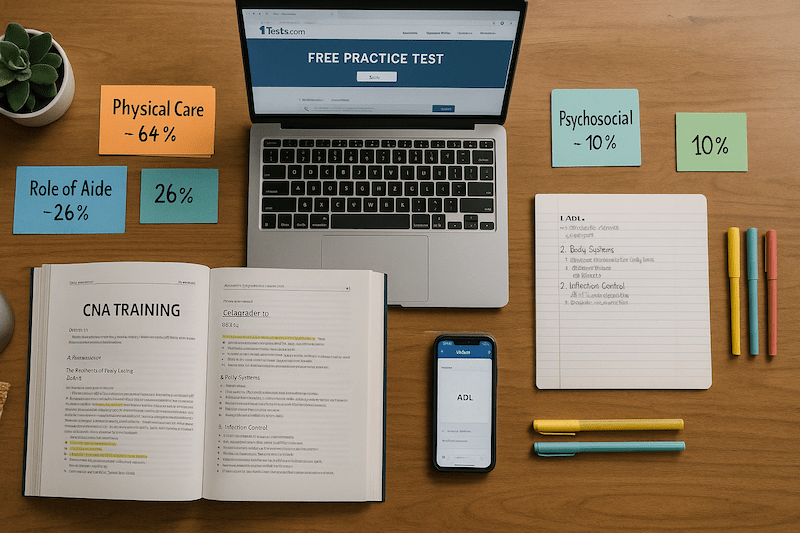
The Credentia 2024 NNAAP Content Outline details the specific knowledge areas tested. Understanding these percentages helps you prioritize study time.
Physical Care Skills: 64% of exam
This largest domain breaks down into three sub-categories:
- Activities of Daily Living (ADLs) – 22%: Bathing procedures, dressing assistance, feeding techniques, toileting support, grooming standards. Questions test proper sequence, safety precautions, and dignity preservation. Example: “When assisting a resident with bathing, what should be done FIRST?” The correct answer involves privacy and safety checks, not immediately starting the bath.
- Basic Nursing Skills – 35%: Vital signs measurement protocols, infection control procedures, positioning and transfers, catheter care, wound care basics. These application-based questions present “what would you do if…” scenarios. Example: “A resident’s blood pressure reads 160/95. What is your FIRST action?” Report to the nurse immediately, not continuing with other tasks.
- Self Care Skills – 7%: Restorative care principles, range of motion exercises, prosthetic and assistive device use. Questions emphasize maintaining resident independence versus doing everything for them.
Because Physical Care comprises nearly two-thirds of your exam, mastering ADLs and basic nursing skills directly impacts your passing score. Most test-takers find this domain most familiar from their clinical training.
Psychosocial Care Skills: 10% of exam
This domain covers:
- Emotional and Mental Health Support – 8%: Recognizing signs of depression, anxiety, or confusion. Responding appropriately to combative or withdrawn residents. Validation techniques versus reality orientation. Questions test understanding of therapeutic responses to behavioral changes.
- Spiritual and Cultural Needs – 2%: Respecting religious practices, cultural food preferences, and end-of-life wishes. Questions emphasize accommodation and respect rather than imposing your own beliefs.
Role of Nurse Aide: 26% of the exam
This professional practice domain includes:
- Communication – 7%: Proper reporting to nurses, documentation basics, communicating with residents who have sensory impairments. Questions test understanding of the chain of command and what MUST be reported immediately versus documented for later.
- Client Rights – 8%: Privacy, dignity, right to refuse care, informed consent, abuse reporting. Scenario-based questions present ethical dilemmas requiring you to identify the correct professional response.
- Legal and Ethical Behavior – 5%: HIPAA basics, scope of practice, mandatory reporting requirements, advance directives. Questions test boundary understanding of what CNAs CAN versus CANNOT do.
- Member of Healthcare Team – 6%: Working with nurses, following care plans, and interdisciplinary communication. Questions emphasize teamwork and following established protocols.
Question Types & Format Examples
Understanding question formats helps you recognize what evaluators are actually asking.
Scenario-Based Questions (Most Common):
“Mrs. Johnson refuses to eat breakfast. She says she’s not hungry and wants to sleep. What should the nurse aide do FIRST?”
- A) Insist she must eat for her health.
- B) Document the refusal and report to the nurse.
- C) Leave and return later
- D) Call the family to convince her
The correct answer is B. Since resident rights include refusing care, the CNA documents and reports, respecting the refusal while ensuring the nurse knows.
Application Questions:
“Which of the following actions breaks the chain of infection?”
- A) Washing hands before and after resident contact
- B) Using the same gloves for multiple residents
- C) Disposing of soiled linens in designated hamper
- D) Covering mouth when coughing
The correct answer is A. Hand hygiene prevents infection transmission, breaking the chain.
Prioritization Questions:
“A nurse aide observes a resident who is confused and trying to get out of bed without assistance. What should the aide do FIRST?”
- A) Restrain the resident
- B) Stay with the resident and call for help
- C) Document the behavior
- D) Tell the resident to stay in bed
The correct answer is B. Because fall prevention requires immediate intervention, staying with the resident while getting assistance prevents injury while respecting the resident’s rights.
Notice the keywords: FIRST, MOST important, BEST action. These signal prioritization questions ask what matters most in that specific situation.
Passing Score Requirements
Passing scores vary by state and vendor:
| State | Passing Score | Reporting Method | Vendor |
|---|---|---|---|
| California | 70% | Numeric score | Credentia/Headmaster |
| Florida | 72% (max 12 incorrect/60) | Pass/Fail | Prometric |
| New York | 70% | Pass/Fail | Prometric |
| Pennsylvania | Confidential | Pass/Fail only | Credentia |
| Ohio | 70% | Numeric score | Headmaster |
| Michigan | 74% | Numeric score | Headmaster |
| Illinois | Confidential | Pass/Fail only | SIU-C |
What if your state only reports pass/fail? This doesn’t mean the exam is easier. You still need to meet a cut score, you just won’t see exactly how many questions you missed. Focus on thorough preparation rather than score-chasing.
Most states require 70-72% to pass. With 60 questions, this means getting 42-43 correct and missing 17-18 questions results in failure.
“Common Sense” vs. Study Reality
Successful students emphasize consistent preparation:
“The written was 50 questions…not difficult as long as you knew the definition of quite a few terms. I just reviewed the terms 3-4 times and took about three mock tests. Passed with a 46/50.” (322 upvotes)
This approach works because it combines terminology review with practice test exposure to question formats, addressing both knowledge gaps and test-taking familiarity.
What DOES need study:
- Medical terminology: NPO (nothing by mouth), ROM (range of motion), perineal care, Fowler’s position, catheter care, ambulation
- Specific procedure steps and sequences: What comes FIRST in handwashing? In transfers? In feeding?
- Legal scope of practice: What can CNAs do versus what requires a nurse?
- Reporting requirements: What gets reported immediately versus documented for later?
- Infection control protocols: When should gloves, gowns, and masks be used? Proper PPE sequence?
The most common mistake I see is students assuming “common sense” means no study needed. General knowledge about being kind to elderly people doesn’t teach you proper catheter care protocols or HIPAA requirements.
Community consensus confirms that free resources work effectively. YouTube channels like Nurse Jar and 4yourCNA, combined with practice tests and Quizlet flashcards, provide sufficient preparation for most students. Expensive study guides aren’t necessary when you use free resources consistently.
Skills Exam Overview
The skills test requires you to demonstrate five randomly selected skills from a pool of 21-25 possible skills, plus mandatory handwashing. Both portions must be passed on the same day for certification.
Handwashing always appears first. This skill must be performed correctly, or you automatically fail the entire skills portion, regardless of how well you perform the other five skills. Since handwashing is always tested first, mastering this skill builds confidence for the rest of your exam.
What to Expect During Skills Testing
Skills are performed on a mannequin or volunteer patient while an evaluator scores each step using a standardized checklist. You demonstrate one skill at a time. Common skills include:
- Personal care: Bathing, dressing, oral care, feeding
- Vital signs: Blood pressure measurement, pulse, respiration, temperature
- Transfers and mobility: Ambulation with a gait belt, wheelchair transfers, positioning
- Restorative care: Range of motion exercises, assisting with walker use
Testing environments can vary significantly:
“I thought the skills exam was going to be a one-on-one with the evaluator, but instead, three testers were put into a cramped room, and one was the patient, and 2 of us were doing two different skills at the same time. I was just completely confused.” (95 upvotes)
This highlights why mental preparation matters as much as skill mastery. Check with your testing center about room setup if this concerns you.
Skills Anxiety is Normal
Most test-takers report significant anxiety about the skills demonstration. In my experience coaching CNA candidates, this fear of being watched while performing often overshadows written exam preparation. Many students report feeling less intimidated after completion of the skills portion than they anticipated during the anxiety buildup.
Each skill has “critical element steps” – actions essential for patient safety or dignity that must be performed correctly. Missing a critical element on any skill typically results in failing that skill. If you fail even one of the five skills, you fail the entire skills portion.
For complete skills preparation, including step-by-step breakdowns of all 21-25 testable skills, practice strategies, evaluator expectations, and test day performance tips, see our Complete CNA Skills Guide. This comprehensive resource covers everything from handwashing protocols to complex skills like catheter care and blood pressure measurement.
Practice With 600+ CNA Exam Questions
See exactly how this skill appears on the real test
Understanding Your Testing Vendor
You don’t choose your testing vendor; your state assigns one (Credentia, Prometric, or Headmaster). The vendor you use determines everything from the number of exam questions and time limits to your registration process and how you get your results. Each has a different online portal and unique procedures.
For a complete 50-state vendor directory and step-by-step registration guides for Credentia, Prometric, and Headmaster, see our CNA Exam Vendor Comparison Guide.
CNA Exam Costs & Fee Breakdown
Exam fees vary significantly by state and vendor. Complete financial transparency helps you budget accurately for this career investment.
Initial Exam Fees
| State | Combined Fee | Vendor | Notes |
|---|---|---|---|
| California | $120-$135 | Credentia/Headmaster | Varies by region |
| Florida | $155 | Prometric | Highest in the nation |
| Texas | Varies | State-specific | Contact the testing center |
| New York | $115-$135 | Prometric | Varies by testing center |
| Pennsylvania | $135 | Credentia | Standard statewide |
| Ohio | $100-$125 | Headmaster | Varies by testing center |
| National Average | $125-$150 | All vendors | Combined written + skills |
Retake Fees
If you need to retake one portion, fees are lower than the initial combined cost:
| Fee Type | Cost Range | Which Portion Failed |
|---|---|---|
| Written Retake | $35-$67 | Passed skills, failed written |
| Skills Retake | $68-$120 | Passed written, failed skills |
| Rescheduling Fee | $30-$35 | Changing the test date with notice |
| No-Show Penalty | Full fee forfeited | Missing without canceling |
Since you only retake the portion you didn’t pass, budgeting for potential retakes means planning for the lower retake fee, not the full combined cost.
Hidden Costs Often Overlooked
Many students budget only for the exam fee and encounter surprise expenses:
- Background check/fingerprinting: $20-$70 (varies by state, required for certification)
- Rescheduling fee: $30-$35 (if you need to change your test date)
- No-show penalty: Forfeit entire exam fee (don’t skip without canceling 24-48 hours ahead)
- BLS/CPR certification: $40-$50 (some employers require, not all)
Total Investment Calculation
Looking at the complete picture helps you budget realistically:
- CNA Training Program: $400-$1,500 (varies widely by state and program type – community colleges typically lowest)
- Background Check: $20-$70
- Exam Fees (first attempt): $115-$155
- BLS Certification (if required): $40-$50
- Total First-Time Cost: $575-$1,775
Students often express surprise at these combined costs:
“I had a lot of anxiety and question’s I couldn’t really find answers for… It cost me $500 for the program, $70 to get my fingerprints taken, 155 for the exam fee AND $50 for my BLS License. So roughly $785 total.”
Cost-Saving Options:
OBRA ’87 regulations allow employers to reimburse exam fees for employee-sponsored candidates. If your employer pays for your training, they often cover exam costs too. Ask your program coordinator about employer sponsorship opportunities.
Workforce development programs, unemployment offices, and vocational rehabilitation may cover costs for eligible participants. Check with your training program’s financial aid office about assistance options.
Because rescheduling costs less than forfeiting your full fee, cancel and reschedule if you need to miss your appointment. A $30-$35 rescheduling fee beats losing $115-$155 entirely.
Understanding logistics prevents test-day surprises.
Test Day Logistics & What to Bring
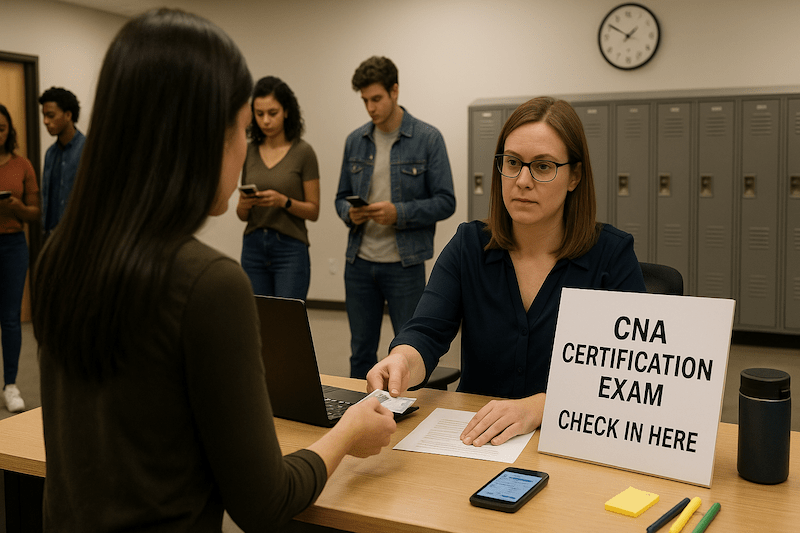
Test day preparation reduces anxiety and prevents problems at check-in. Most test-takers spend longer at the testing center than anticipated.
Plan for the Entire Day
Many students report the all-day commitment:
“On testing day you have to arrive to your testing facility 30 minutes before your start time. And plan on being there ALL DAY. They started testing us at 0930. I didn’t leave until 1530, I was literally the last person to take their skills test!” (288 upvotes)
Because the written portion, break, and skills testing happen sequentially with other test-takers, expect to spend 4-6 hours at the center from arrival through departure. Even though individual exams are short (written 60-120 min, skills 25-35 min), check-in, waiting between portions, and testing order create longer days.
Arrival Requirements
Testing centers require arrival 30 minutes before your scheduled start time. Late arrivals risk being turned away and forfeiting exam fees. Since arriving late means losing your exam slot and your money, build in extra travel time for traffic or parking challenges.
What to Bring
-
✓
Government-issued photo ID
Driver’s license, passport, or state ID – must match registration name exactly -
✓
Authorization to Test (ATT)
Letter or confirmation number -
✓
Pencils
#2 if required – check vendor instructions -
✓
Water bottle
For after exam – not allowed in testing room -
✓
Light snack
For break between written and skills
What NOT to Bring
-
✗
Cell phone
Must be turned off and stored in locker/car -
✗
Bags, purses, backpacks
No personal bags allowed -
✗
Study materials
No notes, books, or study guides -
✗
Smart watches or fitness trackers
No electronic devices -
✗
Outerwear with pockets
Varies by vendor
What to Wear
Dress as if you’re going to a job interview at a healthcare facility:
- Comfortable clothing (you’ll be there for hours)
- Closed-toe, non-slip shoes (required for skills demonstration) – no sandals, flip-flops, or heels
- Professional appearance
- Avoid excessive jewelry (may interfere with skills like handwashing)
- Consider layers (testing rooms vary in temperature)
Typical Test Day Timeline
- 8:30 AM: Arrive (30 minutes before 9:00 AM start)
- 9:00 AM: Check-in, ID verification, secure belongings
- 9:30 AM: Written exam begins (60-120 minutes depending on vendor)
- 11:00 AM: Brief break (restroom, snack, prepare for skills)
- 11:30 AM: Skills exam begins (wait time varies – could be hours if testing center is busy)
- 2:00-3:00 PM: Complete skills, receive preliminary results (some states), depart
The key reality check: Even though individual exams are short, expect to be at the testing center 4-6 hours total due to check-in, waiting between portions, and other test-takers ahead of you.
What Happens After You Pass the CNA Exam
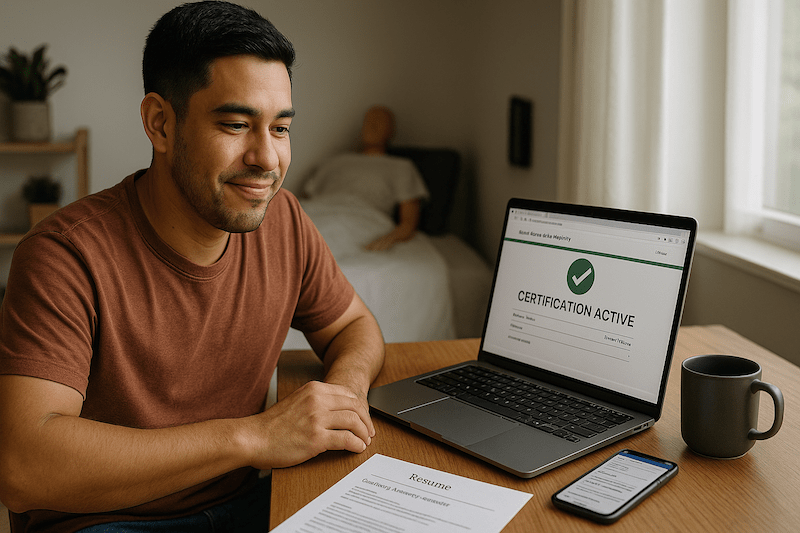
Passing the exam is just the beginning. Understanding the certification process prevents confusion and anxiety during the waiting period.
Results Delivery Timeline
Results timing varies dramatically by state and vendor:
- Immediate Results: Prometric states often provide printed score reports on-site immediately after testing. You walk out knowing whether you passed.
- Within Hours: Credentia posts results online through the CNA365 portal the same day, typically within 2-4 hours of test completion.
- Next Business Day: Headmaster provides results via the TestMaster Universe portal the following business day.
- 2-3 Weeks: Some states email results or mail score reports, creating longer waiting periods.
However, passing your exam doesn’t mean immediate work authorization. Registry enrollment takes additional time.
Registry Enrollment Process & Timeline
Registry processing timelines create understandable anxiety:
“I passed 3 weeks ago…myself nor my classmates are on the cna registry yet or received our license.” (35 upvotes)
Because California has the nation’s slowest processing at 60+ days minimum, this student’s experience is normal for CA, not an error or delay.
Registry timelines by state:
| State | Registry Timeline | Process Type | Notes |
|---|---|---|---|
| Florida | 48 business hours | Automatic | Fastest in the nation |
| Texas | ~1 week | Automatic | TULIP portal access |
| Pennsylvania | Within hours | Automatic | Electronic card immediate |
| New York | ~7 business days | Automatic | Mailed within 5 days |
| Illinois | ~2 weeks | Automatic | Results posted to HCWR |
| California | 60+ days minimum | Candidate-initiated | Can extend to several months |
| Georgia | 10 business days | Automatic | Registry listing confirmed |
License/Certificate Arrival
Physical credentials arrive separately from registry enrollment:
- Pennsylvania: Electronic card immediately, physically mailed ~3 weeks
- Florida: Mailed within 7 days of registry placement
- New York: Mailed within 5 business days of registry enrollment
- Texas: Self-print from the TULIP portal immediately upon registry enrollment
- California: Several weeks to months after exam
When You Can Start Applying for Jobs
Most states require official registry enrollment before you can legally work as a CNA. Verify your name appears on your state’s nurse aide registry public search portal before accepting employment.
Exceptions allowing temporary work:
- Pennsylvania: 30-day temporary authorization pending background check completion
- Texas: Trainees can work up to 4 months (120 days) from training completion while certification processes are in place.
- Illinois: Trainees can work 120 days (4 months) while waiting for certification
- Georgia: Trainees have a 4-month window from the training end date
- Ohio: Trainees have 120 days to test and gain employment
Always verify with your state Board of Nursing and confirm your specific employer’s requirements before starting work. Some facilities require full certification regardless of trainee provisions.
What to Do While Waiting
- Verify registry enrollment: Don’t assume it’s automatic. Check your state’s online lookup tool weekly.
- Update resume: Add “CNA, State Certified” (include registry number when available)
- Start job searching: Apply to positions, attend job fairs, and network with healthcare facilities.
- Gather professional references: Contact instructors and clinical supervisors for a reference letter
- Prepare for interviews: Practice common CNA interview questions about patient care scenarios.
The waiting period between passing and working can feel frustrating. Since processing timelines vary so dramatically (48 hours to 60+ days), knowing your state’s specific timeline prevents unnecessary anxiety.
Understanding retake policies helps if you need a second attempt.
What If You Don’t Pass?
Failing one or both parts of the exam is common, and it doesn’t define your potential. Most states allow three retake attempts within two years, and you only need to retake the specific portion you failed. Policies on waiting periods, costs, and attempt limits vary significantly by state.
For a detailed retake strategy, including how to analyze your score report, identify specific weaknesses, create an improvement plan, and emotional resilience techniques for second and third attempts, see our CNA Retake Strategy Guide. This comprehensive resource provides recovery planning and evidence-based study adjustments.
How to Prepare for the Exam
Success on the CNA exam depends entirely on your preparation. While the written test is often described as “common sense,” it requires specific knowledge of medical terminology, patient rights, and procedure sequences. The skills test requires muscle memory that can only be built through hands-on practice.
- For research-backed study methods, timeline plans, and resource recommendations, see our complete guide on How to Study for the CNA Exam.
- For a deep dive on using practice tests effectively to gauge your readiness, see our CNA Practice Exam Strategy Guide.
Exam preparation doesn’t require expensive commercial study guides. Community consensus confirms that free resources work effectively for most students.
Free Resources Provide Sufficient Preparation
Students consistently report success using free materials:
- YouTube Channels: Nurse Jar and 4yourCNA provide comprehensive video lessons covering all exam domains
- Practice Tests: Free online exams from NursingExams.org, Tests.com, and state-provided practice materials
- Quizlet Flashcards: Search “CNA exam” for hundreds of free terminology sets
- State Resources: Many state Boards of Nursing provide sample test packets
Because 82% of successful students in community discussions used free resources exclusively, expensive study guides aren’t necessary for most test-takers.
Practice Tests Are Essential
Practice testing serves multiple purposes beyond content review:
- Familiarizes you with question formats and scenario phrasing
- Identifies knowledge gaps requiring additional study
- Builds confidence through simulated testing experience
- Teaches time management for the actual exam
Most successful students complete 3-5 full practice tests before their exam date. Since practice tests help you understand what questions actually ask, they’re non-negotiable preparation rather than optional extras.
Effective Study Timeline
How long should you study? Most successful students study 4-8 weeks, depending on prior healthcare knowledge:
- Complete beginners: 6-8 weeks of consistent study (1-2 hours daily)
- Healthcare workers: 2-4 weeks focusing on testing format and terminology
- Career changers: 4-6 weeks balancing work and study
Quality matters more than quantity. Taking 3+ practice tests and reviewing medical terminology 3-4 times proves more effective than passive reading.
For specific study schedules tailored to your timeline (4-week, 2-week, or 1-week intensive plans) and detailed resource recommendations with effectiveness ratings, see our CNA Exam Study Timeline Plans. These plans provide day-by-day guidance on what to study and when.
Frequently Asked Questions
Most states require you to complete both the written and skills portions on the same day. However, if you pass one portion but fail the other, you only retake the failed portion and can schedule that retake on a different day. Some states allow splitting the exam initially for medical or accessibility reasons. Check with your testing vendor for accommodation options if needed. Your passing score on one portion remains valid while you prepare for the other.
This varies by state. Pennsylvania allows a 30-day temporary authorization pending a background check. Texas, Illinois, Georgia, and Ohio allow trainees to work 4 months (120 days) from training completion. Most other states require you to be officially on the state registry before starting work. Always verify with your state Board of Nursing and confirm employer-specific requirements before accepting employment. Registry enrollment timing varies from 48 hours (Florida) to 60+ days (California).
Most states allow three attempts per exam portion within two years of training completion. North Carolina is an exception, allowing only two attempts. Illinois requires passing within 12 months instead of two years. After exhausting attempts, you must complete full CNA training again (minimum 75-120 hours, depending on state) before being eligible to retest. Some states require waiting periods between attempts – Florida mandates 30 days. You only retake the portion you failed, not both portions.
Yes, significantly. While all states follow federal OBRA ’87 requirements for exam content, specifics vary: testing vendor assignment (Credentia vs Prometric vs Headmaster), passing scores (70-80% range), registry enrollment timelines (48 hours to 60+ days), retake policies (2-3 attempts), and costs ($115-$155). Check your state Board of Nursing website or see state-specific pages for Florida, California, and Texas requirements. Understanding your state’s specific policies prevents surprises.
Most states require completion of an approved 75-120-hour CNA training program before exam eligibility. Florida is a notable exception, allowing “challenging” the exam without formal training if you have at least 2 years of relevant healthcare experience and complete a 20-hour approved CNA fundamentals course. Requirements vary significantly by state. Check with your state Board of Nursing to determine if challenging is permitted and what prerequisites apply. Some states allow testing based on military healthcare training or LPN/RN credentials.
Ready to Ace Your CNA Exam?
Get everything you need: video guides, practice tests, and detailed study plans
Conclusion & Next Steps
You now understand the CNA exam structure: a written knowledge test plus hands-on skills demonstration, both required for certification. You know which testing vendor your state uses and how their formats differ. You have realistic expectations – preparation is needed, but success is absolutely achievable.
According to the state Board of Nursing data from 2023-2024, 70-87% of first-time test-takers pass. With proper preparation using practice tests, medical terminology review, and skills practice, you can absolutely be in that majority.
Your Next Steps
- Identify your testing vendor and create an account in their portal (CNA365 for Credentia, Prometric portal, or TestMaster Universe for Headmaster)
- Create your study schedule based on your test date. Most successful students study 4-8 weeks with consistent daily practice.
- Complete 3-5 full practice tests to identify weak areas and build test-taking confidence
- Practice all possible skills with a study partner or using mannequins until handwashing and the most commonly tested skills become automatic.
- Review the cost breakdown and budget for exam fees, background checks, and potential retakes
Ready to Test Your Knowledge?
Test your readiness with our Interactive CNA Practice Exam Tool. This free resource simulates the actual exam format, provides instant feedback on answers, and identifies areas to strengthen before test day.
Additional Resources
- Complete CNA Skills Guide – Step-by-step skill breakdowns with evaluator scoring criteria.
- CNA Exam Study Timeline Plans – Day-by-day study schedules for 4-week, 2-week, and 1-week preparation
- CNA Retake Strategy Guide – Recovery planning and improvement techniques for second attempts
Every successful CNA started exactly where you are now – learning the exam structure and building a preparation plan. The CNA exam represents an important milestone in your healthcare career journey. With the clarity you now have about exam structure, vendor differences, and realistic preparation requirements, you’re equipped to approach this certification confidently.
Because understanding what to expect reduces anxiety and improves performance, you’ve already taken the most important first step. The path from confused to certified starts with the knowledge you’ve gained in this guide.