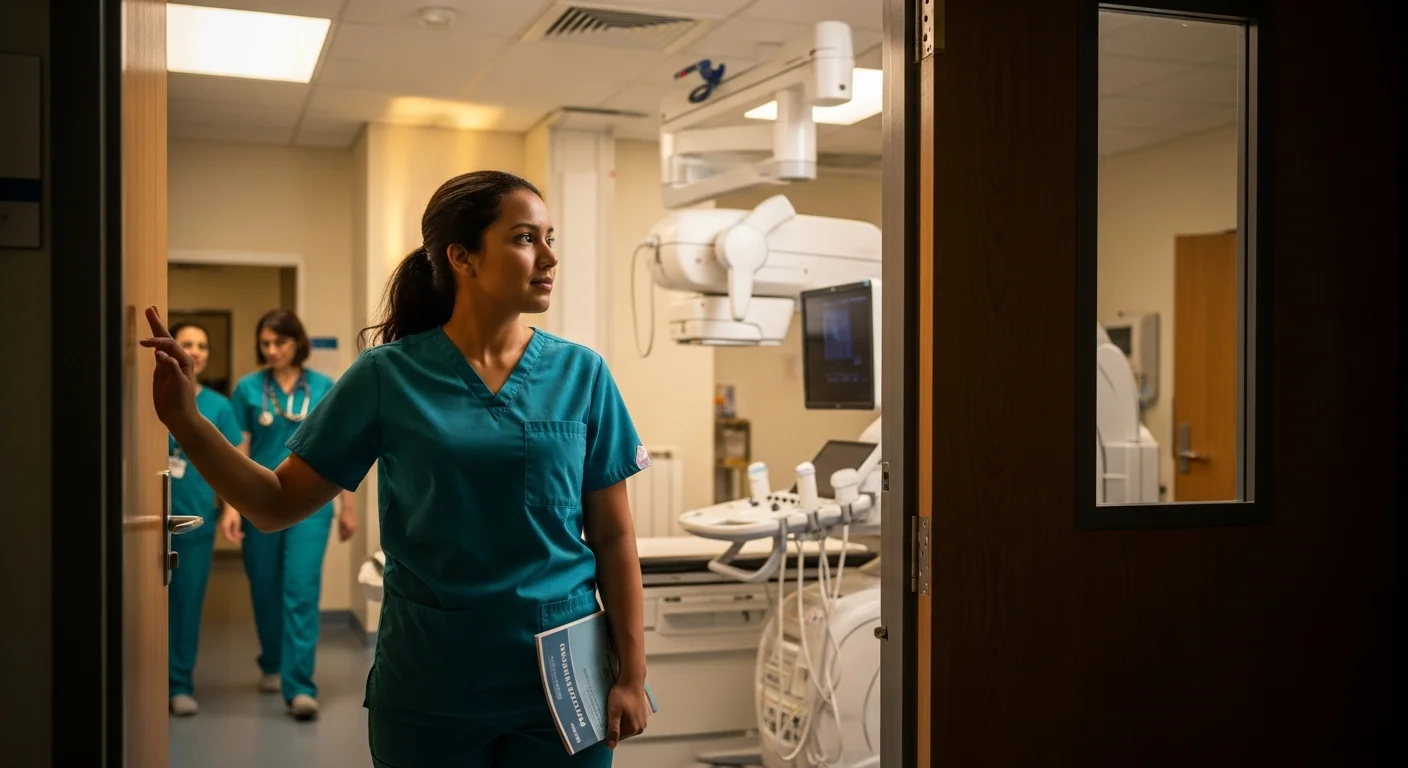
CNAs can move into three medical imaging careers without starting from scratch: radiologic technologist (X-ray and beyond), diagnostic medical sonographer (ultrasound), and EKG technician. These roles pay $50,000 to $89,340 per year according to Bureau of Labor Statistics May 2024 data, compared to the CNA median of $35,760. The path ranges from four weeks for an EKG certificate to 24 months for a sonography associate degree.
This article compares all three paths side by side, maps which of your CNA skills carry over directly, and gives you a decision framework so you can choose the path that fits your timeline, budget, and goals. If you want to explore CNA career advancement options beyond imaging, that series covers the full landscape.
| What | Details |
|---|---|
| Fastest path | EKG Technician — 4-12 weeks, $500-$2,000 |
| Highest salary | Diagnostic Medical Sonographer — $89,340 median (BLS May 2024) |
| Most career flexibility | Radiologic Technologist — leads to CT, MRI, mammography, interventional |
| CNA advantage | Programs prefer applicants with clinical patient care backgrounds |
| Primary certifications | ARRT (rad tech), ARDMS (sonography), NHA CET (EKG) |
Why CNAs Are Moving Into Medical Imaging
The shift from CNA to imaging careers is happening across every type of healthcare setting, and it’s not hard to understand why. CNAs face some of the most demanding patient ratios in healthcare, physical work that compounds over years, and wages that top out well below what the same healthcare system pays technicians one step up the credential ladder.
One of the most upvoted threads in r/cna captures the moment that drives a lot of these transitions:
“Are there any CNAs here who, after working as a CNA, no longer wish to become a nurse? Having to deal with patients, their families, and doctors all at the same time is overwhelming. Most of the nurses I work with are unhappy… I took all the nursing prerequisites while working and my gpa is 3.9, but now I am looking into schools to become a Radiologic Technologist.”
(413 upvotes — Reddit user, r/cna)
That pivot happens every day. The appeal isn’t just higher pay — it’s a different relationship with patient care. Imaging roles involve direct patient contact, but it’s brief and procedurally focused rather than sustained and physically demanding. You position the patient, run the scan or test, and move on.
The salary difference is the other half of the equation. The CNA median wage is $35,760 per year according to BLS data. Radiologic technologists earn a median of $77,660. Diagnostic medical sonographers earn $89,340. Even the fastest and most affordable option, EKG technician, puts you in the $50,000-$60,000 range. That’s not a marginal improvement — it’s a career-level change in earning power, built on the clinical foundation you already have.
You’re not abandoning healthcare or starting over. You’re using what you know as the foundation for a more technical, better-compensated role, and your CNA background is worth more in that transition than most people realize.
Compare Imaging Training Programs Near You
Find accredited radiology, sonography, and EKG programs. View costs, schedules, and admission requirements.
View Imaging Programs →No obligation • Compare program costs and schedules
Three Imaging Paths for CNAs — Compared
The hardest part of this decision isn’t the research. It’s that all three paths sound appealing for different reasons, and you can’t do all three at once.
CNAs in imaging-focused forums voice this exact problem regularly. One user put it plainly:
“I’ve eyed up RRT, Xray tech and now I’m reallllly eyeing up this Nuclear Medicine Tech that just opened up at my community college… I’m in a state of ‘what path is truly the right one’ yknow?”
(75 upvotes — Reddit user, r/cna)
The comparison table below answers that. Scan the “Best For” row first — it’s designed as a decision shortcut.
| Factor | X-Ray / Rad Tech | Ultrasound / Sonographer | EKG Technician |
|---|---|---|---|
| Education | Associate degree (2 years) | Associate degree (18-24 months) | Certificate (4-12 weeks) |
| Accreditation | JRCERT-accredited program required | CAAHEP-accredited program required | No programmatic accreditation required |
| Certification | ARRT (Radiography exam) | ARDMS (SPI + specialty exams) | NHA CET |
| Median Salary | $77,660 (BLS May 2024) | $89,340 (BLS May 2024) | $50,000-$60,000 |
| Patient Contact | Moderate — brief positioning for each scan | Moderate — exam duration (20-60 min) | Minimal — electrode placement, monitoring |
| Career Ceiling | CT, MRI, mammography, interventional radiology | Cardiac, vascular, OB/GYN specialties | Monitor tech, cardiac cath lab support |
| Best For | CNAs who want maximum career flexibility | CNAs who enjoy diagnostic problem-solving | CNAs who need the fastest advancement NOW |
X-Ray / Radiologic Technologist
The radiologic technologist credential is the broadest base you can build in imaging. After your two-year JRCERT-accredited associate degree and ARRT certification in Radiography, you can add post-primary credentials in CT, MRI, mammography, and interventional radiology. Each one expands both your employability and your earning ceiling. MRI technologists earn a median of $88,180 (BLS May 2024), giving you a clear upgrade path from the same starting credential.
One CNA who made this switch described the moment it clicked:
“I’ve been a CNA for two and a half years on a HEAVY cardiac PCU. After working for two years I decided nursing is not for me. So today I officially changed my major from nursing to radiology. The same pay, less hours, less getting assaulted by confused residents. HELL YEAH”
(108 upvotes — Reddit user, r/cna)
If you’re drawn to MRI specifically, the community consensus is clear: start with the full rad tech credential rather than a direct-entry MRI-only program. Direct-entry ARMRIT-certified programs exist, but they limit you to MRI-only positions and are not accepted by all healthcare facilities. The ARRT radiography path opens CT, mammography, interventional radiology, and MRI as post-primary options — five career directions instead of one.
For the full walkthrough of what the rad tech path looks like from CNA to certification, see our complete guide to becoming an X-ray tech.
Ultrasound / Diagnostic Medical Sonographer
Diagnostic medical sonography is the highest-paying of the three paths at a median of $89,340 per year, with the most diagnostic responsibility attached. Unlike rad techs who capture images and pass them to radiologists for interpretation, sonographers actively assess what they’re seeing during the exam — noting abnormalities, optimizing image quality, and communicating findings in real time. It’s the most intellectually engaging role of the three.
The program requires a CAAHEP-accredited associate degree (18-24 months) and ARDMS certification, which involves passing the Sonography Principles and Instrumentation (SPI) exam plus at least one specialty exam in Abdomen, OB/GYN, Vascular, or Cardiac. Waitlists are common at community college programs — apply early.
For a full breakdown of the CNA-to-sonographer pathway and ARDMS exam structure, see our ultrasound tech career guide.
EKG Technician
The EKG technician path is the honest quick-win option. A certificate program takes 4-12 weeks and costs $500-$2,000. The NHA Certified EKG Technician (CET) credential is what most employers look for. Patient contact is minimal — you place electrodes, run a 12-lead EKG, and hand the strip to a physician or cardiologist for interpretation.
Be clear-eyed about the ceiling. EKG technician salaries ($50,000-$60,000) are the lowest of the three imaging paths, and in some smaller markets, hospitals assign EKG duties to CNAs or nurses rather than hiring dedicated EKG techs. As a stepping stone — earning more NOW while you plan a longer program — the EKG cert is genuinely useful.
For the complete EKG career path, certification process, and exam prep, see our EKG technician guide.
What Your CNA Experience Is Actually Worth
The fear that you’re starting over is understandable. You’re not.
Your CNA background maps directly onto what imaging programs train students to do — and in many cases, you’ve already been doing those things for years.
Skills That Transfer Directly
| CNA Daily Task | Imaging Career Application | Why It Matters |
|---|---|---|
| Patient positioning and transfers | Positioning patients for X-ray and ultrasound exams | Reduces injury risk; imaging table transfers are nearly identical |
| Vital signs monitoring | Pre- and post-procedure patient assessment | You can assess patient stability before contrast or sedation |
| HIPAA compliance | PACS data handling, imaging records management | Privacy training is already complete |
| EMR/EHR charting | PACS and RIS navigation | Healthcare IT familiarity shortens the learning curve |
| Patient communication and de-escalation | Explaining imaging procedures, calming anxious patients | Imaging techs deal with claustrophobic, anxious, and confused patients constantly |
| Infection control and PPE | Sterile technique in interventional procedures | Hand hygiene and gloving are already second nature |
| Body mechanics and ambulation assistance | Moving patients to and from imaging tables | Fall risk awareness and transfer mechanics apply directly |
| Working with behavioral challenges | Managing uncooperative patients during imaging | Experience with dementia, delirium, and distress transfers immediately |
One person who completed this exact transition spoke to this directly:
“I was a CNA because I was on route to nursing school, but I changed my mind… I still work in healthcare, but I’m now an x-ray tech instead of being a nurse. My CNA experience has tremendously helped me as an x-ray tech!”
(128 upvotes — Reddit user, r/cna)
Your CNA role experience doesn’t earn you academic credit toward an imaging program. JRCERT and CAAHEP programs require clinical rotations performed under licensed radiologic technologist or sonographer supervision — your CNA clinicals don’t substitute for those hours. What your background DOES do is make you a stronger applicant and a faster learner once you’re in.
The Admissions Advantage
Community college radiologic technology programs are competitive, with selective admissions and waitlists at many schools. CNA experience is a documented competitive edge.
“Most community colleges have rad tech programs, and they looooove accepting CNAs because ya’ll have already seen the worst of healthcare, so you won’t run away from the reality of it. You also have all the patient care skills down.”
(65 upvotes — Reddit user, r/cna)
If you need to revisit your CNA certification background before applying, that resource covers the baseline credential these admissions committees are evaluating.
Ready to Explore Imaging Programs?
Compare accredited radiology and sonography training options near you.
The Quick-Win Strategy — Stack Your Credentials
Two years feels like a long time when you’re burned out on CNA pay. There’s a smarter way to approach this than just waiting.
Many hospitals are already training CNAs to perform EKGs as an unpaid duty expansion:
“Hospital is requiring all CNAs to upscale. We’re ‘required’ to go to these skills classes that involve learning phlebotomy, inserting Foley catheters, ekgs. We’re not getting any type of raise for this…”
(77 upvotes — Reddit user, r/cna)
The difference between doing EKGs as an uncompensated duty and doing them as a certified EKG technician is a credential. Getting that credential formalizes the skill, adds it to your resume, and opens positions paying $50,000-$60,000 versus the CNA median of $35,760.
The parallel path strategy:
- Weeks 1-12: Complete your EKG certification ($500-$2,000, NHA CET). Keep working as a CNA.
- Month 3-4: Apply to JRCERT-accredited rad tech or CAAHEP-accredited sonography programs. Your EKG cert strengthens the application.
- Month 4-6: Transition to EKG tech or PRN CNA if accepted. Higher pay and more scheduling flexibility than floor CNA work.
- Month 6 onward: Complete your imaging program with a higher-paying part-time credential keeping you afloat.
The dual-stacking variation — EKG certification plus phlebotomy — opens you up to patient care technician (PCT) positions at hospitals, which typically pay more than standard CNA roles and look strong on a rad tech program application.
For the complete EKG certification process and study guide, see our EKG certification guide. If your current facility offers online CNA classes for continuing education, those flexible formats can help you manage the overlap period.
How to Choose the Right Imaging Path
Every imaging path in this article is a good career. The question isn’t which one is objectively best — it’s which one fits your specific situation right now.
Four factors determine the answer:
| Your Situation | EKG Technician | Radiologic Technologist | Diagnostic Medical Sonographer |
|---|---|---|---|
| Timeline urgency | Need a raise in weeks | Can commit 2 years | Can commit 18-24 months |
| Budget | $500-$2,000 | $7,200-$30,000 (CC to bachelor’s) | $10,000-$41,000 |
| Patient contact preference | Minimal preferred | Brief, positioning-focused | Moderate, exam-duration contact |
| Career ceiling priority | Quick start, lower ceiling | Maximum specialization options | Highest base salary |
If MRI is on your radar, experienced community members are consistent on this point:
“Do yourself a favor and don’t go the MRI only route for school. Most places prefer a radiologic technologist cross-trained and credentialed into MRI. The rad tech route will also allow you to transition to CT, mammography, dexa, interventional, and cath lab if you choose.”
(65 upvotes — Reddit user, r/cna)
Start as a rad tech, earn your ARRT certification, then add the MRI post-primary credential. You get MRI plus everything else.
The three decision shortcuts:
If you need a raise in the next 1-3 months and can’t commit to a 2-year program yet, EKG certification gets you moving immediately. See our CNA to EKG technician guide for the full path.
If you have 2 years and want the broadest career foundation in healthcare imaging, radiologic technology gives you the most specialization options. See our CNA to X-ray tech guide for step-by-step guidance.
If you want the highest salary ceiling and find diagnostic work intellectually engaging, sonography is your path. See our CNA to ultrasound tech guide for program requirements and ARDMS exam details.
Resources like choosing the right program can also help you evaluate specific institutions once you’ve narrowed your path.
Cost and Financial Aid Overview
The cost of imaging education varies more than most people expect, primarily because community college programs and private institutions deliver similar job outcomes at dramatically different price points.
| Path | Community College | Private/University | Notes |
|---|---|---|---|
| EKG Certificate | $500-$2,000 | $500-$2,000 | No major cost difference; some hospitals sponsor training |
| Radiologic Technologist | $3,600-$8,000/year (in-state) | $15,000-$30,000+ | Mt. SAC in California runs a full program for approximately $3,600/year |
| Diagnostic Medical Sonographer | $10,000-$20,000 total | $25,000-$41,328 | Research.com analysis shows private ultrasound programs averaging $41,328 for comparable outcomes |
One CNA doing the math on the decision put it simply:
“I’m looking into becoming at rad tech. The pay is the same as nurses atleast in florida and less patient interaction which is the main goal. The schooling is only two years.”
(Reddit user, r/cna)
The ROI case is strong. A radiologic technologist earning $77,660 per year versus a CNA at $35,760 generates $41,900 in additional annual income. Even a $30,000 program pays for itself in under a year of the salary difference. Over a 20-year career, that gap compounds to more than $800,000 in additional earnings.
Financial aid available for accredited programs:
- Pell Grants: Up to $7,395/year (2024-25) for FAFSA-eligible students — no repayment required, covers a significant portion of community college program costs
- State workforce development grants: Many states allocate funding specifically for allied health training; check your state workforce board
- ASRT scholarships: The American Society of Radiologic Technologists offers multiple scholarship opportunities for students enrolled in accredited rad tech programs
- Employer tuition assistance: Hospital systems increasingly sponsor imaging education for current employees, sometimes combining tuition coverage with a 1-2 year post-graduation service commitment
- Federal student loans: Available as a last resort after grants and scholarships are exhausted
Start with FAFSA regardless of which program you choose. Many CNAs assume they earn too much to qualify — in most cases, they don’t. CNA scholarships covers additional funding options relevant to healthcare students in allied health programs.
EKG certificate programs from non-accredited providers typically don’t qualify for federal financial aid. Factor that into your cost comparison if you’re planning to use FAFSA-eligible funding.
Find the Right Imaging Program for You
Compare accredited programs near you. View costs, schedules, and admission requirements for radiology, sonography, and EKG training.
