
To earn your CNA certification in Delaware, you need 150 hours of state-approved training and a passing score on the NNAAP competency exam administered by Prometric. The Delaware Division of Health Care Quality (DHCQ) oversees CNA certification in Delaware, and most people complete the full process in 8-14 weeks from enrollment to registry listing.
If you are still weighing whether this career is right for you, start with an overview of what a CNA does on a daily basis. Whether you are exploring CNA classes for the first time or comparing state requirements, Delaware offers one of the most accessible certification paths on the East Coast.
| Requirement | Details |
|---|---|
| Training hours | 150 total (75 classroom + 75 clinical) |
| Program cost | $900-$3,300 (free options available through State Tuition Incentive Program) |
| Exam | NNAAP via Prometric, $115 |
| Background check | IdentoGO fingerprinting, ~$65-$85 |
| Time to complete | 6-12 weeks of training |
| Governing body | Delaware DHSS/DHCQ (Division of Health Care Quality) |
| Registry | Delaware Nurse Aide Registry (managed by Prometric) |
Here are the five steps to becoming a CNA in Delaware:
- Confirm you meet the basic eligibility requirements (age, education, background check).
- Complete a state-approved 150-hour CNA training program.
- Submit to an IdentoGO digital fingerprint background check through the Division of Professional Regulation.
- Pass the two-part NNAAP competency exam through Prometric: knowledge test and clinical skills evaluation.
- After passing, your name is added to the Delaware CNA Registry.
Below, we break down each step with the specific costs, programs, and requirements you need.
Thousands of people start CNA training every year. One person heading to their final class captured the feeling:
“Headed to my last CNA class. Let’s be great”
(2,033 upvotes — Reddit user, r/cna)
That post earned over 2,000 upvotes from working CNAs. Here is what you need to know to start your CNA training in Delaware.
✓ CNA PROGRAMS AVAILABLE IN DELAWARE
Find CNA Training Programs Near You
Enter your zip code to compare accredited CNA programs in Delaware. View costs, schedules, and program details.
Programs near you • No obligation to enroll
Sponsored Ad
Delaware CNA Requirements
To enroll in a state-approved CNA training program in Delaware, you must meet these baseline requirements, per Delaware Code Title 16 and DHCQ regulations:
- Age: You must be at least 18 years old.
- Education: A high school diploma or GED is required.
- Background check: You must pass a criminal background check through IdentoGO digital fingerprinting, managed by the Division of Professional Regulation (DPR).
- Physical ability: You must be able to perform patient care tasks — lifting, repositioning patients, and standing for extended periods.
- No GPA or test score requirement: There is no minimum academic score or standardized test prerequisite for CNA programs.
Delaware does not require a nursing entrance exam. Most adults with a diploma or GED who meet the age requirement will qualify. The background check is the primary screening mechanism, and it targets specific offense categories rather than any criminal record.
If you have any criminal history and are uncertain whether it affects your eligibility, contact DHCQ before enrolling in a training program. We cover the full background check process, including IdentoGO scheduling and disqualifying offense categories, in the background check section below.
Delaware CNA Training Programs
Before getting into programs and costs, it helps to understand what you are actually signing up for.
If you have been researching CNA careers online, you have probably encountered the frustration. One widely shared post simply asked:
“I wonder how many CNAs quit after this”
(4,223 upvotes — Reddit user, r/nursing)
That question resonated with thousands of healthcare workers. CNA turnover is high in facilities with poor staffing, but CNAs who find the right environment build careers that last. Choosing a strong training program is the first step toward landing in the right environment.
150-Hour Training Breakdown
Delaware requires 150 total training hours — 75 hours of classroom instruction and 75 hours of supervised clinical training — before you can sit for the certification exam. This split is set by Delaware DHCQ regulation (Title 16, Section 3220).
The classroom portion covers nursing fundamentals, infection control, patient rights, vital signs, and communication. The clinical portion takes place in a licensed long-term care facility under direct RN supervision. Your program coordinator must be a registered nurse with at least two years of experience, including one year in a licensed long-term care setting.
Programs range from 6 weeks for full-time schedules to 12 weeks for part-time or evening formats. All three Delaware counties — New Castle, Kent, and Sussex — have at least one approved program.
State-Approved Programs and Costs
This is where we differ most from other resources. Competitors often list only Delaware Technical Community College. Delaware has multiple state-approved CNA programs across all three counties.
| Program | Location (County) | Approximate Cost | Format | Tuition Incentive Eligible |
|---|---|---|---|---|
| Delaware Technical Community College, Terry Campus | Dover (Kent) | $1,900-$2,800 | In-person | No (FAFSA may apply) |
| Delaware Skills Center CNA program | Wilmington area (New Castle) | Contact for current pricing | In-person | Yes |
| Bear Professional Institute CNA program | Bear (New Castle) | Up to $3,000 covered | In-person/Hybrid | Yes |
| Sussex County Vocational Technical School District | Georgetown area (Sussex) | Up to $3,000 covered | In-person | Yes |
The Dawn Career Institute CNA program in Wilmington provides another New Castle County option.
Delaware JobLink maintains the full current list of state-approved programs at joblink.delaware.gov/etp/public/institution_programs/2675. Verify any program you are considering against that list before enrolling — it is the official source.
Browse all Delaware CNA programs to compare approved training options by location, cost, and schedule.
Training costs vary, but many Delaware CNAs pay nothing out of pocket. The next section covers every way to reduce or eliminate your training costs, including Delaware’s State Tuition Incentive Program.
Online and Hybrid Options
Can you get CNA certified online in Delaware? Not entirely. Delaware does not approve fully online CNA training programs. The 75 clinical hours must be completed in person at a licensed facility — there is no workaround.
Some programs offer hybrid formats where classroom instruction is delivered online while clinical hours remain in person. Delaware does not approve fully online certification programs, though some hybrid options exist — learn more about online CNA classes and which formats states accept.
If a program claims to offer fully online CNA certification in Delaware, verify its approval status through Delaware JobLink before enrolling.
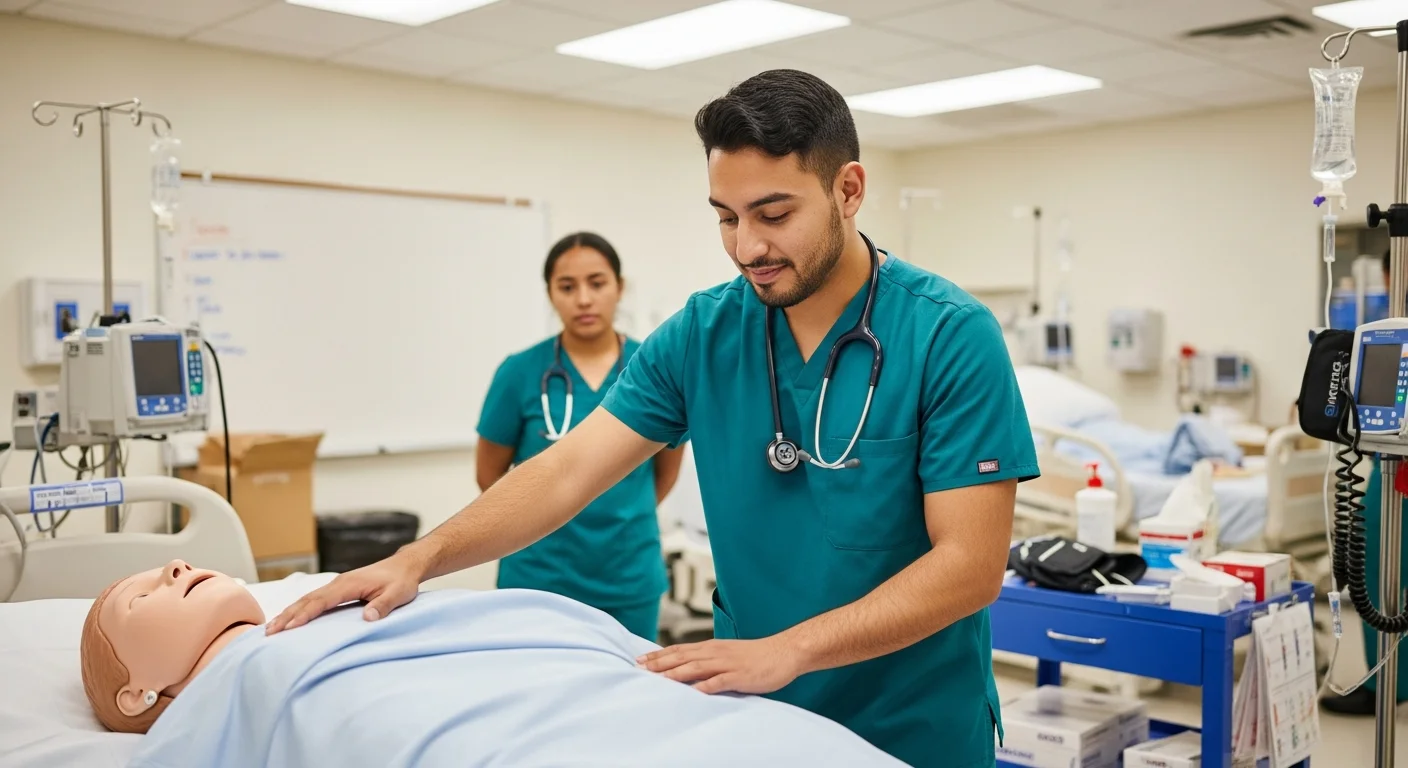
How to Choose a CNA Program in Delaware
Before committing to a program, run through this checklist:
- Confirm the program appears on the Delaware JobLink approved program list.
- Compare total cost -- tuition plus uniforms, supplies, health screenings, immunizations, and drug screenings.
- Check whether the program participates in the State Tuition Incentive Program.
- Confirm clinical site location and schedule compatibility with your work or family commitments.
- Ask the program coordinator about first-attempt pass rates on the certification exam.
Not sure which training option is the best fit? Our guide to choosing a CNA program walks through accreditation, pass rates, clinical site quality, and schedule flexibility.
How to Pay for CNA Training in Delaware
CNA training in Delaware costs $900-$3,300 depending on the provider. That range does not include uniforms, health screenings, immunizations, drug screenings, or the background check fee (~$65-$85 at IdentoGO). For many prospective CNAs, the upfront cost is the primary barrier -- and Delaware has more options than most people realize.
State Tuition Incentive Program
Delaware launched the State Tuition Incentive Program in December 2023 specifically to address CNA shortages in state-run facilities. No competitor resource covers this program in any detail, which means many prospective CNAs in Delaware are leaving significant money on the table.
Here is what the program provides:
- Tuition coverage: Up to $3,000 per student at designated facilities.
- Participating facilities: Bear Professional Institute (Bear, New Castle County), Delaware Skills Center (Wilmington area), and Sussex County Vocational Technical School District (Georgetown area, Sussex County).
- Employment during training: Candidates may be hired as state employees while completing their training program.
- Guaranteed employment: Two years of guaranteed state employment after certification.
- Starting salary: Approximately $34,000 per year with full state benefits, including health insurance, retirement, and paid time off.
The combination of $0 tuition and guaranteed employment makes this program the most powerful financial option for Delaware CNA candidates. To access it, enroll at one of the three designated facilities and contact them directly about upcoming program start dates.
Source: Delaware Public Media and Delaware.gov press release (December 2023).
Employer-Sponsored and Workforce Funding
Beyond the State Tuition Incentive Program, three additional paths exist for reducing or eliminating your training costs.
Employer-sponsored training is one of the most common ways CNAs enter the field without upfront costs. As one CNA shared:
"For context I (20F) have been working as a CNA for a year now, said facility paid for my CNA training and was my first ever job as a CNA and in healthcare in general."
(2,489 upvotes -- Reddit user, r/cna)
That arrangement -- training paid for in exchange for a work commitment -- is standard across long-term care facilities, including Delaware nursing homes. Many facilities will cover your full tuition in exchange for a 1-2 year work commitment after certification.
FAFSA/financial aid: Delaware Technical Community College's CNA program may qualify for federal financial aid. Complete the Free Application for Federal Student Aid (FAFSA) to check eligibility before your program start date.
Delaware JobLink: The state's workforce development system connects eligible Delaware residents with funding for approved training programs. Check joblink.delaware.gov to see what funding may be available in your county.
The most cost-effective path for most Delaware CNA candidates: enroll at a State Tuition Incentive Program facility, get hired as a state employee during training, and pay $0 in tuition with a guaranteed job at the end. Once you complete your training program, the next step is passing the Delaware CNA certification exam.
Ready to Explore CNA Programs?
Compare accredited training options in Delaware — view costs, schedules, and program details.
Delaware CNA Certification Exam
Delaware uses the National Nurse Aide Assessment Program (NNAAP), administered by Prometric. The Delaware certification test follows the national NNAAP format -- our comprehensive CNA exam guide covers what to expect and how to prepare. The exam has two components: a written knowledge test and a clinical skills demonstration. You must pass both.
Knowledge Test Format
The written test contains 60 multiple-choice questions. You have 90 minutes to complete it. To pass, you need a score of at least 72% -- that is 43 correct answers out of 60.
Topics include patient care, safety and emergency procedures, infection control, communication, patient rights, and basic nursing skills. The test is administered at Prometric-approved testing centers in Delaware.
Most candidates who complete their training program pass on the first attempt. As one CNA described:
"Passed my CNA exam on the first try. The skills portion was the most nerve wracking part but honestly if you just practice your steps and stay calm you'll be fine. The written part was easier than I expected."
Skills feeling harder than written is consistent with what candidates report. Prometric administers Delaware's exam, and the skills portion tests 5 randomly selected tasks. Practice each skill until the steps are automatic.
Clinical Skills Test
The clinical skills test requires you to demonstrate 5 randomly selected skills from Delaware's approved skills list. You have 31-40 minutes to complete all 5 demonstrations. All 5 skills must pass -- there is no partial credit.
The test always includes handwashing and at least one indirect patient care skill. Because the remaining skills are randomly selected, you need to be ready to perform any skill from your training. Visit our CNA skills help section for video walkthroughs and technique breakdowns.
Practice each skill until you can perform it correctly while explaining your steps aloud. You will need to verbalize your actions during the test as part of the evaluation.
Exam Fees, Scheduling, and Retake Policy
| Item | Details |
|---|---|
| Exam fee (both parts) | $115 |
| Scheduling | prometric.com/exams/nurseaide-de |
| Maximum attempts | 3 (within the testing window) |
| After 3 failures | Must repeat the entire 150-hour training program |
Schedule your exam through Prometric after completing your training program. Bring a government-issued photo ID on test day.
The 3-attempt limit is the detail most competitors omit and most test-takers are surprised by. If you fail all three attempts, Delaware requires you to repeat the full 150-hour training program before testing again. Before test day, work through a free CNA practice exam to identify weak areas and build confidence with the NNAAP question format. If you want a structured study plan, our guide on how to study for the CNA exam breaks the material into manageable review sessions.
After you pass the exam, your name is added to the Delaware CNA Registry -- use it to confirm your active status and share verification with employers.
Background Check Process for Delaware CNAs
IdentoGO Digital Fingerprinting
As of September 5, 2023, Delaware switched from paper-based fingerprinting to IdentoGO digital fingerprinting for CNA background checks. The process is managed by the Division of Professional Regulation (DPR). The digital system is faster and more convenient than the old paper process.
Here is the step-by-step process:
- Schedule an appointment at an IdentoGO location in Delaware (multiple locations statewide). The fingerprinting fee is approximately $65-$85, paid directly to IdentoGO at the time of your appointment.
- Bring your government-issued photo ID.
- At check-in, provide the Delaware CNA service code (your training program or DPR can confirm the current code).
- Your fingerprints are scanned digitally on-site.
- Results are transmitted directly to DHSS/DHCQ -- you do not need to mail anything.
Many training programs have you complete the background check concurrently with training, so you are not waiting on results after you finish.
Disqualifying Offenses
Not every criminal record disqualifies an applicant. Delaware DHSS evaluates specific offense categories that relate to patient safety and trust.
The disqualifying categories are:
- Theft
- Drug-related offenses
- Violent crimes
- Patient abuse or neglect
A history in other offense categories does not automatically prevent you from becoming a CNA in Delaware. If you have a criminal history and are uncertain how it affects your eligibility, contact DPR at dpr.delaware.gov before investing time and money in training.
CNA Reciprocity in Delaware
Delaware accepts CNA certification from other states through a reciprocity process. The application is handled entirely by mail -- there is no online submission option -- so plan ahead when timing your move.
Here are the steps to transfer your CNA certification to Delaware:
- Confirm your current CNA certification is active and in good standing in your originating state.
- Verify you have completed 420 clock hours of paid nursing work in the last 24 months, OR recently completed equivalent training (150+ hours) in another state.
- Obtain a notarized Employer Verification Form from your most recent employer. Missing this document is the most common reason applications are returned.
- Download and complete the Delaware CNA Reciprocity Application from the DHSS website (dhss.delaware.gov).
- Assemble your package: completed application, $30 fee (check or money order), government-issued photo ID, notarized Employer Verification Form, and proof of active CNA certification.
- Mail the complete package to:
Delaware Division of Health Care Quality
ATTN: Nurse Aide Registry
3 Mill Road, Suite 308
Wilmington, DE 19806
Do not send incomplete applications -- missing documents (especially the notarized Employer Verification Form) are the most common reason applications are returned. Allow 4-6 weeks for processing. If you need to check status after submitting, contact DHCQ directly.
If you are transferring from a state that does not use the NNAAP, review the NNAAP exam vendors by state to understand how your original exam maps to Delaware's requirements.
Maryland applicants: Delaware requires a GNA (Geriatric Nursing Assistant) certificate for Maryland applicants -- not just a standard Maryland CNA. Maryland GNAs have additional geriatric-specific training that Delaware recognizes as equivalent to its requirements. Review the Maryland CNA requirements page for details on that distinction. A standard Maryland CNA certificate does not qualify for Delaware reciprocity.
Delaware does not participate in a multi-state CNA compact -- each reciprocity application is evaluated individually. After your application is processed, verify your status on the Delaware CNA Registry.
CNA Renewal in Delaware
Delaware CNA certification must be renewed every 24 months. Here are the requirements to maintain your active status on the Delaware Nurse Aide Registry:
- Continuing education: 24 hours of approved CE every 24 months, logged through the Relias portal or other DHCQ-approved providers.
- Work requirement: At least 8 hours of paid nursing-related service within each 24-month renewal period.
- Renewal portal: CE hours and renewal are tracked through the employer's Relias account or the DHCQ system.
If your certification lapses, you may need to complete a refresher course or retest -- contact DHCQ for reinstatement requirements specific to your situation.
For the full step-by-step process, including Relias portal instructions and deadline tracking, see our complete guide to CNA renewal in Delaware.
CNA Salary in Delaware
According to BLS 2024 Occupational Employment Statistics, the average CNA salary in Delaware is $39,240 per year -- or approximately $18.87 per hour. Delaware employs approximately 5,660 CNAs statewide.
| Level | Annual Salary | Hourly Rate |
|---|---|---|
| Entry-Level | ~$34,000 | ~$16.35 |
| Average (BLS 2024) | $39,240 | ~$18.87 |
| 75th Percentile (BLS 2024) | $43,570 | ~$20.95 |
| 90th Percentile (BLS 2024) | $49,350 | ~$23.73 |
The state average of $39,240 is slightly below the national average of $39,530. That modest gap reflects regional cost of living rather than a lack of demand -- Delaware's small geographic footprint limits salary variation across counties in ways you would not see in a larger state.
Salary by Setting and Experience
Where you work affects what you earn in Delaware:
- Hospitals typically offer the highest hourly rates for CNAs.
- State-run facilities participating in the Tuition Incentive Program start state employee CNAs at approximately $34,000 per year, offset by health insurance, retirement benefits, and paid time off.
- Home health and agency work can offer higher hourly rates than long-term care, but with less schedule predictability.
- Long-term care facilities are the most common setting and generally pay in the middle of the range.
Salary numbers do not tell the full story. Staffing ratios vary widely across Delaware facilities -- from large nursing homes to smaller assisted living communities. Before accepting a position, ask about the typical CNA-to-resident ratio on your shift. A facility's staffing culture affects your daily experience more than its posted hourly rate.
For higher earning potential, many Delaware CNAs pursue LPN or RN credentials through Delaware Technical Community College.
CNA Career Advancement in Delaware
CNA certification is the fastest entry point into Delaware's healthcare workforce. For many people, it is also the beginning of a longer nursing career.
| Role | Training Time | Approx. Annual Salary (DE) | Key Scope |
|---|---|---|---|
| CNA | 6-12 weeks | $39,240 (BLS 2024, SOC 31-1131) | ADLs, vitals, patient support |
| LPN | 12-18 months | $54,010 (BLS 2024, SOC 29-2061) | Medications, wound care, supervised nursing |
| RN | 2-4 years | $80,220 (BLS 2024, SOC 29-1141) | Full nursing scope, care planning, supervision |
Delaware Technical Community College is the state's primary nursing education pipeline, offering LPN programs (12-18 months) and RN programs (2-4 years) across its campuses. CNA experience is a strong application advantage at Delaware Tech's nursing programs -- with the training timelines in the table above, you can map exactly how long the path from CNA to LPN or RN will take.
For a deeper look at job outlook and career satisfaction, read about why becoming a CNA in Delaware is a strong entry point into healthcare.
Every CNA has a different trajectory. Some stay in the role for decades. Others use it as a launchpad. CNA experience builds a foundation that carries through every stage of a nursing career. One preceptor described a student who skipped that foundation:
"She told me her plan was to blow straight through school to being an NP and never actually work as an RN." (3,231 upvotes -- Reddit user, r/nursing)
Hands-on patient care experience -- the kind you build as a CNA -- creates competence that cannot be shortcut. For Delaware CNAs considering advancement, that foundation is already in place.
Still have questions about becoming a CNA in Delaware? The FAQ below covers the most common ones.
✓ FIND YOUR CNA PROGRAM
Compare CNA Programs in Delaware
You have the full picture — requirements, costs, exam format, and salary expectations. Find accredited programs near you.
Local programs • Compare on your schedule
Sponsored Ad