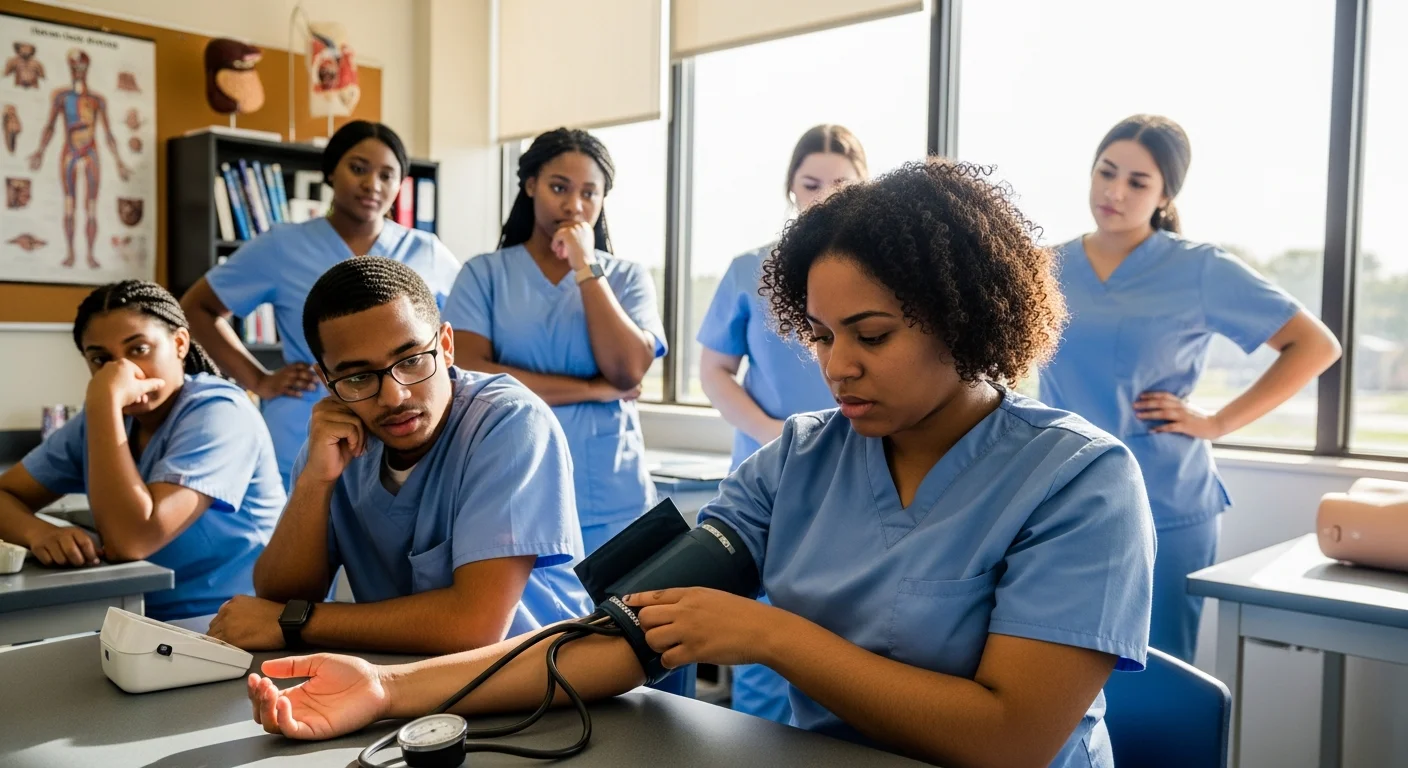
To get your CNA license in Florida, you’ll complete 120 hours of state-approved training, pass a two-part Prometric exam, and clear a Level II background check. Most people finish the full process in 6–8 weeks if they go full-time, or 4–7 months on a part-time schedule.
Florida CNA certification is issued by the Florida Board of Nursing through the Department of Health. This article covers initial certification from start to finish — including what it costs, the challenge exam pathway for people with prior training, reciprocity for CNAs transferring from another state, and renewal basics.
| What | Details |
|---|---|
| Total training hours | 120 (80 classroom + 40 clinical) |
| Exam | Two-part Prometric: 60-question written + 5-skill clinical demonstration |
| Exam cost | $155 total ($35 written only / $120 clinical only for retakes) |
| Background check | Level II, electronic fingerprinting required (ORI: EDOH0380Z) |
| Total cost estimate | $668–$2,360 (training + exam + fingerprinting + supplies) |
| Fastest timeline | ~6–8 weeks (full-time intensive program) |
Find CNA Training Programs Near You
Enter your zip code to find accredited CNA programs in your area. Compare costs and schedules.
What Is a Florida CNA?
In Florida, a Certified Nursing Assistant — also called “nurse aide” in state documents — is licensed by the Florida Board of Nursing through the Department of Health. Both terms appear on floridasnursing.gov and in AHCA program search tools, so use whichever your program uses.
Your licensed scope: assist patients with activities of daily living (bathing, dressing, feeding), take and record vital signs, reposition and transfer patients, and report changes in a patient’s condition to the supervising RN or LPN. You are not licensed to administer medications or perform clinical procedures independently.
Florida has one of the largest elderly populations in the country. That creates sustained CNA demand — particularly in long-term care facilities, which are the state’s primary employer for certified nursing assistants. Sections 9, 10, and 11 cover the challenge exam option, reciprocity for out-of-state CNAs, and renewal for readers who need those paths.
Meet the Basic Requirements
Before enrolling in any training program, confirm you meet these requirements (Florida Board of Nursing):
- Age 18 or older to apply for your license. Some programs accept students at 16 for training enrollment — but Florida requires 18 to submit a license application. You can complete training at 16; you can’t get licensed until 18.
- High school diploma or GED required.
- Current CPR certification — must remain valid through training and your exam date. American Heart Association BLS for Healthcare Providers is widely accepted. Most programs help you get certified if you don’t already have it.
- Physical ability to meet job demands — the clinical component requires lifting, standing, and extended time on your feet. Programs may require a basic health screening.
- Ability to pass a Level II background check — a separate process from basic eligibility, covered fully in Step 3 below.
No prior healthcare experience is required. If you meet these criteria, you’re ready to enroll.
Need BLS certification? Most programs require current BLS before enrollment. Healthcare BLS + First Aid from ProTrainings → Sponsored
Complete a State-Approved Training Program
Florida requires 120 hours of total training: 80 hours of classroom instruction and 40 hours of supervised clinical practice. Of those 40 clinical hours, at least 20 must be completed in a licensed nursing home or long-term care facility. That’s a Florida-specific rule that’s more restrictive than most other states — not every clinical placement qualifies.
Every program must be approved by the Agency for Health Care Administration (AHCA). Enrollment in a non-AHCA-approved program means you won’t qualify to sit for the Prometric exam. Verify AHCA approval before paying any deposit.
Types of Programs
| Program Type | Typical Cost | Timeline | Best For |
|---|---|---|---|
| Community college | $800–$1,479 | 3–6 months (part-time) | Financial aid eligibility; recognized credential |
| Private vocational school | $500–$1,700 | 4–6 weeks (intensive) | Fast completion; pay out of pocket |
| Hybrid (online theory + in-person clinical) | $199–$600 | Varies | Schedule flexibility; clinical still in-person |
| Employer-sponsored | Free or reduced | Varies | Job offer required first |
| Adult education center | Low / free | Part-time | Lowest-cost path for eligible applicants |
Named Florida programs with current pricing:
- Miami Dade College: $1,479 for the full 120-hour program — one of the most recognized community college options in South Florida
- South Florida State College’s CNA program: South-Central Florida; state-approved community college pathway
- Cape Coral Technical College’s CNA program: Southwest Florida regional option
- Daytona State College’s CNA program: Volusia County and surrounding area
- FloridaCNAOnline: $199 for the theory portion — but that excludes the $155 Prometric exam fee and $63–$105 fingerprinting. True all-in starting cost: roughly $417 before supplies.
One clarification on “online CNA programs in Florida”: the classroom and theory portion can be completed online in a hybrid format. The 40 clinical hours cannot be done online. Any program advertising “100% online CNA certification in Florida” is either not AHCA-approved or misrepresenting its format. Look for AHCA verification before enrolling.
The right program comes down to your timeline and budget. Use the AHCA approved program search to find verified options in your county.
What Training Costs in Florida
Most program pages only show tuition. Here’s what you’ll actually spend from enrollment to license in hand:
| Cost Item | Range | Notes |
|---|---|---|
| Training program | $400–$2,000 | Community college ~$1,000–$1,479; private schools $500–$1,700; online from $199 |
| Prometric exam (full) | $155 | $35 written only / $120 clinical only for retakes |
| Background check / fingerprinting | $63–$105 | Livescan service provider fee; paid to the fingerprinting location, not the state |
| Materials, uniform, supplies | $50–$100 | Varies by program; sometimes bundled into tuition |
| Total estimated range | $668–$2,360 | Before financial aid or employer reimbursement |
The cost range comes down to what’s included, where the program is, and whether books, uniforms, and clinical fees are bundled or billed separately. FloridaCNAOnline’s $199 sticker doesn’t include exam or fingerprinting fees. Miami Dade’s $1,479 typically includes clinical placement, materials, and program support.
Two costs most candidates only discover at enrollment or at program completion: the $155 Prometric exam fee and the $63–$105 fingerprinting cost are mandatory for every Florida CNA applicant, regardless of which program you choose. Budget at least $218–$260 on top of your training cost. The total cost table above shows what you’re actually committing to.
Free and Low-Cost Options
If the cost table is a barrier, three pathways offer lower or zero out-of-pocket cost:
1. Adult education centers. Florida’s Adult and Community Education (ACE) program offers CNA training through public school districts at significantly reduced cost — typically $200–$400 total including materials. Each county runs its own program. Search your county school district’s adult education page to find local options.
2. Employer-sponsored programs. Some nursing homes, assisted living facilities, and hospital systems in Florida pay for CNA training in exchange for a work commitment after certification — typically 6–12 months of employment. You’d need a job offer first, then training. Under federal law (42 CFR § 483.152), nursing facilities must reimburse training costs for employees who become certified within 12 months. That’s a federal right, not a discretionary perk. Ask any long-term care facility you apply to whether they sponsor training.
3. Workforce development grants. CareerSource Florida offers grants through local career centers for healthcare training including CNA programs. Availability varies by county and funding cycle. Check your local CareerSource office before paying out of pocket.
These options are real, but not guaranteed. Employer-sponsored requires a job offer first; grants require meeting eligibility criteria. Know they exist before paying full price at a private school.
Once you’ve completed your training program, you’ll need to clear a background check before sitting for the exam.
Complete a Level II Background Check
As of 2024, Florida requires electronic fingerprinting for CNA background checks. Ink fingerprinting is no longer accepted. House Bill 975, passed in Florida’s 2024 legislative session, mandated this change. If you find an older guide that still describes ink fingerprinting as an option, that information is outdated.
A Level II background check screens both Florida and national criminal records — more thorough than a Level I check. Many candidates with any past record wonder whether they’re automatically disqualified. The direct answer: not all records disqualify you. Florida reviews most offenses case-by-case, with rehabilitation evidence considered. Disqualifying offenses under Section 435.04, Florida Statutes include felony assault, battery, sexual offenses, domestic violence, and abuse or neglect of vulnerable adults. Certain serious offenses are automatically disqualifying. Check the Board of Nursing’s disqualifying offenses list before investing in training if this is a concern.
Florida CNA Background Check — Required ORI Number
When submitting Livescan fingerprints, provide ORI number: EDOH0380Z
This identifies the Florida Board of Nursing as the requesting agency. Using the wrong ORI number sends your fingerprint results to the wrong agency and delays your license.
The step-by-step submission process:
- Find a state-authorized Livescan provider via the Florida Health Source background screening page
- Bring valid government-issued ID and payment ($63–$105)
- Provide the technician with ORI number EDOH0380Z
- Fingerprints are submitted electronically to FDLE (Florida Department of Law Enforcement)
- Results route to the Care Provider Background Screening Clearinghouse
- Results reach the Board of Nursing within 1–2 weeks
Most programs have students start fingerprinting during training so results are ready when exam registration opens. Waiting until after training adds 1–2 weeks to your overall timeline. Start early.
After clearing your background check, you’re ready to register for the exam.
Register and Pass the Prometric CNA Exam
The Florida CNA exam has two parts: a written test and a clinical skills demonstration. Both must be passed. Fail one part and you retake only that part. Fail any combination of three total attempts and Florida requires you to complete the full 120-hour training again before retesting.
Written exam: 60 multiple-choice questions, 90-minute time limit, computer-based. Administered at Prometric testing centers across Florida. An oral version is available for candidates with reading challenges.
Clinical skills exam: You demonstrate 5 skills before a trained evaluator in 31–40 minutes.
Always tested on the Florida CNA exam (Florida Board of Nursing):
- Handwashing
- One indirect care skill (infection control or communication-related)
The remaining three skills are drawn randomly from the full skill pool. Practice everything — but know handwashing cold. Missing a handwashing step is the most commonly cited reason for skills exam failure.
Exam costs (Prometric Florida):
| Exam | Cost |
|---|---|
| Full exam (written + clinical) | $155 |
| Written portion only (retake) | $35 |
| Clinical skills only (retake) | $120 |
| Rescheduling fee | $35 |
Register at prometric.com/nurseaide/fl. Book as soon as you receive your Authorization to Test (ATT) — Prometric scheduling in Florida fills quickly, and 2–4 week delays are common for candidates who wait.
For the complete skills list, study strategies, and test day walkthrough, see our Florida CNA exam guide.
Apply for Your Florida CNA License
After passing both parts of the Prometric exam, apply for your license at flhealthsource.gov — the Florida Department of Health’s official online portal. Create an account, submit your application, and pay the licensing fee. Verify the current fee at floridasnursing.gov at the time you apply.
Processing takes 1–2 weeks after your exam results and application are submitted. Once issued, your CNA license number appears in your Florida Health Source account and in the public MQA database. Employers verify your active license status through the MQA portal before hiring you for direct patient care.
A physical license card may or may not be issued. Digital verification through the MQA portal is the standard for employer verification in Florida. Once your license number appears as active in the MQA database — typically 1–2 weeks after passing your exam — you can start applying to positions that require a current active CNA license.
Now that you know the steps, the obvious question: how long does this actually take?
Ready to Compare CNA Programs?
View accredited CNA training options near you. Compare costs, schedules, and program details.
How Long Does It Take?
The fastest path to your Florida CNA license is about 6–8 weeks if you complete a full-time intensive program, start your background check during training, and book your Prometric exam the moment you get your ATT. Most working adults take 4–7 months through part-time programs.
| Phase | Full-Time Path | Part-Time Path |
|---|---|---|
| Choose a program and enroll | 1–2 weeks | 2–4 weeks |
| Complete training (120 hours) | 3–4 weeks | 3–6 months |
| Background check processing | 1–2 weeks (concurrent with training) | 1–2 weeks (concurrent) |
| Exam registration (Prometric) | 1–2 weeks after training | 1–2 weeks after training |
| Schedule and sit the exam | 1–4 weeks out | 1–4 weeks out |
| License processing after passing | 1–2 weeks | 1–2 weeks |
| Total | ~6–8 weeks | ~4–7 months |
Three variables extend your timeline beyond the minimums: community college programs often only enroll quarterly (adding up to 3 months before you start); Prometric exam slots fill quickly (book the moment you get your ATT); and background check processing takes 1–2 weeks regardless of path.
The “certified in 6 weeks” claim you see in program marketing applies to full-time intensive programs with no scheduling delays. For anyone working while training, 4–7 months is the realistic range.
Need BLS certification? Most programs require current BLS before enrollment. Healthcare BLS + First Aid from ProTrainings → Sponsored
How to Look Up Your Florida CNA License
Check your CNA license status at the MQA Online Services portal — Florida’s public license verification database. Search by name or license number to see your license status (active, inactive, or expired), your license number, and your expiration date.
Florida employers are required to verify active license status through the MQA portal before hiring anyone for direct patient care. Most facilities check before your first shift. If your license doesn’t appear after completing the process, contact the Board of Nursing through floridasnursing.gov.
Keep your contact information current in the portal. Renewal notices go to the address on file.
Can You Skip Training? The Challenge Exam Option
Under Florida Statute 464.203, Florida allows candidates who meet the basic eligibility requirements — age 18 or older, OR a high school diploma or GED — to challenge the CNA exam directly without completing a 120-hour training program first. This is called “challenging” the exam, and it’s an option many candidates don’t know exists.
The basic eligibility is intentionally broad. Florida’s philosophy is that demonstrated competency matters more than seat time. If you can pass the exam, you can become certified — regardless of how you acquired the knowledge.
Common paths that lead candidates to challenge the exam:
- Military medical training (medics, corpsmen, and certain military healthcare occupations with documented clinical training)
- Current enrollment in or recent graduation from an accredited nursing program (LPN or RN students who have completed clinical coursework)
- Prior CNA training completed outside Florida that meets the 120-hour requirement
- Other healthcare training as determined by the Board (e.g., home health aide training meeting specified criteria)
- Self-study candidates who meet the age or education requirement and are confident they can pass without formal classroom training
What does NOT substitute for the eligibility requirement: Neither healthcare work experience nor time spent in a clinical setting automatically qualifies you. The challenge pathway is open because of the age/education floor — not because of informal experience on the job.
How to apply:
- Confirm you meet one of the qualifying criteria above
- Apply to the Florida Board of Nursing for challenge exam approval at floridasnursing.gov
- Do not register with Prometric until you receive Board approval
- Once approved, register at prometric.com/nurseaide/fl
- Take the same two-part Prometric exam — same format, same $155 cost, same skills tested
If your application is denied, you’ll need to complete a state-approved 120-hour training program before registering for the exam. The Board makes the final determination on eligibility.
For anyone who qualifies, this pathway can save weeks of training and $400–$1,000 in program costs.
Transferring Your CNA License to Florida
If you hold a current CNA license in any U.S. state, territory, or Washington D.C., you can transfer it to Florida through the Board of Nursing’s endorsement process. Florida calls this “endorsement” rather than “reciprocity” — both terms appear in searches and both refer to the same process.
For florida cna reciprocity/endorsement, you’ll need:
– An active, unencumbered CNA license in good standing from your originating state
– No substantiated findings of patient abuse, neglect, or exploitation on record
– A Level II background check (the same Livescan fingerprinting process as new applicants, ORI EDOH0380Z)
The four steps:
- Download and complete the CNA endorsement application from floridasnursing.gov
- Submit the application and fee to the Florida Board of Nursing
- Complete Livescan fingerprinting using ORI EDOH0380Z
- The Board requests verification from your originating state
Full processing typically takes 3–6 weeks. The verification request to your originating state is the main variable. If you have a start date with a Florida employer, apply early.
Keeping Your License Active: Renewal Basics
Your Florida CNA license renews every 2 years. The on-time renewal fee is $55. Renew 90 days or more after expiration and the fee increases to $105. Renew at flhealthsource.gov using your license number.
You must complete 24 hours of continuing education per cycle. Required CE topics include infection control, domestic violence, medical record documentation, resident rights, communication with cognitively impaired patients, CPR, and medical error prevention. If you’re working for a Florida healthcare employer, most of these hours are typically covered through mandatory in-service training.
The work requirement matters: to remain on the Florida CNA registry, you must have performed nursing-related services for monetary compensation within the past 24 consecutive months. You cannot renew a credential you haven’t actively used. After 24 months without CNA employment, you’d need to re-apply for certification.
If your license expires, you have 90 days to renew at the $105 late fee. After 90 days, your license becomes “null and void” and reinstatement requires passing the Prometric exam again.
What Do Florida CNAs Actually Do?
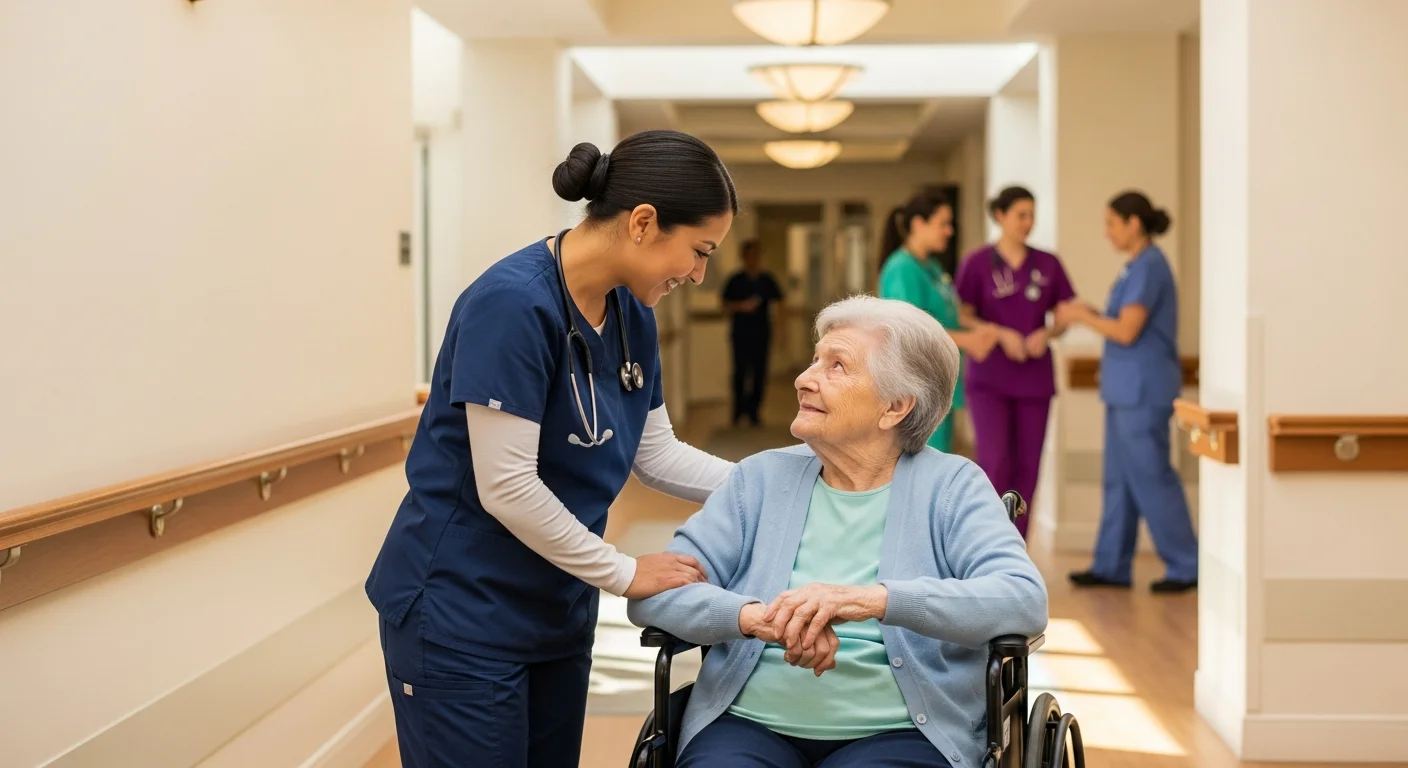
Florida CNAs work primarily in long-term care facilities and nursing homes — the most common setting given the state’s large elderly population. Other settings include hospitals, assisted living facilities, home health agencies, and hospice care. Hospital positions typically offer better pay and lighter patient ratios but are harder to get without prior experience.
Florida’s minimum staffing requirements for nursing homes are set under Chapter 400, Florida Statutes: 2.9 nursing hours per resident per day, with at least one RN on duty for 8 of every 24 hours. In practice, actual staffing on a given shift varies significantly by facility size, census, and turnover. Florida consistently ranks among states with documented staffing shortfalls in long-term care. When evaluating job offers, ask directly: what is the typical CNA-to-resident ratio on the floor you’d be assigned to? That one question tells you more about your workday than any job listing will.
The job is physically demanding. Most of a shift is spent on your feet — transfers, repositioning, and care rounds. For many CNAs, the long-term relationships with patients are what keep them in the field, even when conditions are hard.
Is Becoming a CNA in Florida Worth It?
Here’s the financial picture: total training and certification costs run $668–$2,360. According to the U.S. Bureau of Labor Statistics (BLS OEWS, May 2023), the median annual wage for nursing assistants in Florida is approximately $31,200 — about $15.00 per hour. Entry-level positions run $13–$15/hour. At $14 per hour full-time, you’d earn your total training investment back in about 6–10 weeks of starting work.
Starting wages are real, and they can be tight. Entry pay in high cost-of-living areas like Miami and Tampa means $14/hour full-time doesn’t go far. The pay improves with experience and facility type. Experienced CNAs (5-plus years) average $40,000 or more in Florida. Agency and float pool positions can pay $20–$22 per hour for CNAs willing to work flexible assignments.
In nursing communities, the question of whether to work as a CNA before nursing school generates strong opinions:
“She told me her plan was to blow straight through school to being an NP and never actually work as an RN. She has never worked as a CNA.”
(3,231 upvotes — Reddit user, r/nursing)
The community response was pointed. If nursing school is your goal, working as a CNA first gives you documented patient care hours that strengthen your RN application — and a foundation in patient communication, physical care, and clinical observation that shows in rotations.
Whether CNA certification is a destination or a stepping stone depends entirely on your goals. The same 120 hours of training and $155 exam gets you there either way. For a complete breakdown of what Florida CNAs earn by city, setting, and experience level, see our Florida CNA salary guide.
Compare CNA Programs in Your Area
You’ve seen the requirements, costs, and timeline. Enter your zip code to find accredited programs near you.
Next Steps
Here are three actions based on where you are in the process:
-
Find a state-approved program: Use the AHCA’s approved program search to find verified CNA training programs in your county. Confirm AHCA approval before enrolling or paying a deposit.
-
Understand the exam: See what the Prometric exam covers — the 5 skills you’ll demonstrate, the written exam format, and how to prepare. Florida CNA exam guide.
-
Check the pay: See what Florida CNAs earn by city, setting, and experience level. Florida CNA salary breakdown.