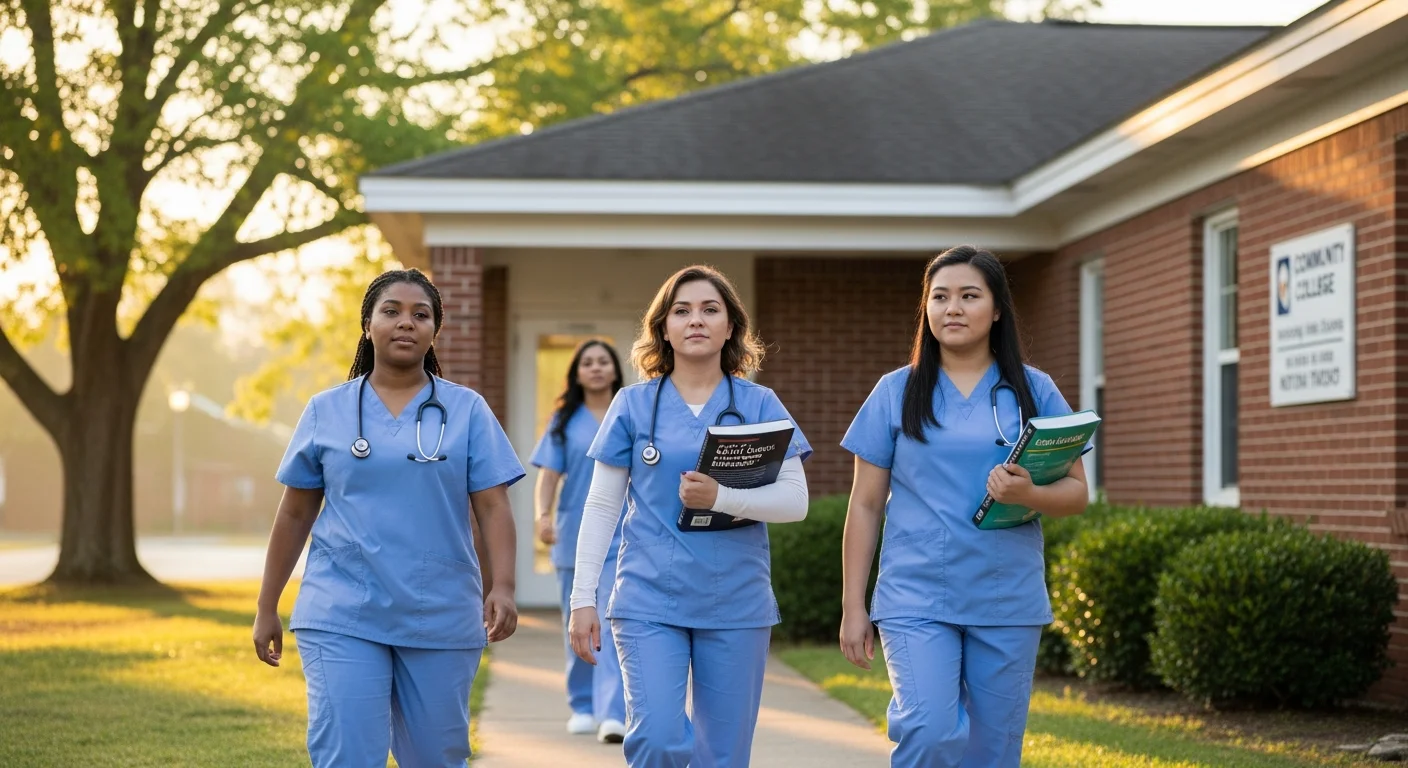
To become a CNA in Kansas, you need to complete a minimum of 90 hours of KDADS-approved training and pass a two-part state exam. The total process takes 2-8 weeks for training, plus exam scheduling. Kansas CNA certification is administered by the Kansas Department for Aging and Disability Services (KDADS), which maintains the state registry and sets all credentialing requirements.
If you are still exploring whether this career fits, start with what a CNA does day to day.
Kansas CNA Certification at a Glance
Kansas requires 90 hours of KDADS-approved training and a passing score on a two-part state exam. These are the numbers and requirements — the sections below explain each one.
| Requirement | Details |
|---|---|
| Training | 90 hours minimum (45 classroom + 45 clinical), KDADS-approved program required |
| Exam Format | Written: 100 questions, 75% to pass / Skills: 5 clinical skills, 75% to pass |
| Exam Administrator | HDMaster LLP, at approved Kansas testing sites |
| Total Cost (out of pocket) | $1,100-$1,750 (tuition + fees + background check + exam) |
| Free Training | Available through Kansas Promise Scholarship and employer-sponsored programs |
| Timeline | 2-6 weeks for training + exam scheduling |
| Registry | Kansas Nurse Aide Registry, maintained by KDADS |
| Minimum Age | 16 years old (parental consent required if under 18) |
Kansas does not issue a physical CNA certification card. Your active status is verified through the online KDADS registry. The sections below walk through each step in detail.
✓ CNA PROGRAMS IN KANSAS
Find CNA Training Programs Near You
Enter your zip code to find accredited CNA programs in Kansas. Compare costs and schedules.
Programs near you • No obligation to enroll
Sponsored Ad
Step 1: Meet the Basic Requirements
Kansas has one of the lowest entry barriers for CNA certification in the country. You can start training at age 16 with no education requirements — no high school diploma, no GED required at the state level (KansasWorks).
If you are under 18, you will need parental consent to enroll.
Background Check
Before you begin clinical hours, you must complete a multi-agency background check. This is where Kansas differs from most states. Rather than a single criminal history check, Kansas runs your record through four separate agencies:
- Kansas Bureau of Investigation (KBI) — criminal history check (KSBN)
- KDADS — their own criminal record check
- DCF Adult Abuse, Neglect and Exploitation Central Registry — substantiated findings in adult care settings (Rewarding Work)
- DCF Child Abuse and Neglect Central Registry — substantiated findings involving minors
The combined cost is $57 (Sedgwick County).
Certain criminal offenses or findings on the DCF registries may disqualify you from CNA certification. If you have concerns about your background, contact KDADS directly before enrolling: 785-296-6877.
Some programs also require CPR/BLS certification (American Heart Association only, approximately $65), a TB test, and a current flu shot before clinical hours. These are program-level requirements, not state mandates — check with your specific program.
Step 2: Complete a KDADS-Approved Training Program
Kansas requires a minimum of 90 hours of KDADS-approved CNA training: 45 hours of classroom instruction and 45 hours of supervised clinical practice (KDADS Health Occupations Credentialing). The program must be KDADS-approved. If you complete training at a non-approved program, you will not be eligible for the state exam.
Choosing a training program is the biggest decision in this process — and it is normal to feel uncertain about it:
“Just signed up for my CNA class. I keep going back and forth on whether I’m making the right call, but I finally just did it. No more overthinking.”
— r/cna
That decision gets easier when you know exactly what Kansas requires. Here is what a KDADS-approved program looks like.
Two-Part Curriculum Structure
Kansas CNA training is divided into two parts (KDADS Health Occupations Credentialing):
Part I: Foundation (40 hours total)
– 20 hours of classroom instruction
– 20 hours of lab and clinical practice
– Covers: basic patient care skills, vital signs, communication, infection control, safety, and personal hygiene
Part II: Advanced Clinical (50 hours total)
– 25 hours of advanced classroom instruction
– 25 hours of supervised clinical practice in a licensed adult care home
– Covers: patient transfers, range of motion exercises, feeding assistance, advanced patient care skills
The key distinction: Part I lab hours can take place in a classroom lab. Part II clinical hours must be completed in a licensed adult care home — not a hospital, not a clinic. This is where you work with real patients under direct supervision.
Program Formats and Costs
Kansas programs come in three formats:
| Format | Duration | Schedule | Best For |
|---|---|---|---|
| Accelerated/Intensive | 2-3 weeks | Full-time, often 8+ hours/day | People who can commit full-time |
| Standard | 5-6 weeks | Part-time or hybrid | Working adults, students |
| Evening/Weekend | 6-8 weeks | Evenings and weekends | People who cannot leave daytime work |
Tuition ranges from $750 to $1,350 depending on institution type. Community colleges (JCCC, Coffeyville CC, Colby CC) typically fall at the lower end. Private and vocational programs like Mid-America College of Health Sciences run toward the higher end (KansasWorks).
Beyond tuition, budget for these additional costs:
| Item | Estimated Cost |
|---|---|
| Registration/enrollment fee | ~$25 |
| CPR/BLS certification (AHA only) | ~$65 |
| TB test | $15-$30 |
| Flu shot | $0-$30 |
| Scrubs (2 sets typical) | $25-$50 |
| Gait belt | $10-$20 |
| Additional fees subtotal | ~$140-$220 |
Total out-of-pocket before financial aid: approximately $1,100-$1,750 (tuition + additional fees + $57 background check + $38 exam).
What to Look for in a Program
Two checks before you enroll:
- Is the program KDADS-approved? This is non-negotiable. Verify at kdads.ks.gov before paying any deposit.
- For community college programs: Kansas Board of Regents accreditation is an additional quality signal.
Most programs also require AHA-certified CPR/BLS before orientation. Complete that before you show up on day one.
Browse CNA programs in Kansas to find KDADS-approved training near you, including Coffeyville Community College, Colby Community College, Fort Hays Tech / North Central Kansas, Neosho County Community College, and Bethel House Training Institute.
Not sure which program fits your schedule and budget? Read our guide on how to choose a CNA program. The next section covers every financial aid option available to reduce or eliminate your training costs.
Step 3: Pay for Training
The tuition price tag is only part of the picture. As one CNA shared after completing their program:
“Between the class, the scrubs, the background check, the TB test, and the exam fee, I spent close to $1,500. Nobody warned me about the extras.”
— r/cna
That experience is common — but it does not have to be yours. Here is the full cost breakdown for Kansas, including every fee, so there are no surprises. And below that, every financial aid option available to cover them.
Kansas Promise Scholarship
The Kansas Promise Scholarship is the biggest financial aid opportunity for Kansas CNA students, and no competitor explains it fully.
The scholarship covers tuition, books, and required expenses at eligible Kansas community and technical colleges. To qualify, you must be a Kansas resident enrolled in an eligible healthcare program. CNA training qualifies at participating schools including JCCC and Fort Hays Technical College. Most Kansas community and technical colleges participate — contact your school’s financial aid office to confirm eligibility and apply (JCCC).
One critical detail: after completing your program, you must live and work in Kansas for two years. If you plan to stay in Kansas after certification, this is effectively free training. If you may relocate within two years, factor that commitment into your decision before applying.
With the scholarship, your out-of-pocket costs drop to approximately $57-$300 (background check, personal supplies, exam fee).
WIOA and Employer-Sponsored Programs
WIOA (Workforce Innovation and Opportunity Act) provides federal workforce funding through local KansasWorks centers. Mid-America College of Health Sciences is listed as a WIOA-approved program on KansasWorks (KansasWorks). Contact your nearest KansasWorks center to check your eligibility.
Employer-sponsored training is another legitimate path to free certification. Some Kansas nursing homes and care facilities hire prospective CNAs and pay for their training. Life Care Center of Andover is one Kansas facility that has offered this model. Call facilities in your area and ask directly — not all of them advertise it.
| Pathway | Estimated Total Cost |
|---|---|
| Paying independently (community college) | $1,100-$1,500 |
| Paying independently (private/vocational) | $1,350-$1,750 |
| Kansas Promise Scholarship (eligible CC) | $57-$300 (supplies + exam only) |
| Employer-sponsored training | $0-$200 (personal supplies only) |
If you qualify for the Kansas Promise Scholarship or an employer-sponsored program, your training could cost $0.
Step 4: Pass the Kansas CNA State Exam
The Kansas CNA state exam is administered by HDMaster LLP at approved testing sites across the state (Donnelly College). The exam has two separate portions. You need to pass both.
Written Exam
The written portion has 100 multiple-choice questions. You have 2 hours to complete it. The passing score is 75% — meaning 75 correct answers (Donnelly College).
Questions cover patient care fundamentals, safety, infection control, communication, and CNA responsibilities.
Use our CNA practice exam to test your readiness, and review how to study for the CNA exam for a structured study approach. You can also learn more about the full CNA exam format before test day.
Skills Evaluation
The skills portion tests 5 clinical skills performed in front of an evaluator in approximately 30 minutes (Donnelly College). Skills are drawn from the Kansas approved list and may include handwashing, taking vital signs, patient positioning, range of motion exercises, and personal care tasks.
The evaluator grades your technique, communication with the patient, and infection control on every skill. Missing a critical step — like hand hygiene before a procedure — can result in failure on that skill. Get our CNA skills help resources and work through the CNA skills test series before exam day.
What to Expect on Test Day
Arrive at least 30 minutes early. Bring two forms of identification, at least one with a photo. The exam fee is $38, paid directly at the testing center and non-refundable. Results are typically available online within approximately one week.
Retake Policy
You get 3 attempts within 12 months from the date your training course started — not from your first exam attempt (Donnelly College).
This distinction matters. If you started your training program on March 1, your three-attempt window closes March 1 of the following year — regardless of when you first sat for the exam. Fail three times on either portion and you must retake the entire KDADS-approved training program before testing again.
The exam format can feel intimidating — especially the three-attempt limit. But preparation works, and the results speak for themselves:
“Passed my state exam today. Written and skills, first try. I studied for two weeks straight and practiced every skill until I could do them in my sleep. It’s doable.”
— r/cna
With your training program behind you and focused preparation, you are walking into that exam with the skills you need. If you do not pass on the first try, our guide on how to retake the CNA exam covers exactly what to do next.
Ready to Explore CNA Programs?
Compare accredited CNA training options near you.
Step 5: Get Listed on the Kansas Nurse Aide Registry
After you pass both portions of the Kansas CNA exam, KDADS adds your name to the Kansas Nurse Aide Registry. You do not need to submit a separate application (KDADS).
Kansas does not issue a physical CNA certification card. Your active certification status is verified exclusively through the online KDADS registry — that is what employers use to confirm your credentials (KDADS).
Many new CNAs are surprised by this. If an employer asks for your CNA card, direct them to the KDADS registry for online verification.
For questions about your registry listing, contact KDADS Health Occupations Credentialing at 785-296-6877 or [email protected].
For step-by-step instructions on how to look up your certification, verify credentials for an employer, or troubleshoot registry issues, see our complete guide to the Kansas Nurse Aide Registry.
Transferring Your CNA to Kansas (Reciprocity)
If you already hold an active CNA certification in another state, Kansas requires you to retest before being added to the state registry — even with years of experience. This is unusual; many states offer automatic reciprocity. Kansas does not (IntelyCare).
Here is the step-by-step process (KDADS Applications and Forms):
- Complete the KDADS interstate application form (KDADS Applications and Forms)
- Pay the $20 non-refundable application fee
- Mail your completed application to: KDADS / Health Occupations Credentialing, 612 S Kansas Avenue, Topeka KS 66603
- Complete the Kansas background check ($57) — KBI, KDADS, and both DCF registries
- Schedule and pass the Kansas Nurse Aide Test (100 written questions + 5 clinical skills, 75% to pass both)
The 4-month trainee window is the most important detail for your situation. While your application is processed and you prepare for the Kansas exam, you can work as a nurse aide trainee for up to 4 months. You start earning income in Kansas immediately while you study and schedule your exam.
If you are a military spouse stationed at Fort Riley or Fort Leavenworth, the 4-month trainee window gives you time to work while completing the Kansas testing requirement.
Keeping Your Certification Active (Renewal)
Once you are certified, keeping that certification active takes very little work, as long as you stay employed as a nurse aide. Your Kansas CNA certification is valid for 24 months (Clipboard Health).
To renew, you need at least one paid, documented 8-hour shift as a nurse aide within those 24 months. The shift must be in a nursing home or similar care facility — not in a doctor’s office or clinic.
Your employer documents the shift by submitting Form 5506-NAR to KDADS (IntelyCare). Contact your employer well before your certification expires to make sure this form is submitted on time.
If you do not meet the work requirement, you must complete a KDADS-approved refresher course before your certification renews. The refresher is 12 hours of classroom instruction plus 9 hours of lab practice (21 hours total) (JCCC). Some websites list the refresher at 10 or 12 hours — the KDADS-compliant requirement is 12 classroom + 9 lab.
Renewal is processed online through the KDADS registry. See our Kansas Nurse Aide Registry guide for step-by-step renewal instructions.
CNA Salary and Job Outlook in Kansas
The median annual wage for nursing assistants in Kansas is $35,320 ($16.98/hour), according to the U.S. Bureau of Labor Statistics Occupational Employment and Wage Statistics. Here is how pay is distributed across Kansas CNAs:
| Percentile | Annual Salary | Hourly Rate |
|---|---|---|
| 10th percentile | $27,580 | $13.26 |
| 25th percentile | $30,820 | $14.82 |
| Median | $35,320 | $16.98 |
| 75th percentile | $39,300 | $18.89 |
| 90th percentile | $44,490 | $21.39 |
CNAs working in Wichita and the Kansas City metro area generally earn more than those in rural Kansas. Reaching $25 per hour typically requires overtime, shift differentials (nights/weekends), or agency/PRN work.
The BLS projects 15% employment growth for nursing assistants nationally from 2023 to 2033, driven by aging population and increasing long-term care needs (BLS Occupational Outlook Handbook). Job listing aggregators show current Kansas postings averaging slightly higher than BLS figures, which may reflect recent market shifts not yet captured in federal data.
For a deeper look at pay by metro area and career advancement paths, see why become a CNA in Kansas. You can also review CNA patient ratios for workload context, and explore why CNA is considered one of the most AI-proof jobs without a degree.
Compare CNA Programs in Your Area
View accredited CNA training programs near you. Compare costs, schedules, and requirements.