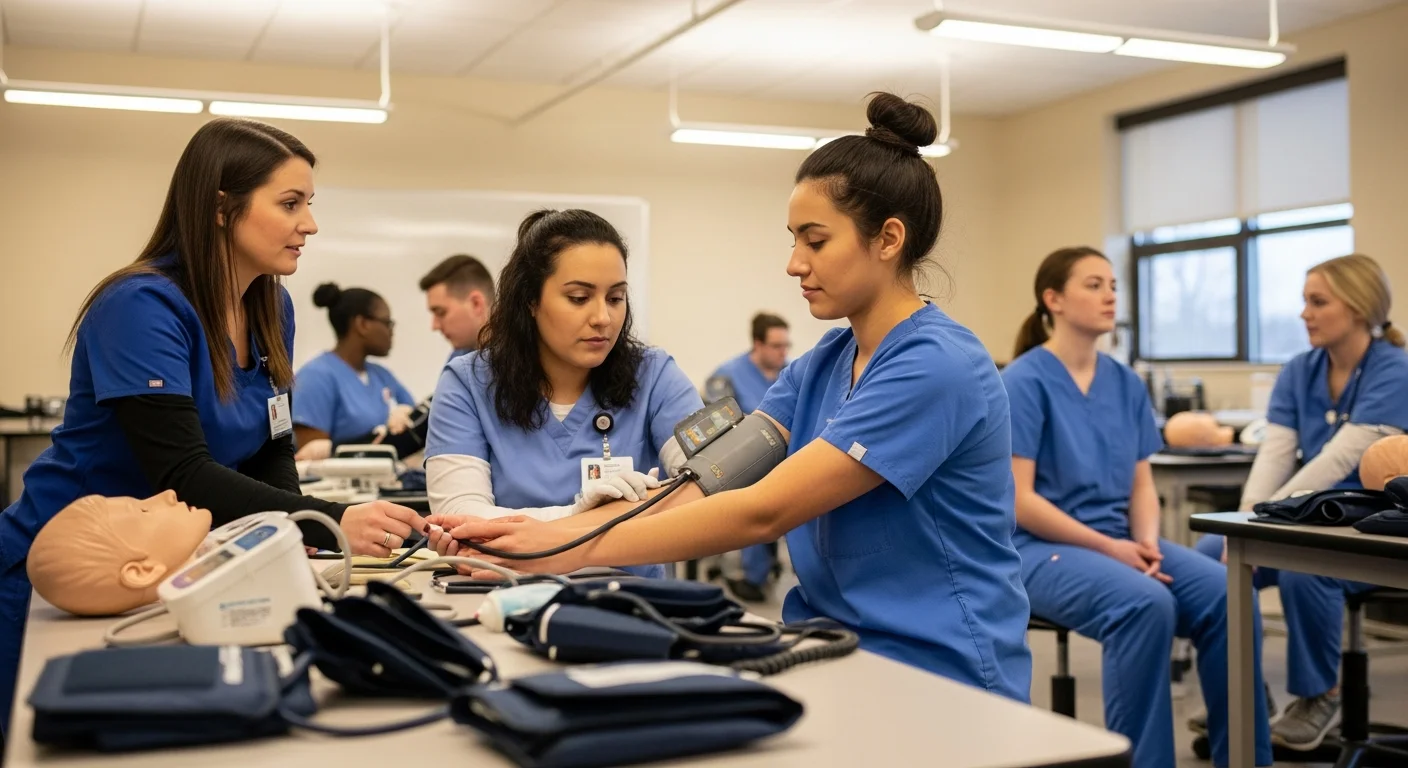
To become a CNA in Minnesota, you must complete a state-approved training program of at least 75 hours, pass a two-part competency exam, and get listed on the Minnesota Nurse Aide Registry. Training can take 2-8 weeks depending on the program you choose.
Minnesota’s demand for CNAs is growing. CNA consistently ranks among the state’s top occupations in demand, according to DEED’s Occupations in Demand data. Multiple pathways exist to get certified for free through the Next Generation Nursing Assistant Initiative and employer-sponsored programs, or you can pay $875 to $2,150 at a private program. The exam costs $250-$265.
This guide covers CNA certification for career changers, high school students (Minnesota allows certification at age 16), and anyone who wants to understand exactly what each step requires, what it costs, and what to expect on test day. Read about what a CNA does if you want context on the role before diving into the certification steps.
The process works. People complete it every day, including students balancing high school classes with clinical rotations:
“just wanted to say i’ve officially passed all the tests and i am a registered cna. i’m 17 in HS and went through a career and technology program in my school where i can get my cna. i’m low key proud of myself and i found this page so i wanted to share. to anyone else reading this: you’re doing amazing!”
(671 upvotes — Reddit user)
That is the finish line. Here is what it takes to get there.
Minnesota CNA Requirements at a Glance
Before the details, here is the complete picture in one scan:
| Requirement | Details |
|---|---|
| Minimum age | 16 years old |
| Training | 75 hours minimum from a state-approved program, including 16 hours supervised clinical with live patients |
| Background study | DHS Background Study via NETStudy 2.0, including fingerprinting at an IDEMIA site |
| Exam | Two parts: knowledge test (70 questions) + skills test (3-4 tasks) |
| Passing score | 74% on knowledge test (52 out of 70 correct) |
| Exam cost | $250-$265 (or $125 through International Institute of Minnesota) |
| Registry listing | Automatic after passing both exam portions |
Each requirement has details that affect your timeline and costs. Here is what you need to know about training programs first.
CNA PROGRAMS AVAILABLE IN MINNESOTA
Find CNA Training Programs Near You
Enter your zip code to compare accredited CNA programs in Minnesota. View costs, schedules, and program details.
Programs near you • No obligation to enroll
Sponsored Ad
Step 1 — Complete a State-Approved Training Program
Minnesota requires a minimum of 75 hours of instruction from a state-approved program, including 16 hours of supervised clinical practice with live patients. You cannot skip the clinical requirement or complete it online. Most Minnesota CNA programs following the HCCC/NA curriculum run 128 hours or more, nearly double the state minimum.
Your training covers communication and interpersonal skills, infection control, patient safety, vital signs, personal care, mobility support, dementia care, and abuse/neglect reporting. You must complete a DHS Background Study before beginning clinical rotations (details below).
If you have a criminal record, contact the Minnesota Department of Health at 651-215-8705 before enrolling. Certain offenses affect registry eligibility, and knowing ahead of time prevents wasted tuition.
Training Program Costs in Minnesota
Training costs are the first barrier most people hit, and the frustration is real:
“I paid $1400 for a 6 week CNA program. Now I make $14/hr. The math doesn’t math.”
(1,200+ upvotes — Reddit user)
That math changes dramatically in Minnesota. Before you pay anything, read the free training section below. If you do not qualify for free training, here is what current programs charge:
| Program | Total Cost | What’s Included | Exam Fee |
|---|---|---|---|
| Minnesota State College Southeast | ~$875 | Tuition, fees, registry test (3-credit course) | Included |
| Scrubs Academy | $1,250 | Tuition, books, supplies | $275 extra |
| Prime Time Medical Training | $1,450 | Course/lab fees | Extra (uniform and background check also extra) |
| HeartCert CPR | $1,500 | Course + exam prep | Included |
| Healthy Helpful Insight | $1,850-$2,150 | Varies by package | State fees often not included |
| International Institute of MN | FREE | Training for New Americans | $125 certification test |
Always confirm what is and is not included before enrolling. Some programs include the exam fee in their tuition; others do not. Not sure how to choose a CNA program? Our guide walks through what to ask before you commit.
How to Verify a Program Is Approved
Before you enroll or pay, confirm the program appears on MDH’s official Nursing Assistant Training Programs list. Do not rely on marketing language like “state-aligned” or “exam prep” — only programs on this list qualify you to sit for the competency exam.
If you are a high school student, filter the list by “Secondary” program type to find the 19 approved high school programs statewide.
Background Study (NETStudy 2.0)
Minnesota requires a DHS Background Study — not a standard criminal background check — before you begin clinical rotations. Here is what that means:
- Your training program initiates the request through the NETStudy 2.0 system. You do not apply on your own.
- You will receive a Background Study Notice via email with instructions to complete fingerprinting.
- Visit an IDEMIA fingerprinting site for digital fingerprints and a photo. Locations are listed on the MN DHS background study page.
- Cost is typically $32-$40, often paid by the student unless the program is employer-sponsored.
- Processing takes 2-5 business days in most cases, though complex reviews take longer.
Certain offenses — particularly abuse, neglect, or theft involving vulnerable adults — result in disqualification from the Nurse Aide Registry. If you have a criminal history, contact MDH at 651-215-8705 before enrolling to discuss your situation and avoid wasted tuition.
Free and Subsidized Training Options
You may not need to pay anything at all. Minnesota has stronger free training pathways than most states:
-
Next Generation Nursing Assistant Initiative (Minnesota Office of Higher Education): Covers tuition, fees, books, scrubs, exam fees, transportation, and technology costs. More than 1,000 Minnesotans have earned CNA certification through this program. Apply through ohe.state.mn.us.
-
Employer-sponsored training (federal mandate): Federal law under 42 CFR §483.152 requires Medicaid/Medicare-certified nursing facilities to cover your CNA training and testing costs if you complete certification within 12 months of hire. Many nursing homes will hire you first, then pay for your training.
-
WIOA/CareerForce grants: Programs like Prime Time Medical Training are WIOA-eligible. Call 833-905-WORK or contact your local CareerForce center to check eligibility.
-
MN Nursing Facility Employee Scholarship Program: If you already work in a nursing facility, the Minnesota Department of Human Services provides scholarship funding for staff pursuing CNA certification. Ask your HR department or visit mn.gov/dhs.
-
M State grants and scholarships: Over half of M State students qualify for tuition-free education through institutional grants. Ask the financial aid office before assuming you pay full tuition.
-
International Institute of Minnesota: Free Nursing Assistant Training for New Americans. A $125 state certification test fee applies, which is lower than the standard $250-$265.
If you are considering online CNA classes, note that Minnesota requires in-person clinical hours. No program can fulfill the 16-hour supervised clinical requirement remotely.
High School Students
Minnesota allows CNA certification starting at age 16. Nineteen high schools across the state offer state-approved CNA training programs through career and technology pathways. Testing fees may be covered through state initiatives. You do not need a high school diploma or GED to take the competency exam.
Step 2 -- Pass the Minnesota Nurse Aide Competency Exam
The Minnesota Nurse Aide Competency Exam has two parts: a knowledge test and a hands-on skills test. You must pass both to get listed on the registry.
The exam is administered by Headmaster (D&S Diversified Technologies), the MDH-approved test vendor for Minnesota. This is not Prometric and not Credentia. All study materials, registration, and exam logistics go through Headmaster. For a broader overview, see our CNA exam guide.
The competency exam is where anxiety peaks for most CNA students, and not without reason:
"I just failed my CNA skills test and I'm devastated. I studied for weeks but the format was completely different from what my instructor prepared us for."
(800+ upvotes -- Reddit user)
That information gap is fixable. Here is exactly what the Minnesota competency exam looks like, section by section, so nothing catches you off guard.
Knowledge Test
The knowledge test is 70 multiple-choice questions with a 120-minute time limit. Most candidates finish well before time runs out. You need 52 correct answers to pass -- that is 74%.
Content areas covered: basic nursing skills, personal care, mental health and social service needs, residents' rights, safety and emergency procedures, infection control, and communication.
As of January 27, 2025, the knowledge test is available in English, Spanish, Somali, and Hmong, per Minnesota Statutes §144A.61. Select your preferred language when registering through the Headmaster TMU portal. The skills test is conducted in-person, with interpreter services available upon request.
You can take the knowledge test virtually or in-person. The skills test is in-person only.
Skills Test
The skills test consists of 3-4 randomly selected nursing assistant tasks completed in 30 minutes. You will not know which specific skills you will be tested on until test day. Practice all of them.
You must wear full clinical attire: scrubs, closed-toe shoes, long hair pulled back. An evaluator watches you perform each task and scores specific steps in a predetermined order.
Common tested skills include handwashing, vital signs measurement, patient positioning, bed-making with an occupied bed, range-of-motion exercises, ambulation assistance, catheter care, and feeding assistance.
The skills test measures clinical competence, but the real-world skills it represents go beyond what any checklist captures. Experienced CNAs know this:
"Teaching a baby CNA how to deal with a freshly passed person..........She was wide eyed and terrified. 'I don't think I can do this!' I walked her through post mortem care step by step...I explained that this was normal. I told her, 'The dead can't hurt you. But we must take the utmost care for them and be respectful.' She calmed down a lot, and was able to go on into her CNA career. I've always felt good about teaching her about death!"
(758 upvotes -- Reddit user)
That mentorship starts with preparation. See our CNA skills test series for step-by-step skill breakdowns before test day.
Exam Registration
Register through the Headmaster TMU portal at mn.tmutest.com:
- Create a new account on the TMU portal.
- Upload your Training Completion Certificate (or select "Test-Out Candidate" if challenging the exam).
- Select "Schedule" to view the live map of testing sites (Century College, Minneapolis College, and others).
- Have ready: government-issued photo ID (name must match exactly), payment method ($250-$265), and any interpreter/accommodation request.
Test dates can fill up -- register as soon as your training program confirms completion. Most candidates can schedule within 1-2 weeks.
Exam Costs
| Test | Century College | Minneapolis College | International Institute |
|---|---|---|---|
| Full exam (knowledge + skills) | $250 | $265 | $125 |
| Knowledge only (retest) | $120 | $115 | -- |
| Skills only (retest) | $250 | $175 | -- |
If you do not pass the first time, you only need to retest the portion you failed. You do not retake the whole exam. Many training programs and employers will cover your exam fee -- ask before paying out of pocket.
For guidance on retaking the CNA exam after a first attempt, see our retake guide.
How to Prepare
-
Download the Headmaster mock skills PDF (free at hdmaster.com). This shows the exact steps evaluators score, not the version your instructor may have taught. Practice those specific steps, in that exact order.
-
Read the Minnesota Candidate Handbook Version 7 (updated March 26, 2025, available through the Headmaster TMU portal). It contains the official content outline, test day procedures, and ID requirements.
-
Take a CNA practice exam to assess your knowledge test readiness. The knowledge test covers the same NNAAP content domains used nationally.
-
Use a structured study approach with our guide on how to study for the CNA exam.
-
Practice skills on real people, not mannequins. Time yourself. Thirty minutes for 3-4 skills is tight under test conditions.
-
Focus on handwashing. Evaluators score it before and after every skill. It is the most common source of point deductions.
-
Review residents' rights throughout your studying, not just as one isolated topic. These questions appear across the knowledge test, not clustered in one section.
Nursing Assistant Review courses are available at Minnesota State colleges for candidates who want structured prep before testing. Contact Headmaster directly at 888-401-0462 (Monday-Friday, 7am-7pm) or [email protected].
Challenge/Test-Out Candidates
You can take the Minnesota competency exam without completing a state-approved training program if you have NOT completed MN-approved training within the last two years. This applies to nursing students, military medics, experienced CNAs from other states, and anyone whose previous training was more than two years ago.
Register through the Headmaster TMU portal at mn.tmutest.com. Bring a valid government-issued, signed, unexpired photo ID. The full exam fee of $250-$265 applies. The exam itself is identical to what trained candidates take.
Step 3 -- Get Listed on the Minnesota Nurse Aide Registry
After passing both parts of the exam, your results are submitted to the Minnesota Department of Health, and your name is added to the Minnesota Nurse Aide Registry. You cannot work in a Minnesota nursing home or certified boarding care home until your name appears on the registry.
The registry is the state's official database of certified nurse aides who have met Minnesota's training and testing standards. Employers check it before hiring you. The registry also records substantiated findings of abuse, neglect, and theft against vulnerable adults, which is why the background study requirement exists from the start.
Registry portal: nar.web.health.state.mn.us
Your certification typically appears on the registry within a few business days of passing your exam, though processing times vary -- contact MDH at 651-215-8705 to confirm current timing. The registry also handles interstate endorsement for CNAs transferring from other states; see Minnesota CNA Reciprocity for that process.
Registry Lookup
You can search the registry two ways:
- By certificate number -- if you already have your certificate number
- By last name + first name + last 4 digits of your Social Security number
The lookup shows your name, certification status, expiration date, and any substantiated findings on record. Employers use the same portal to verify your credentials before extending a job offer -- they can see whether any findings of abuse, neglect, or theft appear on your record alongside your certification status. The public can also search the registry.
If you need to check your status quickly, go directly to nar.web.health.state.mn.us and use the name search method.
Contact Information
| Phone | 651-215-8705 |
| Toll-free | 1-800-397-6124 (Minnesota callers only) |
| Hours | Monday-Friday, 8:00 a.m. to 4:30 p.m. |
| [email protected] | |
| In-person appointments | Schedule via [email protected] |
| Registry portal | nar.web.health.state.mn.us |
Common reasons to contact MDH: name change after certification, address updates, questions about a finding on your record, or issues with your listing not appearing after your exam.
Compare CNA Programs in Minnesota
View accredited training options near you. Compare costs and schedules.
Maintaining Your Minnesota CNA Certification
Your CNA certification in Minnesota is valid for 2 years. To keep it active, you must have worked at least 8 paid hours of nursing or nursing-related services under the supervision of a licensed nurse in an approved facility within that 24-month period.
Renew within 60 days before your expiration date through the registry portal at nar.web.health.state.mn.us. Submit proof of employment online -- pay stubs or work confirmation letters. There is no renewal fee if you meet the work requirement and renew on time.
If your certification lapses, you will need to retake the competency exam. You do not need to repeat a training program, but you do need to pass the knowledge and/or skills test again. Contact the registry at 651-215-8705 to determine what reinstatement requires in your specific situation.
CNA Salary in Minnesota
CNA pay is the most discussed topic in every nursing assistant community online, and the frustration is real:
"I wonder how many CNAs quit after this"
(4,223 upvotes -- Reddit user)
Minnesota CNAs earn more than the national average. Here is what the data actually shows.
CNAs in Minnesota earn a median of $19.38 per hour ($40,310 per year), according to the Bureau of Labor Statistics Occupational Employment and Wage Statistics.
| Wage Measure | Hourly | Annual |
|---|---|---|
| 10th percentile | $16.05 | $33,390 |
| Median (50th) | $19.38 | $40,310 |
| Mean | $19.85 | $41,290 |
| 90th percentile | $25.70 | $53,460 |
Source: BLS OES, May 2024 -- most recent state-level data available for SOC 31-1131 (Nursing Assistants) in Minnesota.
The national median is approximately $36,220/yr per Bureau of Labor Statistics -- Minnesota sits above that. Pay varies by location and setting. The Minnesota Department of Employment and Economic Development (DEED) reports higher wages in the Twin Cities metro than in Greater Minnesota. Hospital CNAs and those working nights or weekends earn above median through shift differentials; long-term care positions at smaller rural facilities pay below it. Check the DEED Occupations in Demand tool for wages in your county.
The median $19.38/hr reflects the starting point of a healthcare career, not the ceiling. Many CNAs use the credential to build experience, then move into LPN or RN programs where the salary picture changes significantly.
Career Advancement Paths
Many CNAs use their certification as a stepping stone into nursing. The hands-on experience you build as a CNA gives you a genuine advantage in LPN and RN programs -- you arrive with clinical exposure that classroom-only applicants do not have.
Career advancement from CNA to nursing is common, but the CNA community has an important reality check:
"Genuinely, for those who don't like being a CNA...what gives you the impression it'll be SO much better [as a nurse]?"
(1,000+ upvotes -- Reddit user)
Fair point. The physical demands of caregiving do not disappear with an RN license. But the scope of practice, compensation, and scheduling flexibility change substantially. In Minnesota, RNs earn a median of $43.79/hr compared to $19.38/hr for CNAs -- and hospital RN positions typically offer more schedule predictability than rotating long-term care shifts.
Concrete pathways from CNA in Minnesota:
-
CNA to LPN: Bridge programs at Minnesota State colleges. Typical timeline: 12-18 months after your CNA certification.
-
CNA to RN: Associate Degree in Nursing (ADN) programs are a 2-year pathway. Many RN programs give preference to applicants with CNA experience, and the CNA credential helps you confirm whether nursing is the right fit before committing to a longer program.
-
Specialized CNA roles: Hospital CNAs earn more than nursing home CNAs and work in acute care environments. Hospice CNAs work in end-of-life care with smaller patient loads. Geriatric care specialists focus on dementia and chronic illness populations. None of these require additional certification.
CNA ranks among Minnesota's highest-demand occupations, according to DEED's Occupations in Demand data. Demand is increasing, which typically improves wages and working conditions over time. For context on CNA patient ratios and what to evaluate when choosing a facility, see our staffing guide.
Find CNA Training Programs in Minnesota
Compare accredited programs near you. View costs, schedules, and request information from multiple schools.