To earn your CNA certification in Washington, you’ll complete 85-108 hours of approved training and pass a two-part state exam: a skills test first, then a separate knowledge test through Credentia. Washington officially calls the role Nursing Assistant Certified (NAC), but CNA is the title used by employers, job postings, and most of the industry. The certification process is managed by the Washington Department of Health (DOH), according to the Washington State Nursing Care Quality Assurance Commission (NCQAC).
The full path from enrollment to active certification typically takes 6 to 20 weeks. Here’s what to expect at each step.
Not sure if the CNA role is the right fit? Learn what a CNA does day-to-day before committing to the process.
| Requirement | Details |
|---|---|
| Minimum age | 18 years old |
| Training | 85-108 hours in a state-approved program |
| Exam | Two-part: skills test first, then knowledge test through Credentia (sequential) |
| Total cost estimate | $700-$2,500+ (training + exam + application fees) |
| Timeline | 6-20 weeks from enrollment to certification |
| Certification body | Washington Department of Health (DOH) |
The table above gives you the basics. The sections below walk you through each step in detail, including Washington-specific details you won’t find in a summary.
✓ CNA PROGRAMS AVAILABLE IN WASHINGTON
Find CNA Training Programs Near You
Enter your zip code to compare accredited CNA programs in Washington. View costs, schedules, and requirements.
Programs near you • No obligation to enroll
Sponsored Ad
Meet Basic Eligibility Requirements for Washington CNAs
Before you enroll in a training program, confirm you meet Washington’s entry requirements. The state keeps the bar practical: no college degree required, no specific work history needed.
Washington CNA eligibility checklist:
- Age: 18 years old minimum
- Health: Physical health requirements and up-to-date immunizations, including TB test results
- Background check: Washington State Patrol check AND FBI fingerprint check (both required)
- Education: No high school diploma or GED required by Washington state. Individual programs may set their own admissions requirements.
Background Check Requirements
Washington requires two background checks: a Washington State Patrol criminal history check and an FBI fingerprint-based check. Results go directly to the Department of Health for review.
Washington uses a specific list of disqualifying crimes maintained by DSHS. Crimes against persons (assault, robbery, kidnapping), sex offenses, drug manufacturing/delivery, and financial exploitation of vulnerable adults are among the categories that trigger a bar. Some disqualifications are permanent; others use a 10-year lookback period. Review the DSHS Secretary’s List of Disqualifying Crimes for the full breakdown before investing in training.
If you have concerns about your history, contact DOH Credentialing at (360) 236-4700 or [email protected] before investing in a training program.
NAR: The Training License for Facility-Hired Students
Here’s a Washington-specific detail most people don’t know: if a nursing facility hires you before you finish certification, Washington issues you a Nursing Assistant Registered (NAR) license. The NAR lets you work under direct supervision at that facility while you’re still enrolled in your training program.
The NAR is not the same as NAC (the full certification). It’s a temporary training license tied to your employer, and the facility applies for it on your behalf.
Once you complete training and pass both exams, you submit a separate NAC application to DOH and pay the application fee. After DOH processes your application, your credential status changes to “Active” in the Provider Credential Search. Until that happens, you must continue working under your NAR status. Passing the exam does not automatically make you an NAC.
This is one of the most common ways students get their training paid for.
Complete an Approved CNA Training Program in Washington
Washington approves training programs through NCQAC. Completing an unapproved program means you cannot sit for the state exam and will need to retrain. Always verify your program is on the approved list before enrolling.
Washington CNA programs vary in format, length, and pathway. Here’s what you need to know.
Three Training Pathways
Washington recognizes three pathways to CNA certification. Your pathway depends on your current credentials.
| Pathway | Who It’s For | Training Hours | Duration |
|---|---|---|---|
| Traditional NAC | New entrants without prior healthcare credential | 85-108 hours (35-60 classroom + ~33 skills lab + 40-50 clinical) | 4-15 weeks |
| HCA Bridge | Existing Home Care Aides registered in Washington | 36 hours | 2-4 weeks |
| MA Bridge | Existing Medical Assistants | Varies by program | Check with programs |
If you’re already working as a Home Care Aide in Washington, the HCA Bridge path cuts your training time by more than half. That’s a significant advantage most HCAs don’t know about.
For readers exploring flexible study formats, see online CNA classes for available options. Note that clinical hours require in-person attendance in Washington regardless of format.
One Washington-specific requirement applies to all three pathways: 7 hours of HIV/AIDS training, mandated by state law. This is already built into the curriculum at approved programs (per nursing.wa.gov) — you don’t need to arrange it separately. It often surprises students who’ve researched CNA training in other states.
What Training Covers
Training combines classroom instruction, skills lab practice, and supervised clinical hours. You’ll learn personal care skills (bathing, dressing, feeding, repositioning), vital signs measurement, infection control and standard precautions, patient rights and communication, body mechanics and safe patient movement, and documentation and reporting.
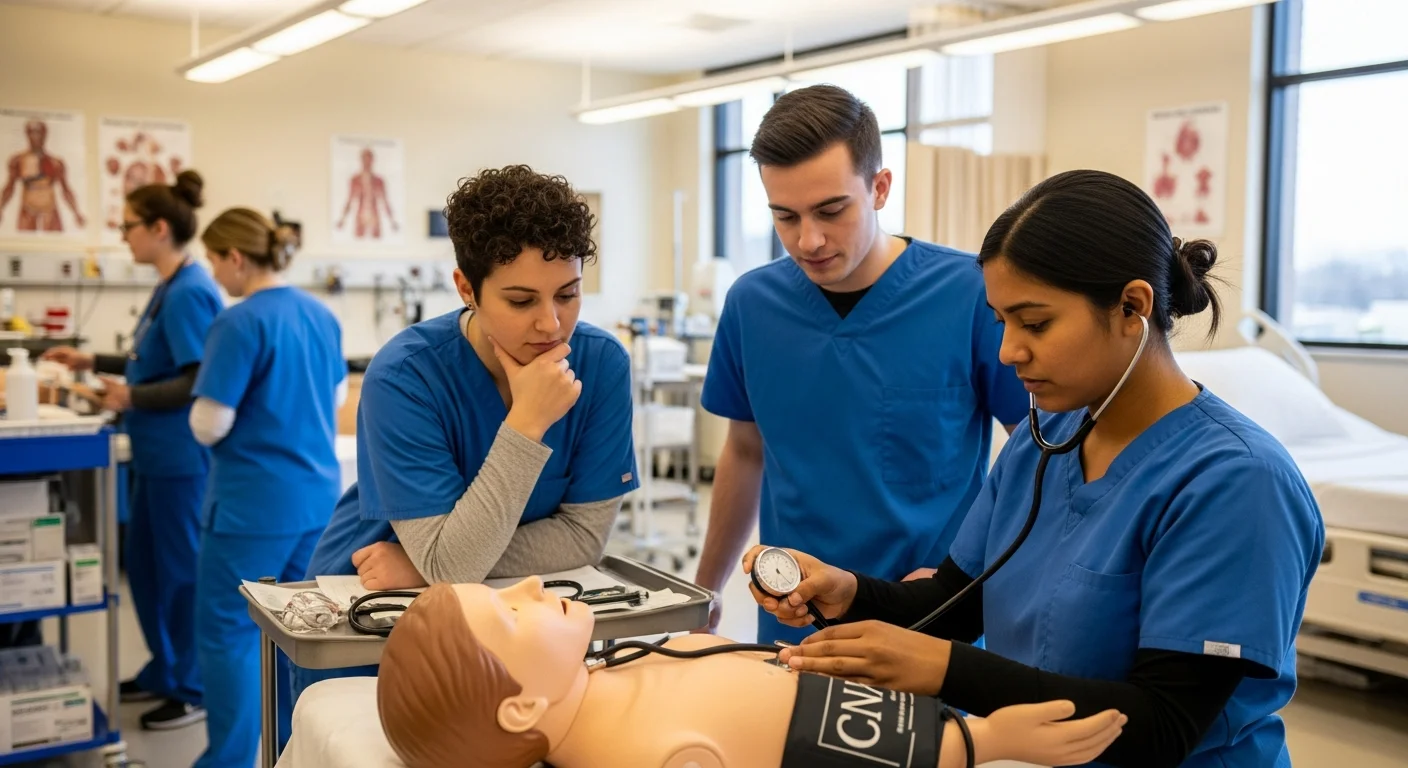
The skills lab is where you practice on mannequins and classmates before working with real patients. Clinical hours put you in a real facility under direct supervision.
Training is physically and emotionally demanding. By the end of your clinical hours, the skills you practiced in the lab become instinct.
How to Find Approved Programs
Use the NCQAC nursing assistant training programs list to find state-approved programs organized by region. Community colleges, vocational schools, hospitals, and employer-based programs all appear on this list.
Once you have a shortlist, our guide on how to choose a CNA program can help you compare options. Now that you know what training involves, the obvious next question: what does it cost?
How Much Does CNA Training Cost in Washington?
The total cost of becoming a CNA in Washington ranges from $700 to $2,500 or more. Training program fees are just the starting point.
Program Cost Breakdown
CNA training programs in Washington charge $500 to $2,200+ depending on the school type and format. NW NAC Training charges $2,200 all-inclusive (tuition, materials, uniforms, background check). Community college and vocational programs tend to land at the lower end of the range.
Additional Costs Beyond Tuition
These are the costs most people don’t budget for until it’s too late. DOH fees listed below are approximate ranges; check the DOH Nursing Assistant fee schedule for current exact amounts, as DOH updates fees periodically.
| Item | Estimated Cost |
|---|---|
| Training program | $500-$2,200+ |
| NAR application (DOH) | $65-$85 |
| Knowledge test (Credentia) | $55 |
| Skills test | Varies ($80-$100 at some programs; included in tuition at others) |
| NAC certification application (DOH) | $65-$85 |
| Background check | $20-$50 |
| TB test/immunizations | $50-$100 |
| Textbooks and supplies | $50-$150 |
| Total estimate | $700-$2,500+ |
Costs add up, and not every employer-sponsored program covers what they promise:
“My facility didn’t pay the scrub store for our uniforms”
(318 upvotes, r/cna)
If an employer offers to cover your costs, get the specifics in writing before you start. Ask exactly what is covered, what work commitment length is required, and what happens if you leave early.
Free and Low-Cost CNA Training Options in Washington
Washington has more free and subsidized training options than most states. Here’s how to find them:
- Employer-paid programs: Many nursing homes and long-term care facilities hire students as NARs and pay for training in exchange for a work commitment (typically 6-12 months). This is the most accessible free path for most applicants.
- DSHS reimbursement programs: DSHS reimburses certain nursing facilities for covering student training costs. Ask local facilities that accept Medicaid residents whether they participate.
- WIOA funding: Workforce Innovation and Opportunity Act funds, accessed through local WorkSource Washington offices, can cover tuition, books, and supplies for eligible applicants.
- DSHS BFET: The Basic Food Employment and Training program covers training costs for Washington residents receiving Basic Food (SNAP) benefits.
- Scholarships: The Long-Term Care Foundation of Washington State and the Washington State Nurses Foundation offer scholarships for CNA and long-term care training. Check their current application cycles directly.
- Federal and state financial aid: Federal Pell Grants (via FAFSA) and the Washington College Grant apply to qualifying programs at eligible community colleges and vocational schools.
Want to know what you’ll earn after certification? See our CNA Salary in Washington guide for the full breakdown.
Pass the Washington CNA Exam
Washington's certification exam has two parts, and the order matters. You take the skills test first. After you pass the skills test, you register separately for the knowledge test through Credentia. These are two different tests administered through two different systems.
This sequential process is the part that confuses most candidates. Here's exactly how it works.
Skills Test: What to Expect
The skills test is administered in person. You perform 5 randomly selected skills in front of a state-approved evaluator, with 30 minutes total for all five.
You won't know which 5 skills you'll be assigned until test day. Practice every skill, not just the ones you're confident in.
The test is administered either through your training program or through the WABON regional skills test scheduler. If your program includes the skills test in its curriculum, you'll test there. If not, you'll book through WABON.
One technique makes a significant difference: Narrate your steps aloud as you perform each skill. Evaluators need to hear your thought process, not just observe your hands. Common skills include handwashing, vital signs measurement, positioning, ambulation assistance, and personal care tasks.
Review each skill with our CNA skills test guide and watch demonstrations in our CNA skills test video series.
Knowledge Test Through Credentia
After passing the skills test, you register for the knowledge test through Credentia. This registration is completely separate from the skills test system.
The knowledge test is 70 questions: 60 scored multiple-choice questions covering nursing assistant knowledge, plus 10 unscored reading comprehension questions. You have 2 hours. The test is delivered online through Credentia's platform, and most candidates complete it from home.
An oral exam option (160 questions) is available for candidates who qualify. This matters if English isn't your first language -- contact Credentia to ask about eligibility.
Knowledge test fee: $55, paid to Credentia at registration. For a structured study plan, see our guide on how to study for the CNA exam.
Eligibility Routes Explained (E1, E2, E4, E6)
When registering with Credentia, you select your eligibility route. These codes tell Credentia which category of test-taker you are. Selecting the wrong route can delay your application.
| Route | Who It's For |
|---|---|
| E1 (New Graduate) | You completed a Washington-approved NAC program. This is the most common route. |
| E2 (Nursing Student) | You are currently enrolled in an RN or LPN program. |
| E4 (Out-of-State) | You completed a CNA training program in another state. If you already hold an active CNA from another state, see our Washington CNA reciprocity guide -- it may be a faster path. |
| E6 (Bridge Program) | You completed an HCA Bridge or MA Bridge program in Washington. |
Exam Fees, Retake Policy, and Practice Resources
| Item | Cost |
|---|---|
| Knowledge test (Credentia) | $55 per attempt |
| Skills test | Varies by program ($80-$100 at some; included in tuition at others) |
You get three attempts on each part. After three failed attempts on either the skills test or knowledge test, you must complete a new approved training program before you can retest. Each retake requires a new registration and fee payment. There is no mandatory waiting period between attempts.
The relief of passing is real. This post, with 671 upvotes, captures what most CNA students feel after completing the exam process:
"just wanted to say i've officially passed all the tests and i am a registered cna"
(671 upvotes, r/cna)
That kind of community celebration tells you something about the stress level going in. The best way to feel confident on test day is to know exactly what you're walking into -- and now you do.
Prepare with the Credentia NNAAP practice exam PDF, then practice with our CNA practice exam. If you've already failed once, see our guide on retaking the CNA exam for strategies specific to a second attempt.
Compare CNA Programs in Washington
View accredited training options near you. Compare costs and schedules.
Apply for Washington CNA Certification Through DOH
After passing both parts of the exam, apply to the Washington Department of Health for your official Nursing Assistant Certified (NAC) credential.
- Create a SecureAccess Washington (SAW) account at the DOH portal if you don't already have one.
- Submit your certification application through the DOH nursing assistant page.
- Pay the application fee: Check the DOH Nursing Assistant fee schedule for the current amount.
- Wait for processing: DOH typically processes NAC applications within 2-4 weeks, though times vary during peak periods. Track your application status through your SecureAccess Washington (SAW) account.
- Do not work as an NAC until your credential shows "Active": Check the DOH Provider Credential Search to confirm. If you were working as an NAR, continue under that status until your NAC is officially issued.
Questions about your application status? Contact DOH Credentialing at (360) 236-4700 or [email protected].
Washington Nurse Aide Registry and License Lookup
Washington maintains two separate systems for CNA records, run by two different state agencies. Knowing which one to use for a given task saves real confusion.
DOH Provider Credential Search
This is the primary verification tool. You can check your NAC certification status at the DOH Provider Credential Search. Enter your name or credential number to see your current status, expiration date, and any disciplinary actions on file.
Employers use this to verify active certification before hiring. Check your own status after your application is approved to confirm your credential shows as active.
DSHS OBRA Registry
Washington also maintains a separate OBRA (Omnibus Budget Reconciliation Act) registry through DSHS, distinct from your DOH certification. This is a federal requirement.
The OBRA registry tracks your employment history as a nursing assistant in Washington and records any findings of abuse, neglect, or misappropriation of property. To remain listed, you must complete 8 hours of paid CNA work under RN supervision in any 24-month period.
Contact the DSHS OBRA Registry at [email protected] with questions.
Your DOH certification is your state license. Your OBRA registry listing is your federal compliance record. You need both current. If you're working regularly as a CNA, you're maintaining both requirements automatically.
Keeping Your Washington CNA Certification Active
Washington CNA certification requires two ongoing requirements managed by two different agencies.
Annual DOH Renewal
Renew your DOH certification before your birthday each year. Check the DOH Nursing Assistant fee schedule for the current renewal fee. No continuing education credits are required for DOH certification renewal.
Renew through your SecureAccess Washington (SAW) account. Credit card payments carry a 2.5% convenience fee; ACH bank transfers have no fee.
OBRA Registry Work Requirement
Separately, show 8 hours of paid CNA work under RN supervision in any 24-month period to maintain your DSHS OBRA registry status. If you're working as a CNA, you're meeting this automatically.
The lapse consequence is significant: If your DOH certification goes more than 3 years without renewal, you must complete a new training program and pass both parts of the exam again.
The best protection is knowing your renewal deadline and keeping both systems current. For the complete step-by-step renewal process, including what to do if your certification has lapsed, see our CNA License Renewal in Washington guide.
CNA Career Outlook in Washington
Washington CNAs earn $20.40-$22.73 per hour on average, with annual salaries ranging from $42,430 to $52,306, according to Bureau of Labor Statistics occupational data. The national average is $17.41 per hour. Washington pays 15-30% more.
For a full breakdown by metro area, facility type, and experience level, see our CNA Salary in Washington guide.
Work Settings
Washington CNAs work across several care settings, each with different pay scales and environments:
- Skilled nursing facilities (SNFs): The largest employer category. Consistent hours, team-based.
- Hospitals: Typically the highest-paying setting. More acute patients, more specialized skills over time.
- Assisted living communities: Lighter care load than SNFs in many cases, consistent resident relationships.
- Adult family homes: A Washington-specific model -- small residential homes licensed for up to 6 adults. A significant part of WA's long-term care landscape that's less familiar to people from other states.
- Home care/home health: One-on-one care in clients' homes. More autonomy, more driving.
Career Advancement Pathways
CNA certification is a starting point, not a ceiling. Washington offers clear advancement paths:
- Licensed Practical Nurse (LPN): One-year programs accept CNA experience favorably in admissions. CNA work counts as direct patient care hours.
- Registered Nurse (RN): CNA experience strengthens nursing school applications and gives you real clinical exposure before enrolling.
- Patient Care Technician (PCT): An expanded role adding phlebotomy, EKG, and other clinical skills. Often achieved through hospital on-the-job training.
- Acute Care CNA: A hospital-based specialized role with additional training and typically higher pay.
CNA certification does not have an age limit or a ceiling. This Reddit post resonated for a reason:
"Starting a CNA program in middle age"
(223 upvotes, r/cna)
Whether you're starting your healthcare career at 20 or 50, the certification path is the same and the advancement options are real.
That said, CNA work is physically and emotionally demanding, and not everyone stays in the role long-term:
"Genuinely, for those who don't like being a CNA, I see some of you guys want to quit"
(358 upvotes, r/cna)
That honesty matters. Going in with realistic expectations makes the difference between burnout and a sustainable career. Washington offers clear paths forward for CNAs who want to advance.
✓ WASHINGTON CNA PROGRAMS
Compare CNA Programs in Your Area
View accredited programs near you. Request information from multiple schools in one step.
Local options • Compare on your schedule
Sponsored Ad