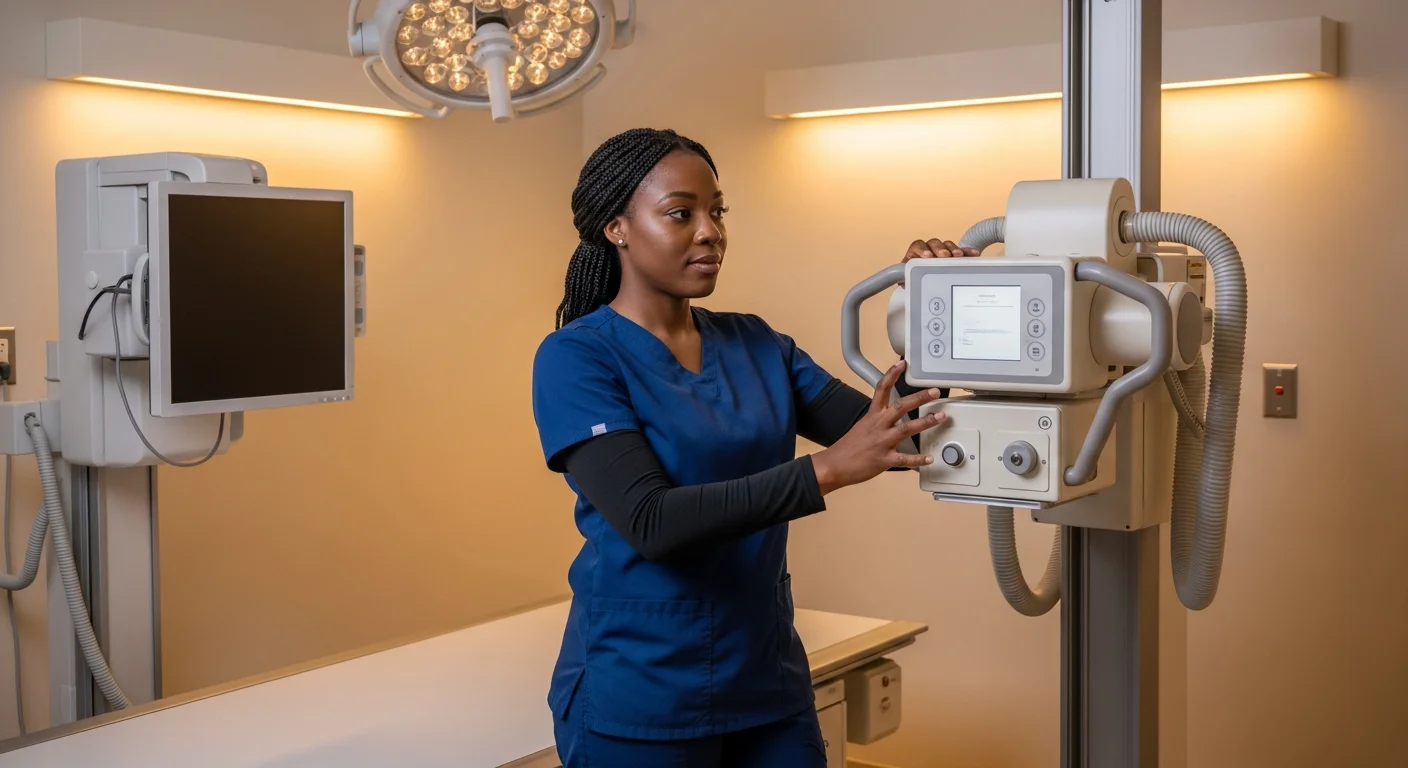
Yes. With a two-year radiologic technology program from a JRCERT-accredited school and passing the ARRT certification exam, you can transition from CNA to licensed X-ray tech. The path takes approximately 2.5 years from application to your first day working as a Registered Technologist (R.T.).
This guide covers what X-ray techs actually do day-to-day, the programs you need, the certification process, and how to make this transition while you keep your CNA income. If you want to compare all three imaging career paths before committing to radiology specifically, start with the overview.
| What | Details |
|---|---|
| Program length | 2-year associate degree (JRCERT-accredited) |
| Certification | ARRT primary exam (Radiography) |
| Median salary | $77,660/year (BLS, May 2024) |
| CNA advantage | Patient care experience strengthens your application |
| Community college cost | ~$1,800/semester in-state |
| Timeline from CNA | Approximately 2.5 years to licensed |
Can a CNA Become an X-Ray Tech?
Yes. A CNA who completes a two-year radiologic technology program from a JRCERT-accredited school and passes the ARRT exam becomes a Registered Technologist in Radiography (R.T.(R)). Your CNA training does not count as program credit, but it gives you a meaningful edge in a competitive admissions process.
Radiologic technology programs are selective. Many receive more applicants than seats. The difference between candidates who get in and candidates who wait for next cycle often comes down to patient care experience and science prerequisites, both of which CNAs frequently have.
Why CNA Experience Gives You an Admissions Edge
JRCERT-accredited rad tech programs combine two years of classroom instruction with supervised clinical rotations in hospitals and imaging centers. Programs need students who can handle real patient contact from day one. Most applicants who struggle in clinical rotations have never worked in a medical setting. You have.
Your CNA background prepares you in ways other applicants lack:
- Patient positioning: You move and reposition patients daily. Rad tech programs test patient positioning extensively — it is a core ARRT exam domain.
- Clinical composure: You have seen the worst of healthcare and stayed. Programs report that CNA students rarely drop out due to clinical shock.
- Medical vocabulary: Anatomy terms, vital signs, infection control protocols — you already speak the language that other students are learning for the first time.
- Communication under pressure: Patients in the imaging room are often scared, in pain, or disoriented. You already know how to communicate under those conditions.
CNAs make this transition regularly, and many report that their patient care background gave them a meaningful advantage in radiology programs and on the job.
“I was a CNA because I was on route to nursing school, but I changed my mind… I still work in healthcare, but I’m now an x-ray tech instead of being a nurse. My CNA experience has tremendously helped me as an x-ray tech!”
(128 upvotes – Reddit user)
That experience advantage is real. CNAs enter radiology programs already knowing how to position patients, communicate with people in pain, and stay composed during emergencies. Those are skills that take other rad tech students months to develop.
Explore Radiologic Technology Programs
Compare JRCERT-accredited rad tech programs with flexible schedules for working CNAs.
View Rad Tech Programs →No obligation to enroll • Compare program costs and schedules
What X-Ray Techs Do (And How It Differs From CNA Work)
The Bureau of Labor Statistics describes the core scope of X-ray tech work as: positioning patients, operating imaging equipment to produce diagnostic images, following physician orders for specific imaging studies, and ensuring image quality before releasing patients. The American Society of Radiologic Technologists (ASRT) defines the scope to include diagnostic radiography, fluoroscopy, portable and mobile imaging, and operating-room radiography.
What the job descriptions don’t capture is what the daily reality looks like compared to CNA work.
A Typical Rad Tech Shift vs. a Typical CNA Shift
| Factor | Rad Tech Shift | CNA Shift |
|---|---|---|
| Shift length | 8-10 hours (some 12-hour ER shifts) | 8-12 hours standard |
| Patient contact time | 5-15 minutes per patient | 8-12 patients for entire shift |
| Physical demands | Equipment positioning, occasional patient transfer | Lifting, turning, toileting throughout shift |
| Emotional labor | Brief encounters, mostly task-focused | Ongoing relationships, high emotional intensity |
| Primary tools | Imaging equipment, protective gear | Bedside supplies, personal protective equipment |
| Setting options | Hospital, outpatient center, physician office, imaging center | Hospital, long-term care, home health |
For CNAs weighing this transition, the daily reality shift matters more than any job description. Here is how one CNA described the moment they committed to the switch.
“I’ve been a CNA for two and a half years on a HEAVY cardiac PCU. After working for two years I decided nursing is not for me. So today I officially changed my major from nursing to radiology. The same pay, less hours, less getting assaulted by confused residents. HELL YEAH”
(108 upvotes – Reddit user)
That post captured what many CNAs feel but don’t say out loud: radiology offers a healthcare career without the physical toll that drives most CNA burnout. The question is not whether the work is better. It is whether you are ready to invest in the training to get there.
Your CNA skills transfer directly. The CNA career advancement path through radiology builds on what you already know. Patient positioning is a core rad tech competency. So is communicating with anxious patients, maintaining sterile technique, and following clinical protocols under time pressure. While CNA patient ratios often mean 8-12 patients per shift, rad techs typically see each patient for just 5-15 minutes, then reset for the next order.
If this sounds like the work environment you want, here’s what it takes to get into a program.
Radiologic Technology Program Requirements
The standard path to becoming an X-ray tech is a two-year associate degree from a JRCERT-accredited radiologic technology program. There is no faster accredited route. Programs that advertise “certificates” or “diplomas” without JRCERT accreditation will not qualify you for the ARRT exam.
Prerequisites You Likely Already Have
JRCERT-accredited programs typically require the following prerequisites before admission. Many CNAs, especially those who started on a nursing track, have several of these completed already.
| Prerequisite Course | Required for Rad Tech? | CNAs often have this? |
|---|---|---|
| Anatomy & Physiology I | Yes (most programs) | Often yes — standard nursing pre-req |
| Anatomy & Physiology II | Yes (most programs) | Often yes — standard nursing pre-req |
| College Algebra or equivalent math | Yes (most programs) | Depends on your training path |
| English Composition | Yes (most programs) | Usually yes — gen-ed requirement |
| Medical Terminology | Sometimes required | Sometimes — covered in some CNA programs |
| General Biology | Sometimes required | Less common |
If the prerequisite list feels overwhelming, consider this: your CNA background is not just relevant experience. It is a competitive advantage in radiology program admissions.
“Most community colleges have rad tech programs, and they looooove accepting CNAs because ya’ll have already seen the worst of healthcare, so you won’t run away from the reality of it. You also have all the patient care skills down.”
(65 upvotes – Reddit user)
That advantage is not just anecdotal. Radiology programs have clinical rotations from day one, and students who have never touched a patient struggle with the reality of hospital work. CNAs don’t have that problem. Your CNA training and certification background — the patient hours, clinical comfort, and ability to communicate under pressure — is exactly what admissions committees look for.
And community college programs are also the most affordable option.
What JRCERT Accreditation Means (And Why It Matters)
JRCERT is the Joint Review Committee on Education in Radiologic Technology, the only agency recognized by the U.S. Department of Education to accredit radiography programs. JRCERT accreditation means the program meets national educational standards for content, clinical training, and outcomes.
Without JRCERT accreditation, you cannot sit for the ARRT certification exam, and most employers will not hire you. Before applying to any program, verify its accreditation at jrcert.org using the program finder to search by state.
Program cost by institution type:
| Institution Type | Approximate Total Cost | Example |
|---|---|---|
| Community college (in-state) | $5,000-$15,000 | Mt. San Antonio College (~$1,800/semester) |
| University-based program | $20,000-$50,000 | Varies by school |
| Hospital-based certificate | $15,000-$35,000 | Emory Healthcare Certificate Program |
| Private technical school | $25,000-$40,000 | Varies by school |
For most working CNAs, community college programs are the practical path. All four institution types lead to the same ARRT exam eligibility.
Once you have chosen a program type, you face one more major decision: full rad tech certification or MRI-only. This choice has significant career implications.
Rad Tech vs. MRI-Only Path — Which Should CNAs Choose?
You have decided on imaging. But two program types exist, and they lead to very different careers. The full rad tech route earns ARRT primary certification in Radiography. The MRI-only route earns ARMRIT certification through a shorter, MRI-focused program. Both paths lead to imaging careers. The long-term implications are very different.
Full Rad Tech Route (ARRT)
A two-year associate degree from a JRCERT-accredited program earns you ARRT primary certification as a Registered Technologist (R.T.). From that credential, you can pursue post-primary certifications in:
- CT (Computed Tomography)
- MRI (Magnetic Resonance Imaging)
- Mammography
- Interventional Radiography
- Cardiac Catheterization Lab
- Bone Densitometry (DEXA)
Each post-primary certification opens its own career path with its own salary ceiling. MRI techs earn a median of $88,180 per year (BLS, May 2024). CT techs, interventional techs, and cath lab techs all earn above the base rad tech salary. One degree, many careers.
MRI-Only Route (ARMRIT)
ARMRIT-approved programs run 12-18 months and focus exclusively on MRI technology. Graduates earn ARMRIT certification, which qualifies them for MRI tech positions at employers who accept ARMRIT credentials. The shorter timeline is genuinely appealing for CNAs who want to transition quickly.
But the limitations are real. Not all employers accept ARMRIT. Many hospitals and imaging centers require ARRT-certified MRI techs (rad tech base credential plus post-primary MRI). Job postings often specify “ARRT (MR),” not “ARMRIT.” ARMRIT certification also locks you into MRI with no lateral path to CT, mammography, interventional, or any other modality. If you decide later that you want CT or cath lab work, you would need to complete a full rad tech program from scratch. ARMRIT credits do not count toward ARRT eligibility.
According to Accredited Schools Online and AIMS Education, the ARMRIT route typically runs 12-18 months. Jackson Health Professionals notes that ARMRIT acceptance varies by state, with some states only recognizing ARRT credentials.
| Factor | Full Rad Tech (ARRT) | MRI-Only (ARMRIT) |
|---|---|---|
| Duration | 2 years (associate degree) | 12-18 months (certificate) |
| Accrediting Body | JRCERT | ARMRIT |
| Certification Exam | ARRT primary (Radiography) | ARMRIT exam |
| Starting Modality | X-ray, fluoroscopy, portable, OR | MRI only |
| Post-Primary Options | CT, MRI, mammography, interventional, cath lab, DEXA | None |
| MRI Salary Potential | $88,180 median (via ARRT post-primary) | $88,180 median (if employer accepts ARMRIT) |
| Employer Acceptance | Universal | Variable |
| Career Flexibility | High (6+ specialization paths) | Low (MRI only) |
What the Reddit Community Says
The data above tells part of the story. Working rad techs in the Reddit community are even more direct about their recommendation.
“Do yourself a favor and don’t go the MRI only route for school. Most places prefer a radiologic technologist cross-trained and credentialed into MRI. The rad tech route will also allow you to transition to CT, mammography, dexa, interventional, and cath lab if you choose.”
(65 upvotes – Reddit user)
That advice reflects a pattern across the industry: employers overwhelmingly prefer ARRT-certified radiologic technologists who add MRI as a post-primary credential. An MRI-only certificate limits you to one modality with no lateral movement. A rad tech degree opens six or more specialization paths, each with its own salary ceiling and career trajectory.
That said, MRI-only programs are not always the wrong choice.
When MRI-Only Makes Sense
Consider ARMRIT if all four of these apply to your situation:
- You have confirmed with your target employers that they accept ARMRIT certification (verify before you enroll)
- Your long-term goal is specifically MRI and you have no interest in CT, mammography, or interventional work
- Cost and time constraints make the extra 6-12 months of a full rad tech program genuinely prohibitive
- You are in a market where ARMRIT-credentialed techs are actively hired
Even in these cases, Lone Star College’s post-primary MRI program for ARRT-credentialed rad techs illustrates the standard employer preference: most hospitals cross-train their own MRI techs from existing ARRT staff. If you are drawn to diagnostic imaging but want to avoid ionizing radiation entirely, the CNA to ultrasound tech path is also worth evaluating.
Whether you choose the full rad tech route or MRI-only, you will need to pass a certification exam. Here is what to expect from the ARRT process.
ARRT Certification and State Licensure
After graduating from a JRCERT-accredited program, your next step is the ARRT certification exam. Passing it earns your R.T.(R) credential, the standard credential for radiologic technologists across the United States.
The ARRT Exam
The ARRT exam is computer-based and multiple-choice. It covers five content areas:
- Radiation protection
- Equipment operation and quality control
- Image production and evaluation
- Radiographic procedures
- Patient care and education
Your JRCERT-accredited program prepares you for every one of these areas through classroom instruction and clinical rotations. The first-time pass rate for ARRT candidates is approximately 89-92%. Your program's clinical director can advise on ARRT study preparation specific to your program's outcomes.
State Licensure Requirements
Most states require a license for radiologic technologists who work with ionizing radiation. Passing the ARRT exam and holding active ARRT registration typically satisfies your state's licensure requirement, though the specific application process varies by state.
Florida, for example, requires radiologic technologists to apply through the Florida Department of Health Bureau of Radiation Control. Florida requires 12 continuing education hours every two years, including nine technical hours and an HIV/AIDS course. Scrubs CE provides a detailed walkthrough of the Florida renewal process.
Check your state's requirements via the ARRT state licensing page.
Reciprocity Between States
If you hold ARRT registration and a state license, transferring to a new state is typically straightforward. Most states offer licensure by endorsement for ARRT-registered technologists. Your ARRT credential is recognized nationally, which simplifies moves across state lines.
With certification and licensure in hand, here is what you can expect to earn.
X-Ray Tech Salary and Career Growth
Before we look at the numbers, here is the salary picture as many CNAs first encounter it, through word of mouth and community research.
"I'm looking into becoming at rad tech. The pay is the same as nurses atleast in florida and less patient interaction which is the main goal. The schooling is only two years."
(Reddit user)
Those claims hold up, with some important nuances. According to the Bureau of Labor Statistics (May 2024), radiologic technologists earn a median of $77,660 per year. The CNA median sits at approximately $35,760 per year, a difference of roughly $42,000 annually at the median.
Post-Primary Specialties and Salary Premiums
The base rad tech credential is just the starting point. After earning your ARRT R.T.(R), you can add post-primary certifications that come with salary premiums:
| Specialty | Median Annual Salary | Path to Credential |
|---|---|---|
| CNA (current baseline) | $35,760 | N/A |
| Radiologic Technologist (X-ray) | $77,660 | ARRT primary exam |
| MRI Technologist | $88,180 | ARRT post-primary (MR) |
| CT and other specialties | Above $77,660 median | ARRT post-primary certs |
| Top 10% earners (all specialties) | $106,990+ | Experience + specialty + location |
Source: BLS, May 2024. nurse.org and AllAlliedHealthSchools provide supplementary data by experience level and work setting.
Salary also varies by work setting. Hospital positions typically offer higher base pay and shift differentials. Outpatient imaging centers may offer better hours with slightly lower base pay. Physician offices generally have the most predictable schedules.
These salary numbers assume you complete a program, pass the ARRT exam, and get hired. Here is a realistic timeline for making that happen while you keep working as a CNA.
Exploring Rad Tech Programs?
Compare accredited radiologic technology programs near you.
How to Transition -- Step-by-Step Timeline for Working CNAs
The timeline for this transition depends on where you are starting. For many CNAs, the real question is not how long the program takes. It is how long they have already spent in a career that is not going where they want it to go.
"Honestly I've been a cna for over 5 years, I went into it thinking I wanted to be a nurse. Well, I am burnt the f out. I tried other things and became a med tech and phlebotomist as well but my goal now is radiology. Nursing can really suck the life out of you sometimes"
(159 upvotes - Reddit user)
That 5-year journey -- CNA to med tech to phlebotomist to finally targeting radiology -- is more common than it should be. Every lateral move delays the credential that actually changes your earning power. Here is what a direct CNA-to-rad-tech timeline looks like when you commit to the path.
Phase 1: Research and Prerequisites (Months 1-3)
- Search jrcert.org for accredited programs in your area
- Check which prerequisites you already have (A&P I and II are the most common gaps)
- Contact program admissions offices to ask about selection criteria and timelines
- Enroll in any missing prerequisite courses at a community college while working CNA
Phase 2: Apply and Arrange Financial Aid (Months 4-6)
- Submit FAFSA at fafsa.gov -- community college programs qualify for Pell Grants and federal loans
- Apply to multiple JRCERT-accredited programs (waitlists exist -- don't count on one acceptance)
- Ask your current employer about tuition assistance for allied health degrees
- Check available CNA scholarships to help offset program costs
Phase 3: Complete the Program (Months 7-30)
- Most programs run classes and clinical rotations during weekday business hours
- Work evening and weekend CNA shifts to maintain income
- Consider switching to PRN (per diem) CNA status for maximum schedule flexibility
- Plan for reduced CNA hours in your second year when clinical rotations intensify
Phase 4: Certify, License, and Get Hired (Months 31-33)
- Register for the ARRT exam at arrt.org after graduation
- Apply for state licensure via the ARRT state licensing page
- Many programs have clinical placement partnerships that lead to job offers before graduation
Want to earn more while you apply to rad tech programs? EKG certification takes weeks and adds a credential that hospitals value. It is a practical way to increase your hourly rate during the 2-3 years of the CNA-to-rad-tech transition.
Financial Planning for Working CNAs
The CNA-to-rad-tech transition typically costs between $5,000 and $15,000 in tuition at a community college, or $20,000-$50,000 at a university-based program. All institution types lead to the same ARRT exam eligibility, so the community college path is the most cost-effective for most working CNAs.
Funding options:
- FAFSA and Pell Grants: Federal aid is available for community college programs. File early at fafsa.gov.
- Employer tuition assistance: Some healthcare systems offer tuition reimbursement with a post-graduation work commitment. The Johns Hopkins MRI Technologist Training Program is one example of what employer-paid specialization looks like after you earn your R.T. credential (a paid 6-month MRI program with a 2-year commitment).
- CNA scholarships: See available options through our scholarship page.
- PRN CNA work during school: Maintaining per-diem CNA shifts is the standard approach for students who cannot afford to stop working.
Ready to start? Here are answers to the most common questions CNAs ask about this transition.
Find Radiologic Technology Programs Near You
Compare accredited rad tech programs. View costs, schedules, and admission requirements.
