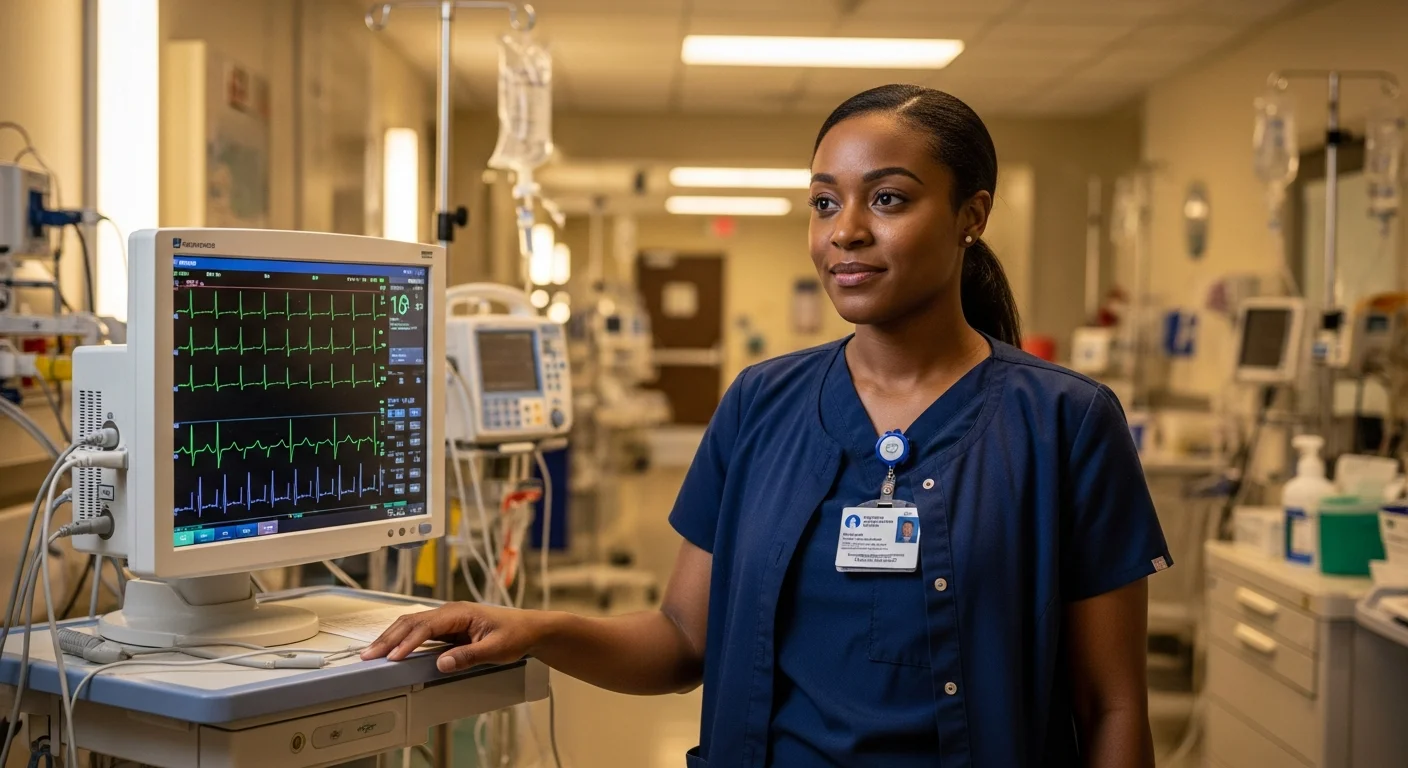
Yes. EKG certification is available to CNAs in 4-12 weeks and costs $500-$2,000 typically, the fastest and most affordable healthcare credential you can earn. If you already work in a hospital, there’s a good chance you’ve already run EKG tracings without the title or the pay to match.
This article covers the full CNA-to-EKG-technician pathway: what the job actually involves, how to choose a program, the NHA Certified EKG Technician exam, whether the pay bump is worth it, and how to use EKG certification as a launching pad to bigger credentials.
| What | Details |
|---|---|
| Program length | 4-12 weeks |
| Program cost | Typically $500-$2,000 (tuition) + ~$117 NHA CET exam fee |
| Certification | NHA Certified EKG Technician (CET), most employer-preferred |
| EKG tech salary estimate | $50,000-$60,000 (BLS cardiovascular technologists group) |
| CNA median salary | $35,760 (BLS, May 2024) |
| State license required | No; NHA CET certification is employer-preferred, not state-mandated |
Can a CNA Become an EKG Technician?
Yes. And if you work in a hospital, you may already be performing EKGs without the title or the pay.
Hospitals routinely require CNAs and patient care technicians to learn EKG placement, phlebotomy, and other expanded skills as part of unofficial “upskilling” programs. That means many CNAs have already practiced the core physical skill of electrode placement and patient interaction, the parts most people find hardest. What formal certification adds is the interpretation knowledge, the credential on paper, and the salary to go with it.
No state in the U.S. requires a license to work as an EKG technician. The NHA Certified EKG Technician (CET) credential is what most employers look for when hiring for dedicated EKG tech roles. It takes 4-12 weeks of training and one exam to get there.
Across Reddit, CNAs on cardiac and telemetry floors describe the same pull toward technical roles:
“I’ve been a CNA for two and a half years on a HEAVY cardiac PCU. After working for two years I decided nursing is not for me. So today I officially changed my major from nursing to radiology. The same pay, less hours, less getting assaulted by confused residents. HELL YEAH”
(108 upvotes — Reddit user)
EKG technician is one of the fastest ways to make that shift. If you’ve worked a cardiac or telemetry floor, you already understand the clinical environment, and that’s a head start no training program can give you.
If you’re still comparing imaging career options, the CNA to imaging careers guide covers all three paths side by side. For CNAs with existing CNA training and certification, the EKG pathway builds directly on what you already hold.
Before you enroll, here is what EKG technicians actually do on the job, and how it compares to your current CNA work.
Find EKG Technician Programs Near You
Your CNA experience gives you a head start. Compare accredited healthcare programs and take the next step toward EKG certification.
View Healthcare ProgramsAccredited programs | No obligation to enroll
What EKG Technicians Do
EKG technicians perform electrocardiograms, recordings of the heart’s electrical activity that help physicians diagnose arrhythmias, heart attacks, and other cardiac conditions. The core tool is the 12-lead EKG: you place 10 electrodes on the patient’s chest and limbs, run the tracing, check for artifacts, and deliver the results to the reading physician.
That encounter takes 15-30 minutes. Then you move to the next patient.
According to the Bureau of Labor Statistics, EKG technicians work in hospitals, physician offices, and outpatient cardiology clinics. The main duties include:
Core Daily Tasks
12-lead EKG acquisition. You place 10 electrodes on the patient’s body, run the tracing, verify signal quality, and flag any artifacts before delivering results to the reading physician. Most encounters take 15-30 minutes.
Holter monitor setup. You attach a portable cardiac monitor the patient wears for 24-48 hours, walk them through how to wear it, and review their diary when they return the device.
Stress testing assistance. You work alongside a cardiologist while the patient walks on a treadmill, monitoring the continuous EKG tracing and watching for rhythm changes that indicate the test should stop.
Cardiac monitoring and telemetry. In hospital settings, EKG techs may monitor multiple patients remotely from a central station, watching tracings for arrhythmias that require a clinical response.
One distinction that confuses many CNAs: EKG is not the same as echocardiography. EKG measures the heart’s electrical activity, recorded as a tracing on paper or screen. Echocardiography uses ultrasound imaging to show the heart’s structure and motion. That is a completely different career. For the ultrasound path, see the CNA to ultrasound technician guide.
The physical demands are lower than CNA work. You are not turning or repositioning patients for hours, and most encounters are brief and technical. You are still on your feet and moving equipment, but the sustained physical load is different.
If this work appeals to you, here is the good news: EKG certification is the fastest healthcare credential you can earn.
EKG Certification Programs — The Fastest Healthcare Credential
You can become a certified EKG technician in as little as 4-12 weeks. Compare that directly to the other imaging paths: radiology programs require 2 years, and ultrasound programs require 2 years. EKG certification is the fastest and most affordable healthcare credential available to working CNAs, by a wide margin.
| Credential | Duration | Typical Cost |
|---|---|---|
| EKG Technician Certificate | 4-12 weeks | $500-$2,000 (tuition) + ~$117 exam |
| Phlebotomy Certificate | 4-12 weeks | $700-$2,000 |
| Radiologic Technologist (Associate’s) | 2 years | $10,000-$30,000+ |
| Diagnostic Medical Sonographer (Associate’s) | 2 years | $10,000-$40,000+ |
Sources: CareerStep, NHA, BLS
For CNAs weighing their options, time is a real constraint. Many have already done the math on longer programs:
“I’m looking into becoming at rad tech. The pay is the same as nurses atleast in florida and less patient interaction which is the main goal. The schooling is only two years.”
(48 upvotes — Reddit user)
That CNA was looking at a two-year program and calling it short. EKG certification takes weeks, not years.
4-Week Accelerated Programs
Intensive, full-time attendance. Best for CNAs who can take a month away from work or have genuinely flexible schedules. These programs cover the same curriculum at a faster pace. Cost range: typically $500-$1,000. Even a 4-week program requires focused daily study; the pace is real.
8-12 Week Comprehensive Programs
More common. Offered as evening or weekend classes to accommodate working students. Slower curriculum pace with more clinical practice time. Cost range: typically $1,000-$2,000. The extra weeks usually mean more supervised hands-on hours, not more classroom content.
Online Hybrid Programs
Didactic coursework online (cardiac anatomy, rhythm recognition, EKG interpretation) with in-person clinical skills lab for electrode placement and equipment operation. Good for CNAs who can’t attend daytime classes. Verify that the program includes real supervised clinical hours before enrolling. Electrode placement requires hands-on practice, not just video instruction.
What You Learn
Programs cover four core areas:
- Cardiac anatomy basics: heart chambers, valves, the electrical conduction system (SA node to AV node to bundle of His to Purkinje fibers)
- EKG interpretation: reading 12-lead tracings, identifying normal versus abnormal patterns
- Rhythm recognition: sinus rhythm, bradycardia, tachycardia, atrial fibrillation, atrial flutter, ventricular tachycardia, ventricular fibrillation
- Equipment operation: 12-lead placement technique, Holter monitor setup, artifact troubleshooting
If you already run EKGs at work, you have a significant head start on electrode placement and patient interaction. The program fills in the interpretation and anatomy knowledge that informal on-the-job training typically skips.
How to Choose a Program
Look for programs that specifically prepare students for the NHA CET exam. Programs built around the CET content outline give you the best alignment between what you study and what the exam tests. Programs that don’t lead to a recognized certification waste your money regardless of how quickly they finish.
One thing worth asking your employer: some hospitals that require CNAs to upskill in EKG technique will pay for formal certification, especially if they’ve already invested time training you informally. It’s worth a direct conversation with HR before you pay out of pocket.
Apply the same criteria you used when choosing a training program for your CNA credential: accreditation, clinical hour requirements, and exam preparation alignment are the three questions that matter most.
Once you complete a program, the next step is the NHA Certified EKG Technician exam. Here is what to expect.
NHA Certified EKG Technician (CET) Exam
The NHA CET is the most widely recognized EKG technician certification in the U.S. Most employers hiring for dedicated EKG tech positions expect, and often require, the CET credential. According to NHA, the exam format is:
| Element | Details |
|---|---|
| Format | Computer-based, multiple-choice |
| Scored questions | 100 |
| Unscored pretest questions | 20 (mixed in, unidentified) |
| Time limit | 2 hours |
| Exam fee | ~$117 |
The 120-question total with a 2-hour window gives you about 1 minute per question. The content domains cover EKG acquisition, patient care and safety, EKG analysis and interpretation, and compliance and quality assurance.
NHA uses scaled scoring and does not publish a specific passing percentage threshold. You receive a pass or fail result, not a raw score.
Two alternatives exist, though NHA CET is the standard. ASPT (American Society of Phlebotomy Technicians) offers an EKG certification alongside phlebotomy credentials, useful if you plan to stack both. NCCT (National Center for Competency Testing) offers the National Certified ECG Technician (NCET) credential with a work-experience eligibility pathway. If you’re choosing between them, NHA CET is the safe bet for broad employer recognition.
Practice rhythm strip identification daily, even 15 minutes of flashcard-style reading builds pattern recognition faster than re-reading notes. Use NHA’s official study guide and practice exam, which are built to the actual content domains. Schedule your exam within two weeks of finishing your program: knowledge of specific rhythms and anatomy details fades quickly without reinforcement. If you prepared for your CNA certification exam, you already know how to study for a timed, multiple-choice credentialing test.
With certification in hand, the question most CNAs ask next is whether the pay bump is actually worth it.
Does EKG Pay More Than CNA?
Here's the frustrating reality many hospital CNAs already know:
"Hospital is requiring all CNAs to upscale. We're 'required' to go to these skills classes that involve learning phlebotomy, inserting Foley catheters, ekgs. We're not getting any type of raise for this..."
(77 upvotes — Reddit user)
If your hospital is already training you to run EKGs, you're building the skill set without getting paid for it. A formal EKG technician certification turns that unpaid expectation into a credential that commands its own salary.
Yes, EKG technicians earn significantly more than CNAs. Here's what the data shows:
| Role | Median Annual Salary | Source |
|---|---|---|
| CNA | $35,760 | BLS Nursing Assistants, May 2024 |
| EKG Technician (estimated) | $50,000-$60,000 | BLS Cardiovascular Technologists |
| Radiologic Technologist | $77,660 | BLS, May 2024 |
| Diagnostic Medical Sonographer | $89,340 | BLS, May 2024 |
One caveat worth knowing: EKG technicians don't have their own BLS occupational category. They're grouped with cardiovascular technologists and technicians, which includes cardiac sonographers and vascular technologists who earn more. Entry-level EKG tech roles typically fall in the $35,000-$45,000 range; experienced techs in specialized hospital settings reach the higher end.
The total investment is $617-$2,117 (program tuition plus the ~$117 NHA CET exam fee). At an estimated $14,000-$24,000 annual salary increase over CNA pay, that investment pays back in 1-2 months of higher earnings.
The dual-certification premium is where the math gets more interesting. CNAs who add EKG certification can qualify for monitor tech and cardiac PCT positions that pay more than either a standalone CNA or a standalone EKG tech role.
On EKG versus phlebotomy: both certifications cost similar amounts and take similar time. EKG tech roles tend to pay slightly more due to cardiac specialization. But stacking both certifications is the strongest short-term play; dual-certified PCTs with EKG and phlebotomy skills command the highest compensation available from certificates in this tier.
If you're tracking your CNA career advancement options and your goal is a long-term career, not just a raise, EKG certification is a fast win that opens the door, not the destination itself.
If you are thinking about the long game, EKG certification is not just a paycheck. It is a stepping stone to bigger credentials.
Compare Healthcare Training Programs
EKG certification pays back in 1-2 months. Explore accredited programs that fit your schedule as a working CNA.
EKG Certification as a Stepping Stone
EKG tech has a real salary ceiling without additional credentials. That is not a reason to skip it; it is the reason to plan what comes next before you even start.
Here's what a realistic career ladder looks like from where you are now:
- Now: CNA earning ~$35,760/year
- 4-12 weeks: Certified EKG tech, earning $40,000-$50,000 (or higher in a monitor tech or cardiac PCT dual-cert role)
- 6-12 months: Add phlebotomy certification ($700-$2,000, another 4-12 weeks). Dual-certified PCT roles pay more than either credential alone and keep you employed at a higher rate while you wait for longer program admission.
- Year 1-2: Apply to rad tech or ultrasound programs with EKG clinical experience on your application. Cardiac experience and technical credentialing signal real commitment to cardiovascular healthcare to admissions committees.
- Year 3-4: Working as a radiologic technologist ($77,660 median, BLS, May 2024) or ultrasound technologist ($89,340 median).
This is not a detour. It is the fastest first step on a multi-year path.
EKG certification strengthens longer program applications in a specific way: admissions committees for radiology and sonography programs value applicants who can operate cardiac equipment, read clinical data, and pass a credentialing exam. Those are signals that translate directly to program readiness in a way that general CNA experience alone does not.
The dual-stacking strategy deserves a direct recommendation. Earning EKG and phlebotomy certifications in the same 6-12 month window makes you a dual-certified PCT candidate. These roles pay more than either certification alone and keep you earning at a higher rate during the 1-2 year gap before longer program admission.
Ready for the next step? The CNA to X-ray technician guide lays out the full radiology path from a CNA starting point. For sonography, see the CNA to ultrasound technician guide. Compare all three imaging paths in the CNA to imaging careers guide if you haven't decided on a direction yet.
Still have questions about making the switch from CNA to EKG technician? Here are the answers to the most common ones.
View EKG and Healthcare Training Programs
You have the CNA experience. EKG certification takes 4-12 weeks. Find accredited programs that work with your schedule.
